Scale: Difference between revisions
m Fix links |
Deceptitran (talk | contribs) m BOT: replacing (1) links to "Waspinator" with "Waspinator (BW)" |
||
| Line 178: | Line 178: | ||
Much less common are instances of a Transformer turning into an overscaled real-world object. Most such instances occur in the ''Beast Wars'' era. | Much less common are instances of a Transformer turning into an overscaled real-world object. Most such instances occur in the ''Beast Wars'' era. | ||
Although the Beast Warriors are consistent day-to-day in their relative size to each other, their scale in relation to their real-world animal equivalents is more complex. While the bug characters such as [[Waspinator]] and [[Inferno (BW)|Inferno]] are obviously scaled-up, other characters are more subtly not quite the right size. | Although the Beast Warriors are consistent day-to-day in their relative size to each other, their scale in relation to their real-world animal equivalents is more complex. While the bug characters such as [[Waspinator (BW)|Waspinator]] and [[Inferno (BW)|Inferno]] are obviously scaled-up, other characters are more subtly not quite the right size. | ||
[[Cheetor (BW)|Cheetor]] and [[Tigatron]] are shown standing next to real members of their species, and they are both the same size as the animals in question. {{storylink|Beast Wars (Part 1)}} {{storylink|Law of the Jungle}} This makes them (and Cheetor in particular, since he's around more) the measuring sticks for the other characters. Therefore, [[Rhinox (BW)|Rhinox]] is a rather small rhinoceros, and [[Optimus Primal]] is a roughly normal (or female) gorilla. However [[Rattrap]] is a monstrously huge rat, the size of a large dog (indeed, the writers stated that Season 1 Rattrap was 5' (1.5 m) tall<ref>[http://groups.google.com/group/alt.toys.transformers/msg/8227a6ca84c0238d Bob Forward gives Rattrap's height from the show bible]</ref>). Likewise [[Dinobot (BW)|Dinobot]] is considerably larger than a real velociraptor. [[Megatron (BW)|Megatron]], however, is a tiny specimen of a T. Rex. In their interactions with adult [[protohuman]]s, the Transformer characters seem between twice and three times their height. Considering our ancestors really were smaller than modern humans, this is not extremely wrong, but it deserves noting. | [[Cheetor (BW)|Cheetor]] and [[Tigatron]] are shown standing next to real members of their species, and they are both the same size as the animals in question. {{storylink|Beast Wars (Part 1)}} {{storylink|Law of the Jungle}} This makes them (and Cheetor in particular, since he's around more) the measuring sticks for the other characters. Therefore, [[Rhinox (BW)|Rhinox]] is a rather small rhinoceros, and [[Optimus Primal]] is a roughly normal (or female) gorilla. However [[Rattrap]] is a monstrously huge rat, the size of a large dog (indeed, the writers stated that Season 1 Rattrap was 5' (1.5 m) tall<ref>[http://groups.google.com/group/alt.toys.transformers/msg/8227a6ca84c0238d Bob Forward gives Rattrap's height from the show bible]</ref>). Likewise [[Dinobot (BW)|Dinobot]] is considerably larger than a real velociraptor. [[Megatron (BW)|Megatron]], however, is a tiny specimen of a T. Rex. In their interactions with adult [[protohuman]]s, the Transformer characters seem between twice and three times their height. Considering our ancestors really were smaller than modern humans, this is not extremely wrong, but it deserves noting. | ||
Revision as of 19:29, 30 April 2009

Scale in Transformers is, not to put too fine a point on it, screwed.
Virtually no era, franchise, fiction, toyline or other incarnation of Transformers has presented scale in a logical or believable fashion. (The only exceptions are the 1:24 toys for Alternators and Kiss Players, but they have their own problems.) Most fans agree that one must either ignore it or accept it, lest they be tempted to explain these problems and in the process fanwank themselves into oblivion.
However, the scale problems of Transformers still merit description.
| “ | "Clearly, the pitiful humans at Hasbro are so overwhelmed by the awesomeness of Cybertronian life forms that they can't get the scale right." | ” |
Scale within toylines
Toys out of scale with others in the same line

The early Generation 1 toyline, especially the pre-movie lines, were repackaged and redecoed toys from several different Japanese toylines. The crucial point is that the toylines were initially unrelated. The characters should be in scale to each other as they all have real-world altmodes that (should) pass for real vehicles. However, since Diaclone toys were not part of the same line as Microman toys, scale issues arose. Diaclone figures such as Optimus Prime, Prowl and Hound are more-or-less in correct scale to each other (though problems already arise with Sunstreaker and Sideswipe, whose alternate modes are based on the same car yet are not quite the same size), but many of the Mini Vehicles from the New Microman line are clearly far too small by comparison. Even aside from their deformed penny-racer proportions, a Volkswagen Beetle Microman toy is disproportionately tiny when compared to a Porsche 935 Diaclone toy. The disparity becomes even more obvious with Minibots such as Warpath (a tank) and Seaspray (a hovercraft), who should be many times their actual size.
Another glaring scale problem comes in the form of the Seekers, who turn into F-15 Eagles which, in real life, are 19.4 m (63.8 feet) long. Correctly scaled, this would make their robot modes colossal compared to most Autobots. Similarly, the Constructicons, despite also coming from the Diaclone line, are too small. Far worse is the other Diaclone combiner team, the Trainbots, who have train engine altmodes, yet their toys are among the smallest of the Diaclone releases.
Toys out of scale within teams
Even toys specifically designed to interact with each other suffer from this problem. The Combaticons are wildly out of scale to each other—Blast Off's space shuttle mode should dwarf Swindle, with the others somewhere in between. Instead, they're about the same size. Among the Constructicons, Long Haul is designed to look like a gigantic "earth-mover" mining truck. He should be able to carry all his teammates in his bed, with some crowding. Similarly, Silverbolt (a Concorde jet) is dramatically undersized compared to his fighter-jet Aerialbot teammates. These scale problems are necessary to avoid misproportioned gestalt forms.
Don't even ask about the Protectobots with their motorcycle and helicopter limbs...
Same altmode, different sizes
Other scale problems come from characters who transform into the same (or similar) altmodes but whose toys are different sizes. For example Air Raid transforms into an F-15 Eagle, but his toy is half the size of Starscream's. The same can be said for the Lamborghini Countach Breakdown, who should be the same size as Sunstreaker and Sideswipe, not significantly smaller. These discrepancies are also seen in the other Scramble City combiners with Earth altmodes, whose toys are all smaller than similar earlier toys.
Multiple scales of same character
Although it was never really a problem in G1 (later retro-iterations of G1 Prime e.g. Masterpiece don't count), later franchises sometimes released multiple versions of the same character in different size classes within the same product line, usually limited to the leader characters. Multiple versions of Optimus Primal and Megatron in Beast Wars weren't exactly an example of this, as they represented different bodies, but Beast Machines began the problem in earnest with three different Cheetor toys released over the course of the line. With one toy at the Supreme size point, one at the Mega point, and a third slight variant at the Deluxe point, there was no real indication of which size if any was the "correct" one. The same line also released two different Jetstorm toys and two different Optimus Primals.

Robots in Disguise continued the trend, with several prominent characters receiving a smaller Spy Changer toy in addition to their larger toy, such as Scourge and X-Brawn. The Armada line featured both a Super-Con and Super-Base version of Optimus Prime featuring the same design at different size-classes, an issue repeated with Megatron in Energon. The introduction of the "Legends of Cybertron" size class in Cybertron only compounded matters, as a plethora of different characters were released at a size wildly out of scale with any of their contemporaries. Cybertron also featured the first notable case of out-of-scale toys being at least partially explained in the fiction with Starscream, who did change size over the course of the series.
With the explosion of toys for the Movie, even more scale problems erupted. The line offered both Voyager and Leader-class iterations of Prime and Megatron, not to mention nearly all of the movie's onscreen cast getting a Fast Action Battler toy which introduces scale problems between the toys and one another. The fact that Blackout came with a small Scorponok, and a separate Deluxe class Scorponok was released, only expands the scale problems when one realizes that the Blackout and Deluxe Scorponok toys are meant to interact. Blackout can carry the small Scorponok while clipped on to the larger one as well, effectively transporting both at the same time, which makes the entire assembly a nightmare of scaling problems.
This mishmash has expanded even further in the Animated line, with Deluxe, Voyager, and even Supreme-class versions of Optimus. Megatron, has a Voyager, Deluxe, and a leader mode. And there's even two different sizes for poor Bulkhead.
Originally, the intent was apparently to make the popular Optimus and Megatron characters available at lower price points than just "leader" class so that children with less money would not miss out, while also forcing completist collectors to buy multiple versions of one character. The result, however, is that it creates further confusion about scale within the toyline, as the contradictory sizes of these toys leave it up to the fans to determine which is the "correct" version, either using apparent show-accuracy or other criteria. Sometimes this creates even further problems, though—if one assumes that the Voyager-class Movie Prime is the "correct" version, then he either has comically small seats for human passengers or Ironhide has absurdly large seats.
Toys out of scale with themselves

Triple Changers create a whole new set of problems. Octane transforms from a 20 m (60') tanker truck into a 65 m (200') jumbo jet. Broadside transforms from an Earth jet into an entire aircraft carrier.
Even a two-mode toy can have this problem. Twentieth Anniversary Optimus Prime has wheels which are pretty tiny for a Freightliner truck, while his rear hitch section is too thick. These out-of-proportion vehicle parts were necessary to give his robot mode show-accurate proportions.
Toys with roleplay altmodes
The characters with roleplay altmodes such as Generation 1 Megatron, Soundwave, Perceptor, or Armada Laserbeak are scaled to be human-scale (well, kid-scale). Since the size changing seen in the fiction is not possible for real toys (at least, that's what Takara wants us to think), this human-scaling makes in some cases for inordinately large robot modes. E.g., Blaster's toy, in robot mode, is taller than most other Transformers.
The opposite problem is seen with Masterpiece Megatron, whose robot mode is in scale with Masterpiece Optimus Prime. The result is that, while he may transform into a very accurately-proportioned handgun, it's unmistakably much larger than the real thing. (Not that this has stopped him being widely banned as a "realistic firearm replica"...)
Fanciful altmodes
Most post-movie Generation 1 characters (for that matter, most post-Generation 1 lines) are difficult to accurately scale, as they generally transform into futuristic or Cybertronian vehicles whose size we don't really know. (Or, indeed, they don't transform into vehicles at all.) The scale of characters such as Hot Rod or Leobreaker is fairly arbitrary and can only be estimated by their relative size to other characters in the fiction (although most fiction is highly inconsistent in this regard, see below). Nevertheless, if one assumes that most vehicle altmodes are intended for human-sized passengers, comparing toys such as Chromedome and Lightspeed suggests the combiner scale problem continues.
Big toys
It goes without saying that the city-bot and planetbot toys (such as Fortress Maximus and Unicron) are not remotely to scale with normal Transformer toys. While they are indeed large toys, they're only two to five times bigger than typical Transformer toys, and thus transform into "cities" and "planets" about the (relative) size of a bungalow. The scale problems extend to the details. Some of the citybot toys have visible windows, which are too large for a city, suggesting instead a medium-sized building.
However, it's hard to begrudge Hasbro not offering us a Primus toy the size of an asteroid. Where would we keep it?
An exception
There has only been one notable exception to all of this scale weirdness in the toys: the Alternators toyline, where every toy is a 1:24-scale representation of a real car, and thus they are in perfect scale with each other. Unfortunately, for practical reasons this limits the choice of altmodes. A Blast Off (space shuttle) toy in scale with the Alternators toys would be 1.6 m (5.1') long, while a Broadside (aircraft carrier) toy at that scale would be over 12 m (40'). (Hasbro actually displayed mock-ups for an unproduced line of "military" Transformers in scale with the Alternators during the BotCon 2007 Hasbro Tour; two of them recycled parts of Armada Unicron, and were thus Supreme-sized, which made said potential toyline not particularly commercially viable for Hasbro.)
Scale within fictions
Scale issues abound within the fiction, especially the Generation 1 cartoon. Some can be attributed to animation errors, such as layering problems,123 but some "errors" were deliberate choices, for a variety of reasons.
Fictional scale vs. toy scale


G1 Transformers fiction often depicts characters to the same relative scale as the toys, which duplicates the intra-toyline problems described above. The cartoon, for example, shows Prime, Megatron and Soundwave as about the same height, Seekers and Autobot cars as slightly shorter (though not as much as the toys are), and Minibots as smaller yet. This scale was carried over to their vehicle forms, resulting in differently-sized cars that, based on real world measurements, should be virtually the same size.

For another example, the Marvel Comics portrayed the Pretenders as literal interpretations of their toys: 60-foot humans with full scale Transformers inside. The "disguise" aspect of this was later explained by having Landmine and Cloudburst encounter giant, transformer-sized humanoids on an alien planet which made them appear to be of a "normal" scale.
Transformers fiction commonly shrinks or inflates characters, relative to their toy sizes. "Giant" characters such as Omega Supreme are, even aside from any size changing for transport purposes, clearly not in the same scale in toy form as they are depicted on screen. Cassette characters such as Rumble's toys are roughly the same height as most Minibots, while in the show they are usually portrayed as human-sized.
Rodimus Prime and Ultra Magnus are usually shown to be of a fairly similar height (although Magnus is much bulkier), whereas there is a considerable difference between the size of their toys. By the same token, Rodimus is always depicted as being an equal stature to his opposing leader Galvatron, whereas the toy Galvatron is instead the same size as Magnus. Optimus Prime is also usually shown as only a head or so shorter than Magnus (if that), which gets very strange when you realise that a redeco of Prime's toy forms but a small part of Magnus' robot mode.

The cast of Beast Wars were size-tweaked quite a bit, relative to the toyline. The most noticeable problem is Optimus Primal, who has an Ultra toy (the "level four" size, almost twice the size of the "level three" Mega next-largest Maximal toys), but is shorter than both Dinobot and Rhinox (both of whom are "level two" Deluxe sized toys). Further, Cheetor and Tigatron's toys use the same (Deluxe) mold, but Tigatron is a head taller in the show (both because tigers are larger than cheetahs, and because Cheetor is "a kid"). New and altered characters in later seasons were generally more consistent in size (and appearance) with the toys.
The Beast Machines' toyline was far worse in size discrepancies with the cartoon. Of the Maximals featured in the show, the tallest character, Silverbolt, is the shortest toy, while the diminutive Nightscream is a massive Ultra-class toy. And, sadly, the most show-accurate toy, Air Attack Optimus Primal, is a ginormous Supreme figure, towering over the other toys. (Weirdly, the King Kong-like size of this toy became canon in one specific micro-continuity. Prime Spark)

In the otherwise fairly toy-scale-savvy Unicron Trilogy, Cybertron Metroplex and the other citizens of Gigantion are depicted as gargantuan in animation, whereas the toys are merely among the normal boxed size-classes. Within the animation, this causes problems with their Mini-Con partners, who are depicted as human-sized in robot mode by themselves, but when shown directly interacting with their larger partners, are scaled up right along with their partner... resulting in some temporarily gigantic Mini-Cons!
The Japanese Galaxy Force release of Metroplex, dubbed "Megalo Convoy", included an exclusive redeco of the Legends of Cybertron Optimus Prime toy to indicate the "correct" scale.
The Animated franchise has its share of scale problems when comparing its toyline to the cartoon (not helped by multiple releases of some characters in different sizes - see above), with several characters seeming roughly one size class too small, such as the Dinobots being a mix of one Voyager size and two Deluxes, Sentinel Prime looking rather diminutive as a Deluxe, and, most egregiously, Lugnut as a very squat Voyager who's shorter than even some Deluxes. (As with Voyager-class Bulkhead, more of his mass went into his width, plus his weapon takes away some from his robot mode.) Conversely, the traditionally stunted Bumblebee is marginally too tall and bulky to be in correct scale to his otherwise fairly accurate core teammates, assuming one includes Voyager Optimus and Leader Bulkhead in their lineup. In fact, Animated is one of those toylines where you're not quite sure who you're supposed to base correct scale on.
Inconsistent portrayal


Even if a size was decided on, it often didn't remain consistent. The height of the cartoon's Skyfire, just to name one, frequently varied between episodes.
The Generation 1 Marvel comic is notorious for changing the relative sizes of various characters. A single Transformer's size is rarely consistent between artists. For example, Rumble and Frenzy vary in height relative to Soundwave. A panel in the "Time Wars" shows Goldbug, Ironhide, Scattershot, and Swoop all the same height. Omega Supreme, titanic in his original appearance, Command Performances! shrunk steadily in subsequent issues until he was not much taller than the average Transformer. Fortress Maximus suffered a similar problem, shrinking in size even though he was explicitly rebuilt to be twice as tall as the average Transformer.

Between the Great War and the Beast Era, the majority of the Cybertronian race considerably downgraded in size at the Great Upgrade. When entering the Ark, the Beast Warriors are quite small compared to the dormant Generation 1 characters, especially Optimus Prime—but just how much bigger varies quite a bit from scene to scene and episode to episode. When interacting with the Autobot technology of the Ark and the Autobot shuttle, the Maximals are often dealing with equipment grossly oversized for them (standing on the chairs to reach the controls, turning knobs the size of their heads); yet the Ark also seems to feature some human-sized computer control panels. Master Blaster Without any height booster, Blackarachnia can interface well with these controls.
On the other hand, Robot Masters depicted Generation 1 and Beast Wars characters like Optimus Prime and Optimus Primal as being exactly the same size. Lovely. It's possible that passage through the Blasty Zone may somehow account for this discrepancy.
Explicit size changes
Numerous characters are explicitly shown to shrink or expand at various times.
Human-scaled alternate modes
Blaster becomes a human-size radio; Megatron shrinks into a Transformer-scaled handgun. The cartoons and comics typically show this without explanation, leaving the reader to attribute it to advanced alien technology.
Pretenders
Some versions of the Pretenders are shown to explicitly shrink when hiding in their human-sized outer shells. In the U.S. toy commercials, Grimlock, Bumblebee, and Jazz in their new Pretender forms were small enough to fit in Powermaster Optimus Prime's hand. So, at least in that micro-continuity, they were human-sized. Super-God Masterforce featured Pretenders who did not have outer shells but rather an ill-defined holistic transformation which explicitly involved size changing. A vaguely similar explanation appeared in Dreamwave's More Than Meets The Eye encyclopedia.
Implicit size changes
Characters often change size when transforming in a less explicit fashion. These changes in scale are usually attributed to size changing by that portion of the fanbase who like to find explanations for things. The other explanation is that the artists hoped the audience wouldn't notice.
Transport characters
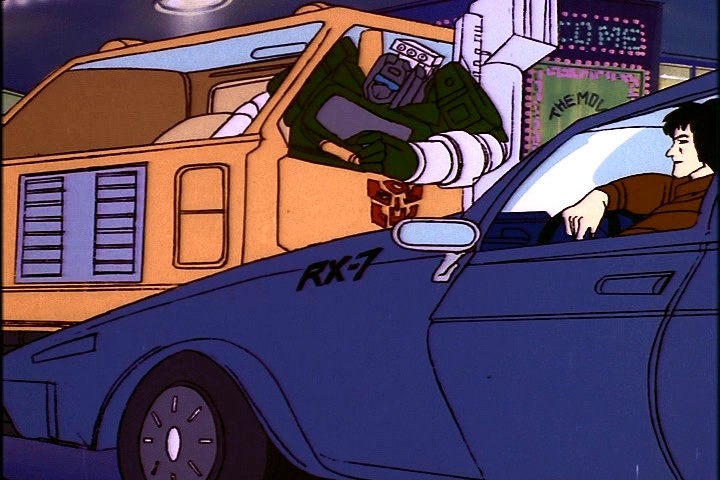
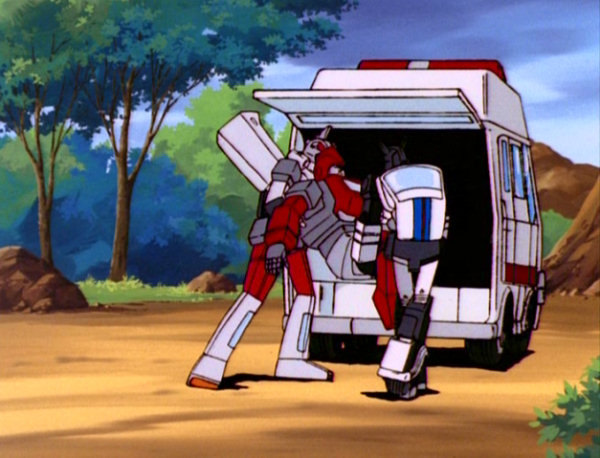
In the original cartoon, Transformers that act as transport for other Transformers, such as Astrotrain, Skyfire, and Cosmos, will often dramatically change size relative to their compatriots between one shot and the next. For example, Cosmos is much shorter than Blaster in robot form; yet Blaster easily fits within his spacecraft mode. Likewise, a whole squad of Decepticons can fit into Astrotrain's shuttle mode easily, yet he's an ordinary-sized trooper in his robot form.
Sometimes the cartoon would show ordinarily-scaled characters such as Cyclonus, Thrust or Huffer carrying another Transformer in their cockpit, implying either a tiny passenger or a huge vehicle. Even Omega Supreme, who is supposed to be huge, would have to have a greatly expanded scale for his rocket ship component to accommodate passengers as shown on the cartoon.
The Marvel comics commonly sidestepped this issue by not using Transformers as transport characters, or else requiring the passengers to transform into their explicitly smaller forms to be carried. Yet they were not immune to this problem. In one story, the Pretender Cloudburst exited his shell, transformed into jet mode, and then his shell (and Landmine) boarded him as a passenger. The fact that his outer shell was now much smaller than the inner robot was quietly ignored. Guess Who the Mecannibals Are Having for Dinner?
Dreamwave's More Than Meets The Eye series of bio comics tried to explain this for characters such as Astrotrain and Broadside by saying they're able to expand themselves to increase cargo space in vehicle mode, though their armor becomes thinner as it is spread out more. Conversely, the series notes, in robot mode, all that armor and structure being compressed into a smaller form makes that mode stronger and more durable for combat.
-
 Definitely not toy-accurate.
 -


Combiner characters

Combiner characters are often depicted as far larger than the sum of their parts. Characters such as Devastator and Menasor are frequently shown as Godzilla-sized. Given that their limbs are mere cars and construction vehicles, this is patently absurd. (Superion, by contrast, would be building-sized, given that his torso is a 100-seat jetliner.)
Combiners are also often out-of-scale with other Transformers; a combiner with cars for legs and another car for its torso should be only twice as tall as a one-car Transformer, but they are routinely drawn as five to dozens of times taller than their comrades.
Scale problems and size-changing
Some fans interpret the many otherwise-unexplained scale issues above to all be the result of size changing, but this is debatable. If virtually all characters use mass-shifting (or whatever) to gain or drop a few feet of height for no logical reason, the technology would be pointlessly mundane. There's also no known reason for (e.g.) the Seekers to choose to get shorter when going into battle. A to-scale Starscream in robot mode could kick Bumblebee around like a soccer ball. There's simply no positive evidence that size-changing is so widespread.
Undersized alternate modes
Many Transformers are portrayed in fiction as having alternate modes that are smaller than the real-life objects they are imitating. Sometimes this is deliberate, allowing them to match their toy scale and/or be of a similar size to other characters; in other cases, it is essentially an artistic error.
Toys at the lowest price points usually include "mini" or "micro" in their name. Mini Vehicles Warpath, Seaspray, and Powerglide are usually depicted as smaller than other Transformers in fiction, even though their alternate modes should have them towering over other characters. This often results in minuscule vehicle forms; Seaspray is a tiny hovercraft, despite being covered with doors and windows.

The Micromasters are explicitly downsized Transformers, roughly the size of a human in the comics, meaning that they should have explicitly tiny vehicle modes... which wouldn't make for very convincing disguises. The Micromasters are about the same height in robot mode, but they transform into equally tiny cars, trucks, planes, tanks, and other vehicles that should be vastly different sizes.
Despite this, the Marvel comic featured Roadhandler carrying a human passenger in his vehicle form, as though he were a full-sized car. The Dreamwave miniseries Micromasters suggested that the Micromasters were scaled down to interact more easily with "smaller beings". Whether that meant creatures of human scale or even smaller stature is never clarified, but the Micromasters' passenger compartments are presumably too small to accommodate human passengers.
The Mini-Cons of the Unicron Trilogy are another race of small robots who stand approximately the same height as humans and, like the Micromasters before them, are clearly modeled to carry passengers. Really teeny passengers. (Notable exceptions are Grindor (in his original body), Sureshock, and High Wire, who become small one-man conveyances.) This results from the Mini-Cons scanning normal vehicles and then resizing them to fit, retaining now-useless passenger compartments. In the Cybertron cartoon, the Recon Mini-Con Team have slightly-larger-than-human robot modes, but their alternate modes are large enough for a single human passenger, implying either a little size-changing or that their cockpits are kinda cramped. Though the Recon Team all originate from Gigantion, and seeing how partnered Minicons seem to change size to fit their larger companions, a little size shift to accomidate a passenger doesn't seem too far-fetched compared to other scale issues.
Likewise, the Beast Era Maximals and Predacons possess roughly human-size bodies; yet when portrayed as vehicles on Cybertron ("Dawn of Future's Past", the Vehicons in Beast Machines), they feature seats and cockpits that, at their size, should be basically useless.
Citybots

A few characters have "city" alternate modes. As actual real-life cities can sprawl for many miles, a city-bot that can notionally house a population of humans, let alone Transformers, should have a robot-mode that'd make Godzilla look like a gecko. Suffice to say, almost no fiction even begins to approximate the logical size of a true "city-bot". In the American and Japanese cartoons, all four were shown as massive robots capable of housing many normal-sized Transformers. Even so, it would take something along the lines of the grossly undersized depictions of Unicron (see below) even to begin to represent reasonably the colossal size of a transformed city; so in the context of Transformers, "city" is perhaps better read as "building" or "fortress".
These city-bots often have "small" robots forming vital components. Scorponok has a "human-sized" being forming his head. Full-Tilt, Six-Gun, and Slammer must logically be building-sized in robot-mode to be in-scale with Trypticon and Metroplex, but, again, are not drawn as such.
The Marvel Generation 1 comic sidestepped this issue by depicting Trypticon, Fortress Maximus and Scorponok as merely "large-standard" characters. However, Metroplex, during his one, brief appearance, was depicted as being immensely larger, crushing Quintesson attack cruisers under foot without batting an eyelid. He was still considerably smaller than a city, however, but this was justified by him merely serving as the 'transformation core' for Autobot City: Earth, not the actual city itself.
Planets and planetbots

Scale when it comes to planets is so fraught it's painful. The problems of describing citybots as "cities" is a thousand times worse if Unicron is supposed to have a planet alternate mode, and Cybertron is in turn supposed to be of similar size. Though different stories have compared Cybertron/Primus and Unicron to drastically different real planets, the fact remains that they are planets, and yet are shown in such insane scale to characters as to suggest they are the size of a very small moon (or space station).
To start with, Cybertron was shown throughout Generation 1 with buildings visible from space. Although this was intended to show that the planet was technological in nature, it makes little sense, as the structures would have to be the size of small nations to be visible. If the buildings were in fact supposed to be skyscrapers (or even 2000 A.D.-style arcologies) sized for 10 m (30') robots, Cybertron would still be less than 150km (100 miles) across. By comparison, the rather Coruscant-like shots of Cybertron in Beast Machines may be less distinctive or "Cybertronian", but are far more believable. Some people let this go by reasoning that Transformers being larger than humans, don't need to breathe, and all that technology meaning buildings CAN be that big.
Unicron is a more extreme problem. Assuming no size changing occurs during his transformation (and really, what possible reason would he have to become smaller?), in robot mode he would be so massive that any shot featuring a recognizable part of his body, let alone the whole thing, would be on a scale such that no normal Transformer would even be visible.

Scenes in the 1986 movie in which he directly interacts with normal Cybertronians are blatantly absurd (though totally phat-looking). Shots such as the Dinobots fleeing his grasping hand, a starship penetrating his eye, impaling Brainstorm on his fingernail, On the Edge of Extinction! or especially him picking up Galvatron between his fingers before swallowing him, break any concept of "planetary" scale.
If Cybertron is the size of Earth's moon (and that's generous), and Unicron is about the size of Cybertron, his hands would be about the size of Europe and Galvatron (to the right) would be about the size of Massachusetts, only less evil. Try not to think about it.
There is no explanation for any of this. Just go with it.
The depiction of Unicron's scale in Armada was (debatably) a slight improvement, in that physical interaction with normal beings was not attempted. He preferred instead to communicate with normal Transformers by possessing one of them. Sideways Nevertheless, shots featuring Thrust and Megatron standing on his neck are still farcically out of scale.
Oversized alternate modes

Much less common are instances of a Transformer turning into an overscaled real-world object. Most such instances occur in the Beast Wars era.
Although the Beast Warriors are consistent day-to-day in their relative size to each other, their scale in relation to their real-world animal equivalents is more complex. While the bug characters such as Waspinator and Inferno are obviously scaled-up, other characters are more subtly not quite the right size.
Cheetor and Tigatron are shown standing next to real members of their species, and they are both the same size as the animals in question. Beast Wars (Part 1) Law of the Jungle This makes them (and Cheetor in particular, since he's around more) the measuring sticks for the other characters. Therefore, Rhinox is a rather small rhinoceros, and Optimus Primal is a roughly normal (or female) gorilla. However Rattrap is a monstrously huge rat, the size of a large dog (indeed, the writers stated that Season 1 Rattrap was 5' (1.5 m) tall[1]). Likewise Dinobot is considerably larger than a real velociraptor. Megatron, however, is a tiny specimen of a T. Rex. In their interactions with adult protohumans, the Transformer characters seem between twice and three times their height. Considering our ancestors really were smaller than modern humans, this is not extremely wrong, but it deserves noting.
However, thanks to the scaling up of the bug characters, it is relatively safe to assume that the Transformers scanned only animal forms and then rescaled them to fit their own size, which is actually slightly more believable than all other series, in which the Transformers use mass shifting to make their alt modes the right size.
Artistic license
Variation for characterization

Some scale problems are for the sake of characterization. For example, Optimus Prime is routinely shown as thoroughly gargantuan, several stories in height, and capable of cradling humans in his palm. If he's the size of a real truck, Prime in robot mode should be 8–10 m (25'–30') tall, at best. He's drawn large because he's a leader character.
Conversely, Bumblebee is sometimes shown only a few feet taller than an average human, while in reality he would be 3–5 m (10'–15') tall (the Marvel comic actually states he's 15' tall Plight of the Bumblebee!). He's drawn small because he's a human-friendly character, and a junior member of the Autobots.
With fighter jet alternate modes, the Seekers should be among the largest everyday Transformers and would tower over their Autobot adversaries; instead, the animation depicts characters such as Thundercracker and Wheeljack as about the same height. Though jets are much larger than cars, they're drawn the same height so the battles appear fair. (And also to make it easier to animate; blocking a shot where characters differ radically in height is difficult.)
In a related vein, sometimes Transformers are able to enter human buildings, fitting through their doors and able to run up their staircases without crashing through. B.O.T. A cast that couldn't enter buildings would be grossly inconvenient for telling some stories, so the animators fudge things.
Intentionally strange scale

Sometimes artists draw a character at a different size intentionally. For example, on the cover of the first issue of the original Transformers comics series, Optimus Prime is extremely huge compared to the highway, bridge, and normal cars. (Laserbeak is bigger than usual, too.) This is purely for dramatic effect.
Another notable example is the splash screen for the "World of the TRANSFORMERS" website, which depicts Optimus Primal (in his original gorilla body) as the same size as G1 Optimus Prime and Movie Optimus Prime, directly contradicting the size difference seen in "Optimal Situation" and elsewhere (except for Robot Masters).
Artwork for the Star Wars subline features humans from another galaxy standing at the same height as Transformers.

The 2007 Transformers movie

The creators of the live-action movie took great pains to avoid out-of-scale issues. (Well, greater than previous franchises.) This is sometimes reflected in the choice of vehicle or the design of their robot mode. E.g., Optimus Prime is an extended-hood cab in order to have more mass with which to make a taller robot mode. Starscream's robot mode is nearly as wide as it is tall, with shorter, digitigrade legs, so the massive jet-former won't end up twice as tall as Optimus. In the case of Blackout, his huge alternate mode simply results in a hulking, towering robot mode.
There are still minor scale issues to be found, though. For example, Optimus Prime can hold both Sam and Mikaela in one hand. Comparing this shot with when he picks up Archibald Witwicky's glasses a few minutes later, it seems the glasses have lenses a foot (30cm) in diameter. This is a visual cheat so the glasses are visible to the audience. There's also debate about whether Frenzy's head could compact itself into a slim mobile phone. The movie-franchise toys, meanwhile, are only intermittently consistent (particularly since some of the secondary ones are redecos of toys from previous lines), with the largest contrast among the "primary" toys being between Deluxe Class Arcee, a motorcycle, and Voyager Class Decepticons with helicopters as their alternate modes, such as Blackout and Incinerator. However, many of the wheeled vehicles are close to 1:35 scale, although Deluxe Class Jazz and 1977 Bumblebee are obviously not the same scale.
Official scale guides


Animators and comic book artists received official scale guides showing relative and (in some cases) absolute heights. Some of these were published in the character model guides The Ark and The Ark II. Though they were sometimes ignored, they still give insight into the official scale of characters in Generation 1. However, even here, there are problems. Devastator in the Season One scale guide was approximately 2.5 times the height of Optimus Prime, but by Season Two he was somewhat less than twice Prime's height.
Beast Wars likewise had an official scale guide, which appeared as a bonus on the DVD set of Season 2. Despite this guide, the series writers have indicated some measure of disregard for relative scale, when it suits the needs of dramatic tension.[2] Thus, Optimal Optimus is ungodly tall in his first appearance, later reduced to perhaps two times the height of the rest of the cast.


