Asahi Corporation

The Asahi Corporation (朝日コーポレーション) - founded as Asahi Tsusho Co., Ltd. in 1955 - was a Japanese toy manufacturer, with their toys often being distributed through subsidiary Fujisho (不二商). They later became a subsidiary of Casio in 1991, and their shares were then transferred to Bandai, and ultimately became part of Denkyo Group Holdings since 2024 with the company now operating under the name of CCP Co., Ltd.
Their relevance to the Transformers franchise comes from a pair of transforming robot molds powered by a pullback motor that auto-transform when crashing into a wall, which they manufactured and released domestically through Fujisho's Attack Change Machine Powertron toyline before eventually becoming the Bat-Robôs in Estrela's Brazilian leg of the original Generation 1 Transformers toyline.
Sounds simple, right?
As you can see, there's a giant wall of text right below, so maybe not quite.
Overview
[edit]
Before becoming Transformers
[edit]So, tracing the origins of the pre-Transformers molds that we now know as the Bat-Robôs is actually surprisingly complicated.
For starters, we know that they were originally manufactured by the Asahi Corporation [1], however; the designs were conceived by Masahiro Tao of Frex Co., Ltd. [2]. After being created in 1984, it seems these designs were shortly thereafter licensed by the Ertl Company in 1985 and sold as Pow-R-Trons in North America, the United Kingdom, and other parts of Europe... All before they were actually released in their home country of Japan.
Ertl's use of the molds included the evil Distroid (grey/black truck) and Fy-Ton (black/grey car) versus the heroic Zoomer (red/black truck), Turboid (yellow/grey car), and "Knight Rider" (black/red car, based on the TV show and fully-licensed, possibly only available in the UK and mainland Europe).[3] The design company Frex notes the license agreement with Ertl on its webpage, and says the Pow-R-Trons sold a million units (although it misspells both).[4] From there, the Pow-R-Trons were sold in 1985 [5] by Fujisho, who marketed Ertl's unchanged toys, minus Knight Rider, as the Fairlady Z 300ZX and Dattora Turbo [6] in the short-lived Attack Change Machine Powertron (アタックチェンジマシーン パワートロン) toyline.[7]
So, in summary; as far as can it be discerned, it isn't the case that these molds simply come from a Japanese toyline as most other pre-Transformers toys do: Asahi seems to have made the physical toys for Ertl first, then had Fujisho put the Ertl stock they were already making into localized packaging for Japan. While a 1986 Tokyo Toy Show catalog has the Powertrons being offered by Asahi Tsusho itself in unique decos,[8] all of the samples on the Japanese aftermarket retain Ertl's color schemes, stickers, and copyright stamps, again suggesting the toys weren't sold in Japan either before or after Asahi's collaboration with Ertl.
-
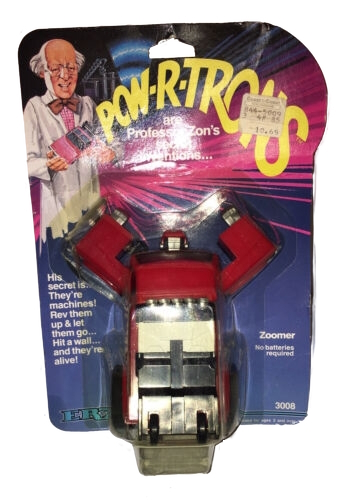 This deco be bussin fr no cap on god (Pow-R-Trons Zoomer)
 -
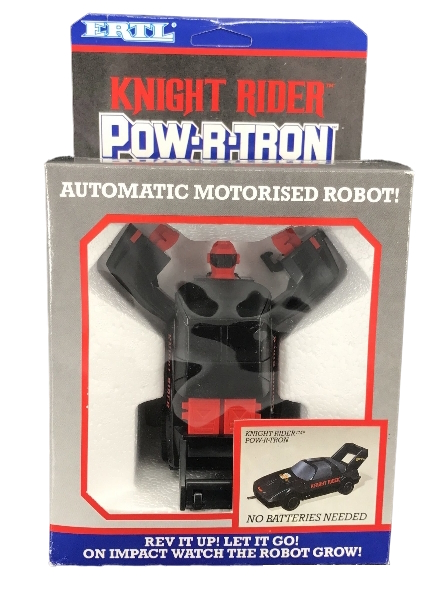 A shadowy flight into the dangerous world of a toy too confusing to exist (Pow-R-Trons Knight Rider)
 -
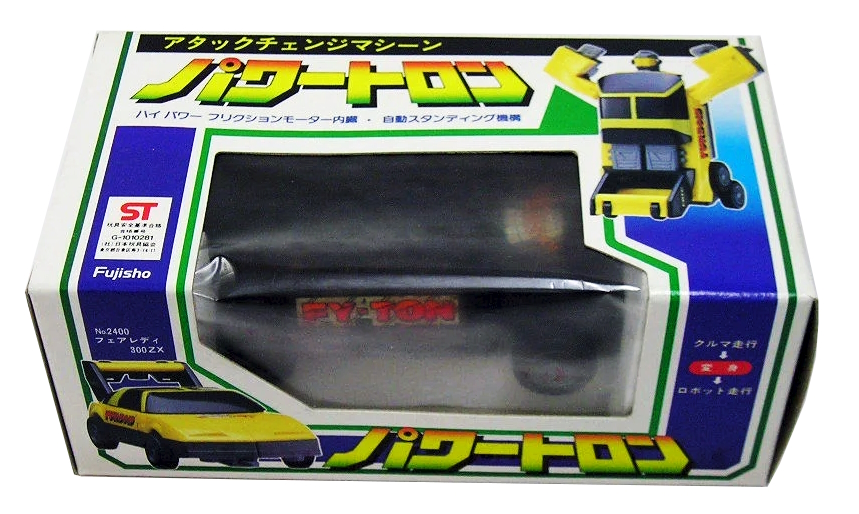 I both am and am not the original version of this toy! Confused? So am I! (Attack Change Machine Powertron Fairlady Z 300ZX)


After becoming Transformers
[edit]The molds would finally reach the Brazilian Transformers toyline as the Bat-Robôs sometime between 1985 and 1986 [9], earning the names Turbo and Pick-Up, and each featuring a pair of decos that were entirely new to these releases.
You'd think that this would be the end of the story for these molds - most other pre-Transformers toys would remain exclusive to the Transformers brand after the fact - but no: the molds were also released in 1993 by Glasslite in Brazil (with each figure getting one of its original Pow-R-Trons colors and another new color scheme) as the Crash Tron Blocker and Turborg under the Mutante toyline, one of the country's localizations for the GoBots [10]! It is still up in the air whether or not the Mutante toys were officially licensed by Bandai (more can be read about this conundrum on the GoBots wiki), but the fact that these were not just sold just a handful of years after their Estrela Transformers counterparts in the Brazilian market but were also part of a GoBots / Machine Robo derived line — easily the greatest Transformers competitor at the time — is pretty damn crazy... And it doesn't end there.
These molds would continue getting reused into the following decade, as the Korean Brave and Transformers licensee Sonokong would also release a pair of Korean-exclusive Brave toys under the Transforming Robocar (변신 로보카) name sometime during the 1990s, with one of these being a straight-up recolor of the Asahi 300ZX mold with added police lights and the other being a slight retool that changes up the design of the alt mode into a generic 90s sports coupe, also featuring police lights. Both of them feature the addition of battery-operated components, with the police lights being functional and a siren sound playing when they're turned on. It is unknown whether these were directly licensed from Asahi or just blatant rip-offs, although the former seems more likely given Sonokong's reputability as a company.
Finally, enter the early 2000s and Glasslite once again rolls out their red version of Pick-Up and yellow version of Turbo (the two colors taken from their Ertl equivalents), now selling them in Brazil under the name of "Crashmon"... As part of none other than a regionalized Digimon toyline [11]. What transforming vehicles has anything to do with a monster-collecting franchise is beyond anyone's guess, but nonetheless, these releases are the cherry on top of the cake for how utterly chaotic the story of these molds is.
So, to summarize: these same figures were, at various points, Transformers, Knight Rider, GoBots, Brave, and Digimon toys. And you thought Hasbro repurposed characters too often!
-
Hey, my existence is the reason why editors spent hours researching the contents of this page! (Transformers Bat-Robô)
-
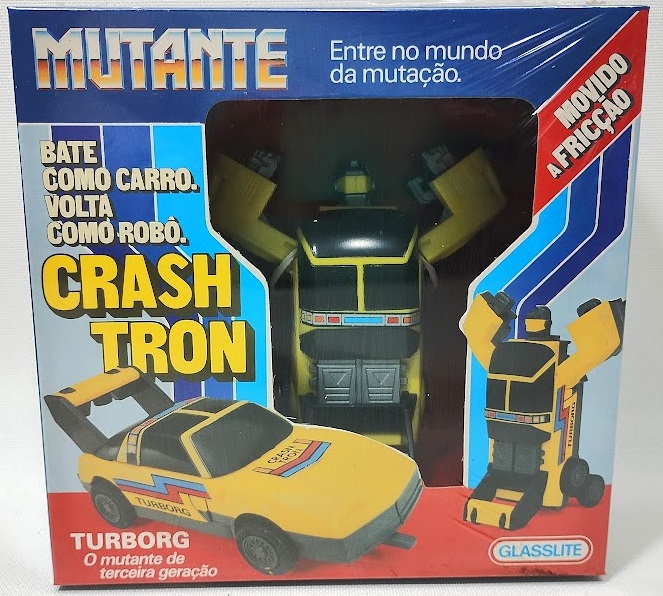 An affront to the natural order of things (Mutante Turborg)
 -
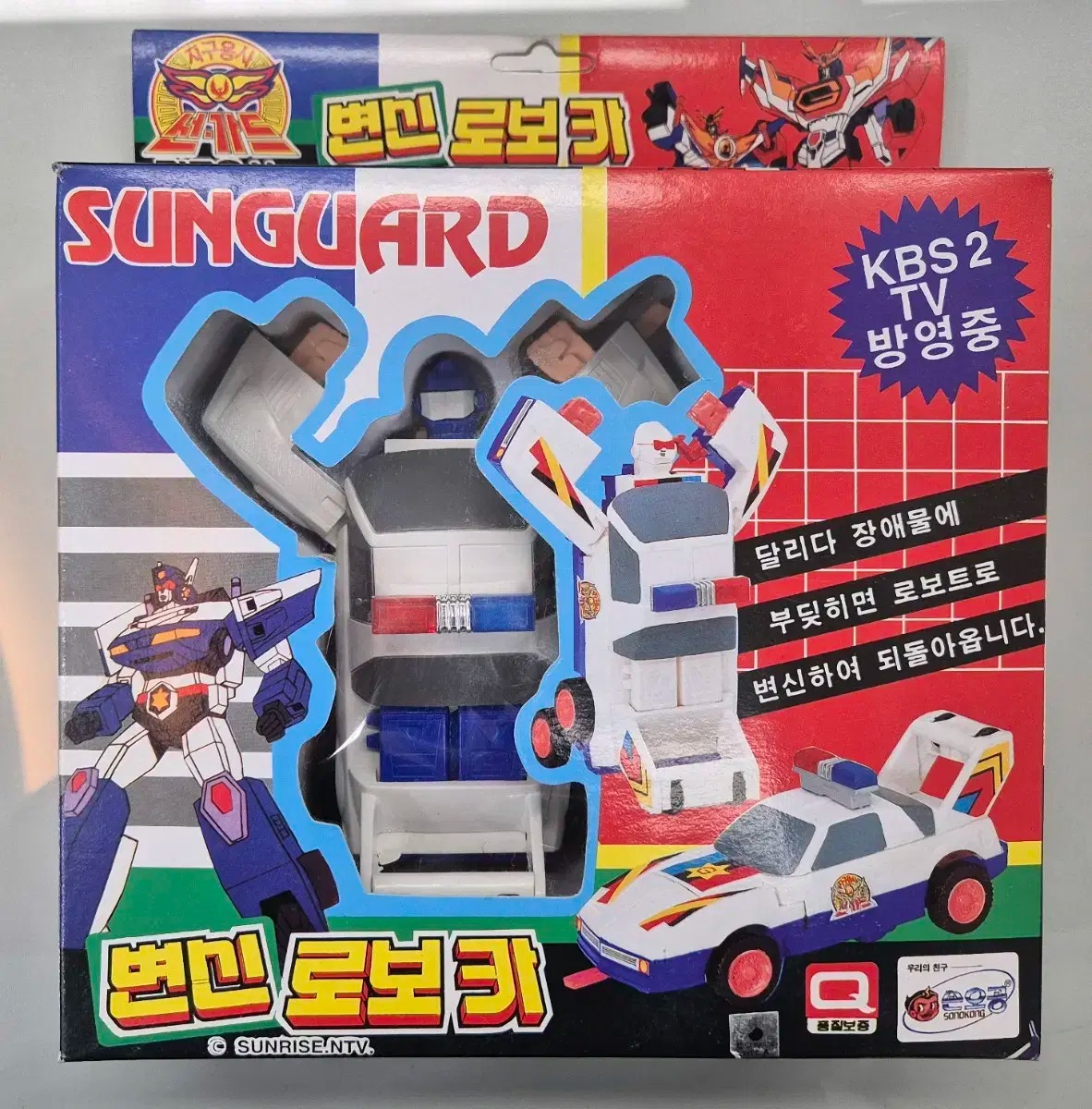 I don't know if I'm a bootleg! (Brave Transforming Robocar)


Asahi moulds released as Transformers
[edit]
Attack Change Machine Powertron
[edit]- Turbo - "No. 2400 300ZX Fairlady Z", in new orange and green color schemes
- Pick-Up - "No. 2401 Dattora Turbo", in new blue and red color schemes
Notes
[edit]- As always whenever the Bat-Robôs are brought up, it's important to clarify that the "Bat" portion of their name comes from the Portuguese word for "beating" (Bater), which is also generally synonymous with "crashing" - hence its connection with the play function of the cars. Sorry to disappoint you if you read through this entire article hoping that we'd explain how the Bat-Robôs are connected to Batman.
- Copies of the Bat-Robôs would also be sold in Argentina under the "Robot-Car" name, featuring mostly plain black packaging with additional portions photocopied from the Estrela originals. These versions do not feature any manufacturing information besides an "Industria Argentina" (e.g., the national equivalent of a "Made in [Country]") tag, making them seem, at a glance; similar to the odd Invasion Galactica Argentinian releases of Estrela Mini-Vehicles - but alas, whereas those are packaging swaps of authentic toys, these seem to come from a different production batch of figures given some differences in plastic colors and deco applications which, coupled with the aforementioned lack of any manufacturer and/or licensing identification, makes it more likely that they're regionally-manufactured bootlegs with no official relation to the other toys mentioned in this article instead. [12]
See also
[edit]- Yonezawa Toys, another Japanese company whose toys were adopted by Estrela as part of the Brazilian Transformers toyline
References
[edit]- ↑ Asahi patent for the toy that would become the Pow-R-Trons
- ↑ Frex Co., Ltd. patent for the toy that would become the Pow-R-Trons
- ↑ Pow-R-Trons by ERTL on the-liberator.net
- ↑ 1984: ERTEL「POWERTRON」をライセンス契約。全世界100万個を超える販売実績のヒット商品となる。http://www.frextoys.co.jp/company.html
- ↑ A Japanese blog post on Powertron, from ameblo.jp
- ↑ "Dattora" (ダットラターボ) is a Japanese slang contraction of "DATsun TRuck".
- ↑ A review of the Powertron Fairlady 300ZX, from plaza.rakuten.co.jp
- ↑ ""南米展開でトランスフォーマーとなった奴が朝日通商のパワートロンとして発売されてる!?コイツ等、南米でトランスフォーマーになったのいつ頃なんだろう!?" https://t.co/LsCZNe24nH"—kyano13neo, Twitter, 2019/03/25
- ↑ It is often presumed that the Bat-Robôs released alongside the second batch of Estrela Transformers toys in 1986 since they were only advertised alongside the Optimus x Malignus figures in 1986, however; given that they share the box graphic design with the 1985 wave instead, will err on the side of caution and assume it's not out of the question that they could have released a little bit later.
- ↑ 1993 Glasslite catalogue, via @tokusatsutoy on Instagram.com
- ↑ Glasslite commercial featuring the Digimon Chashmon figures
- ↑ An Ebay listing for an Argentinian Robot-Car Turbo bootleg.


