Estrela

This article is a featured article, and considered to be one of the most informative on this wiki.

Estrela is Brazil's largest toy manufacturer [1], being first founded in São Paulo in 1937 and remaining active to this day.
They are best known internationally for holding the license to produce and market regional permutations of multiple Hasbro toylines during the 1980s like G.I. Joe (under the localized names of Falcon and Comandos em Ação, i.e., "Commandos in Action"), My Little Pony (under the localized name of Meu Querido Pônei, i.e., "My Dear Pony") and, of course, The Transformers (under the localized name of, uh, Transformers). Although much of the Hasbro mainline would not be sold by Estrela, their aforementioned freedom to manufacture their own toys during this time resulted in multiple redecos of existing molds — and even some entirely unique toys altogether! — that remained exclusive to the Brazilian market.
They would also license out the Transformers brand to Antex in Argentina, who would in turn make their own smaller toyline with its own set of exclusive redecos. Later on, Estrela distributed most Transformers toylines in the country up until Cybertron, being eventually replaced by Hasbro's own Brazilian subsidiary starting from 2007. The fallout was a long and complicated legal dispute between the two companies regarding royalties for the Hasbro-derived toylines that Estrela was still manufacturing domestically, lasting all the way up until its settlement in 2021.
Overview
[edit]
Estrela's Transformers toyline
[edit]Estrela's approach to localizing The Transformers was somewhat unusual. The first edition of the U.S. comics would be published nationally by Rio Gráfica Editora in November of 1985 and the cartoon would only premiere on Brazilian airwaves in 1986, however; Estrela decided to preemptively release their Transformers line in May of 1985, quite a few months before most domestic audiences had been introduced to the characters.
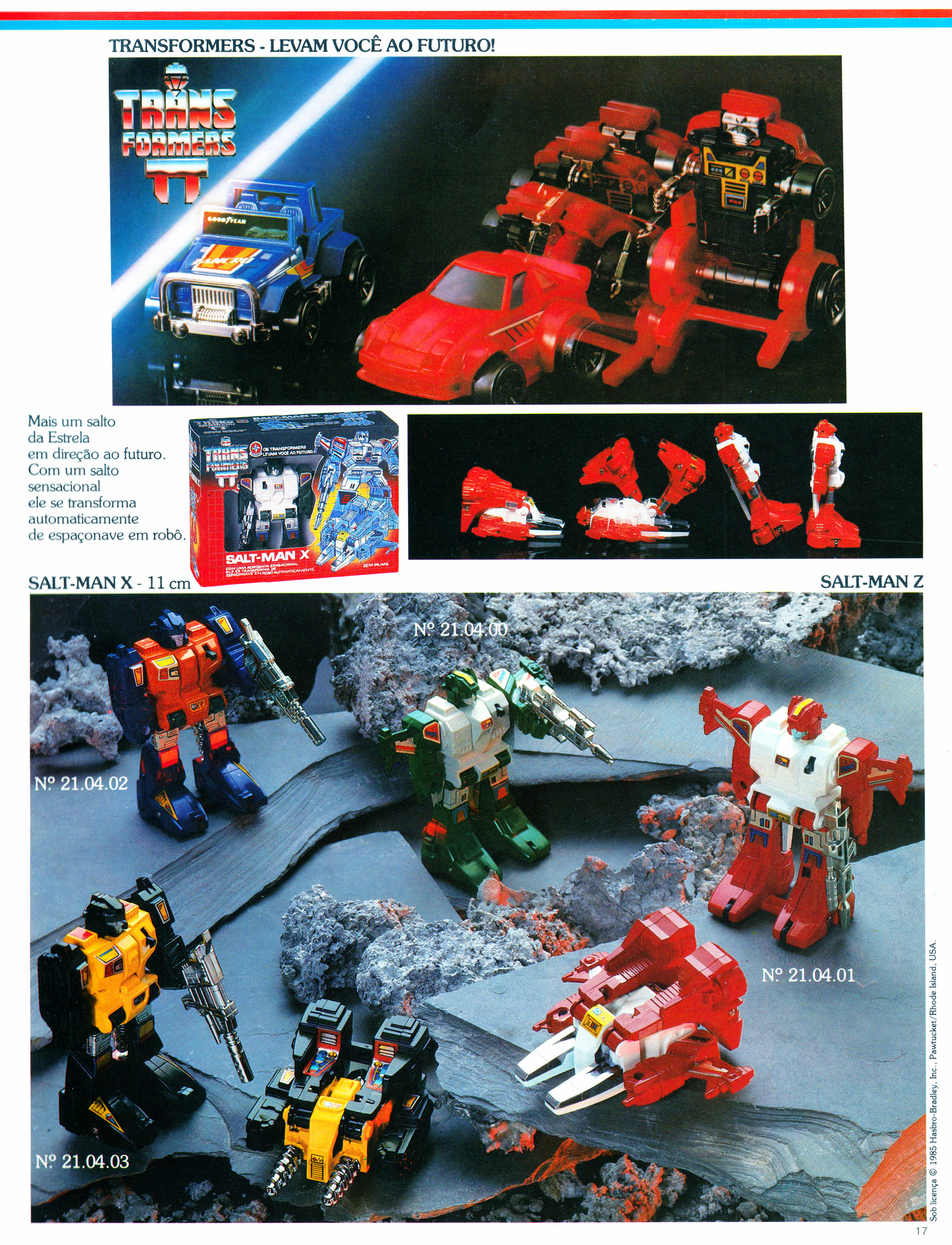
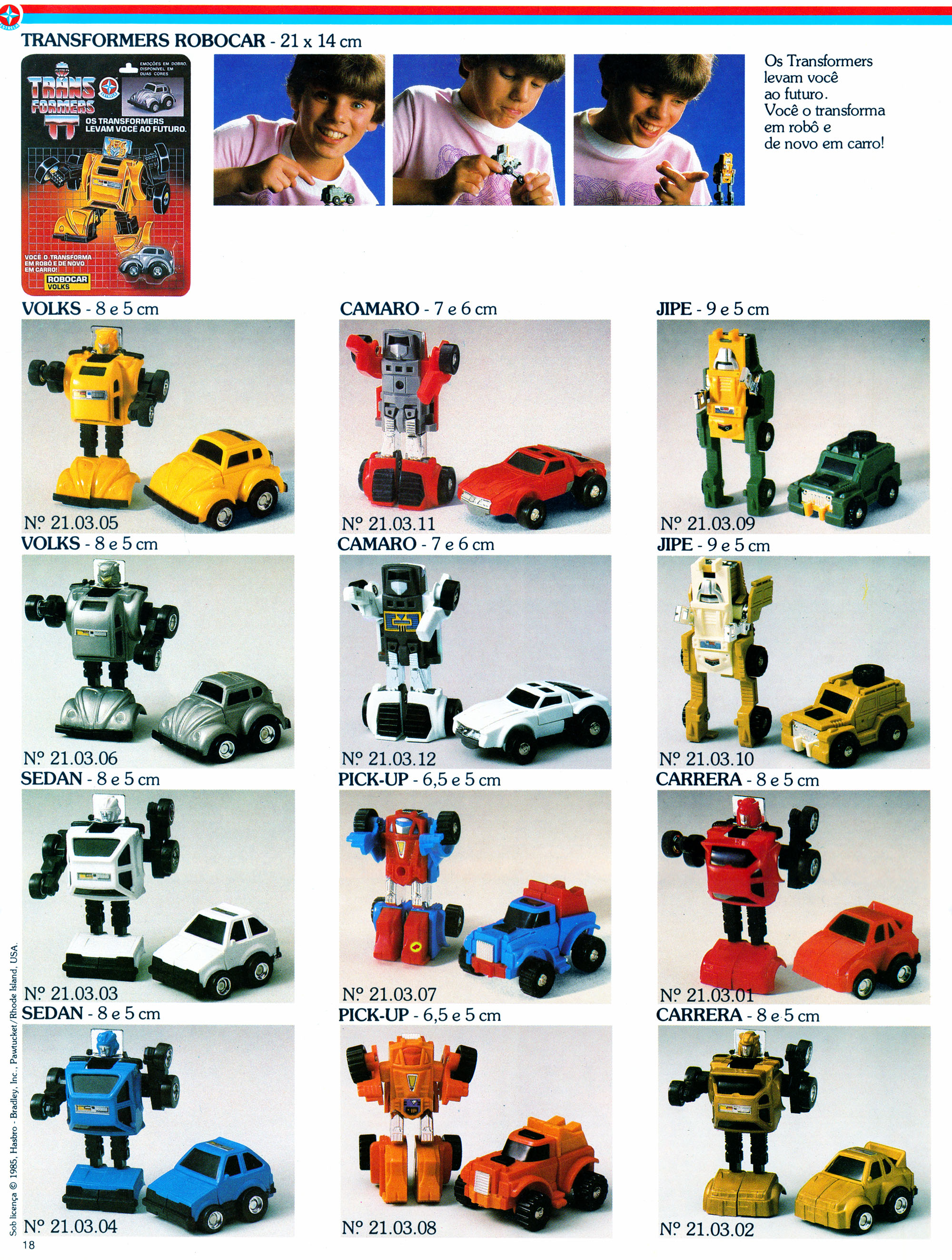
The stars of this toyline were a handful of Mini-Vehicles and Jumpstarter redecos, respectively renamed into the Robocars and Salt-Men (the Salt here being a contraction of "salto", the Portuguese word for "jump") and releasing in packaging similar to their U.S. counterparts but featuring an entirely new Transformers logo instead. The fact that there was no known fiction for these figures within the Brazilian market left Estrela to name them after their alternate modes instead — and thus, the Bumblebee mold became known as "Volks" (per his Volkswagen Type 1 'Beetle' mode), the Cliffjumper mold as "Carrera" (per his Porsche 924 Carrera GT alt mode [2]), and so on. The Topspin and Twin Twist molds were also renamed into, respectively; "Salt-Man X" and "Salt-Man Z" [3]. The lack of a pre-established mythology also meant that this first batch of toys did not have faction insignia, instead featuring stickers identical to the original Micro Change and Diaclone versions of their respective molds. This was changed in a second run of the Robocars, as the introduction of The Transformers comic book in Brazil by the end of 1985 would bring about the renaming of the Autobots and Decepticons into "Optimus" and "Malignus" — and thus, the toyline would also get its own Optimus and Malignus factions in 1986, now also sporting much flashier decos. [4]
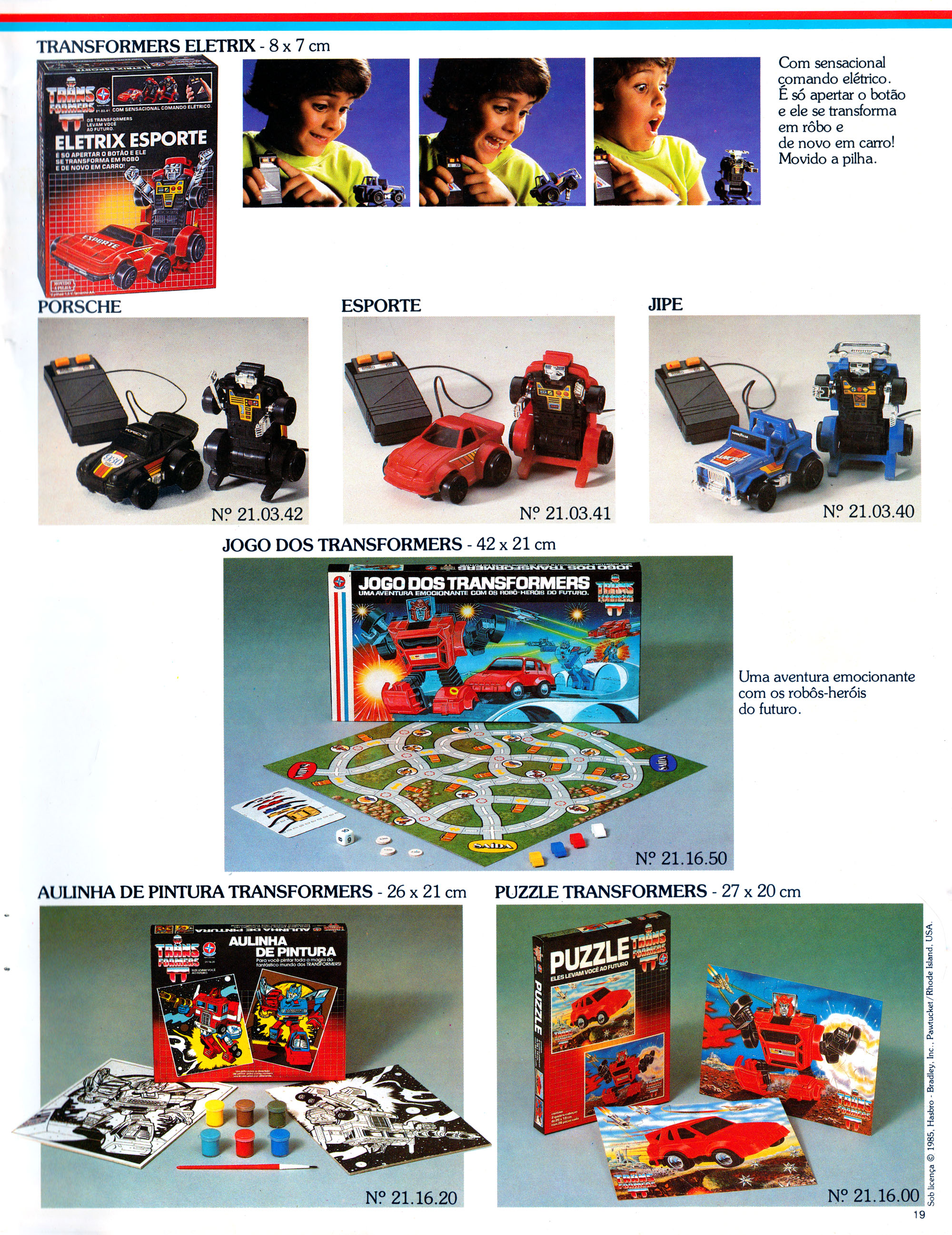
The line-up was also supplemented by larger toys licensed from other companies which were not featured in any other of the many international Transformers toylines [5]. These included the auto-transforming Bat-Robô figures with pullback motors (three years before the American line did the same) which were originally from Asahi Corporation's Attack Change Machine Powertron toyline, the also auto-transforming Eletrix figures that doubled as rudimentary remote-controlled vehicles (thirty five years before Robosen kind of did the same with uh, a marginal difference in quality) which were originally from Yonezawa Toys' Remote Change Robo Series toyline, and... that was it, these are all the figures released under Estrela's original Transformers toyline, and also the only ones available on domestic toy aisles throughout the following years as the show premiered.
Noticeably absent from this line-up is nearly every single major Transformers character, therefore depriving Brazilian fans during the 1980s of some of the most important figures like Optimus Prime, Megatron, the Seekers, the Dinobots, the Diaclone Car Robots-derived characters like Jazz, Prowl, Sideswipe et al., and many, many, many more: effectively, beyond those based on the first year of Mini-Vehicle molds, virtually no other characters with cartoon or comic appearances received toys in Brazil during this time! As a result, a common part of the experience of being a young Transformers fan in Brazil often involved filling in the ranks of missing characters with GoBots (which were actually localized twice in the country, first by toy company Glasslite as Mutante and then by Mimo as Convert), using toys like Road Ranger as a stand-in for Optimus or Leader-1 as a stand-in for Starscream. [6]
Licensing and distribution in Argentina
[edit]
- Main articles: Antex / Invasion Galactica
Estrela licensed out the Transformers toyline to Argentinian company Antex, who also released their Transformers toyline in 1985. Considering Hasbro's ownership of the brand, whether or not Estrela actually had the legal right to do so is... questionable, but regardless, neither company seemed to suffer for it, as both Estrela and Antex would go on to become official distributors of Transformers figures in their respective countries during later years. [7] Antex's line-up was mostly similar to Estrela's pre-Optimus vs Malignus toys, featuring some of the Robocars (in yet another batch of all-new color schemes) and the Salt-Men molds (also bearing some, albeit fewer, deco changes), but no Bat-Robôs or Eletrix. They also reused the logo created for Estrela's toyline, as well as the unique character names.
On another odd note, Estrela's original versions of the Sedan, Camaro, and Pick-Up molds were also sold across some locations in Argentina in 1985 under unusual circumstances: the toys and their bubbles were manually cut off the Transformers branded cards and then crudely attached to new blister cards featuring the logo Invasion Galactica and art of a flying saucer zapping the figures. Collectors from South America have long maintained that these packaging swaps were done by legitimate retailers, who were attempting to find a way to move their Transformers merchandise during a time when protectionist laws made it difficult to sell product that had been manufactured in foreign countries [8]. This is corroborated by the fact that, beyond the aforementioned logo, the only other piece of writing in the packaging for these toys is a small "Industria Argentina" on the bottom left of the cards (the Argentinian equivalent of a Made in USA or a Made in China): considering how these are the Brazilian-made Robocars, it stands to reason that this is most likely a sneaky bit of deception added to evade suspicion from authorities.
Despite the aforementioned protectionist laws, the regular international Transformers toyline also released to multiple retailers in Argentina, with the more popular Autobots and Decepticons being commonly available alongside the domestic Antex products — something that a lot of Brazilian kids could only ever dream of seeing in their national stores.

Later partnership with Hasbro, break-up, and lawsuit
[edit]Eventually, as the 90s came and the Transformers brand proved itself to be a reliable long-term investment for Hasbro worldwide, Estrela went from being a manufacturer to a distributor for the post-Generation 1 toylines, with figures from Beast Wars, Beast Machines, and all the way into the 2000s with Transformers: Universe and the "Unicron Trilogy" getting Estrela-branded releases with import stickers in Brazil. Other Hasbro toylines, like the then recently-obtained Star Wars license (formerly belonging to Kenner before it was absorbed into Hasbro), were also similarly distributed by Estrela. In contrast, multiple popular Hasbro-owned board games like Monopoly (sold in Brazil as Banco Imobiliário, i.e., "Real-Estate Bank") and Cluedo (sold in Brazil as Detetive) kept on being manufactured locally by Estrela, as well as a few other toys like Play-Doh (sold in Brazil as Super Massa, i.e., "Super Dough"). Within the scope of board gaming, Estrela would also briefly return to the Transformers franchise in a manufacturing capacity, releasing a board game for Transformers: Armada in 2003. Curiously, the G.I. Joe-derived Comandos em Ação / Falcon franchises would also be briefly resurrected in a duo of small domestically-made toylines, one in 1994 [9] and another in 2000 [10]: notably, while the 1994 toyline was co-branded with Hasbro (and even featured the G.I. Joe title on the packaging alongside its regional equivalents), the 2000 Falcon toyline only bore Estrela's branding, suggesting that they had begun to grow more confident about their in-house products being passably distinct from Hasbro... And oh boy, did that come to bite them in the ass.
By 2007, Hasbro had stopped renewing their licensing and distribution contracts with Estrela in favor of setting up their own self-owned South American distribution chain: thus, the 2007 movie toyline would be instead briefly handled by national distributor Gulliver, while future Transformers figures, starting from Transformers Animated and beyond up until today, were released in Brazil directly by Hasbro. Still, Estrela kept manufacturing Super Massa and the aforementioned board games under their own localized titles: this led to Hasbro suing Estrela for royalties in 2008 and culminated in a lengthy legal battle lasting a whole 15 years. Eventually, the Court of Justice of São Paulo ruled in 2021 that while some of these brands, like Detetive and Super Massa, still belonged to Hasbro, others, like Banco Imobiliário, had been made sufficiently legally distinct to belong to Estrela instead:[11] thus, to this day, both the original Monopoly and its localization as Banco Imobilário can be found in Brazilian stores.
Interestingly, this court ruling also determined that Falcon and Comandos em Ação — as mentioned, a pair of Brazilian localizations of G.I. Joe — were a property of Estrela rather than Hasbro, and conveniently, since 2017, Estrela also began releasing a still-ongoing series of both new toys and high-quality repros of the original 1970s Falcon figures! [12] Unfortunately, since Transformers as a brand most definitely belongs to Hasbro over Estrela in Brazil (the franchise wasn't even mentioned in the aforementioned lawsuit, likely because Estrela hadn't produced proper Transformers toys in over two decades since the break-up), it is unlikely that Estrela will ever do something similar with their Transformers molds... But not impossible. Who knows, maybe they could get away with rolling out some repros under their "Optimus X Malignus" name someday!
The continuity kerfuffle
[edit]
The fiction of the toyline is... fuzzy. The cardback bios for the Robocars are direct Portuguese translations of their base molds' Hasbro bios (with the exception of Bumper-mold Sedan who did not have an "official" Hasbro release and thus features an entirely new bio instead), and as a result, this wiki places those toys as those already-established characters. However, the Salt-Men have unique bios, placing them as all-new characters. Every other toy lacks a bio. While this is not so big a deal when it comes to the Bat-Robô and Eletrix (who have no Transformers analogues whatsoever), things get hinky when it comes to the Optimus and Malignus, who use the same names as their Robocar forebears; for simplicity (or as close as this can generally get), this wiki treats all of the Optimus and Malignus as new characters. Odder still, since none of the pre-Optimus/Malignus toys or packaging featured any faction symbols, their allegiance is mostly conjecture, but between the re-use of "Autobot" character bios on "Autobot" molds and all of them using the "Autobot" style packaging, plus the lack of any indication in what bios exist that any of the toys are villains, the general fandom assumption (and wiki default placement) is "Autobot".
Weirdly, Rio Gráfica Editora's regionalized version of the comics both backs and contradicts this interpretation: all of the Mini Vehicle-derived characters are introduced with entirely new regional names (Bumblebee is now "Furão", i.e., Ferret, Cliffjumper is now "Saltador", i.e., Jumper, etc.)... Except for Brawn, who is instead first presented with the Estrela toy-derived title of "Robocar Jipe, o Brigão" (i.e., "Robocar Jipe, the Brawler"), which suggests that the "Robocar Jipe" portion of his name is his original Cybertronian name and that "Brigão" is just a nickname or callsign instead. If one extrapolates this to the to the other Mini-Vehicle-derived characters in these issues, it might be inferrable that all of them are also called their Robocar equivalents and just go by nicknames, although this is never explicitly done in the comics.
Add to all of this the fact that, as mentioned, the Optimus and Malignus factions were originally just the localized names for the Autobots and Decepticons in the comics, however; the 1986 toyline featured them with entirely new insignia while the cartoon that was concurrently rolled out in the same year abandoned the "Optimus" and "Malignus" names in favor of the original Autobot and Decepticon faction titles and insignia: the result, thus; was that fans tended to treat the Optimus and Malignus of the Estrela toyline as independent "good" and "evil" factions that exist somewhere in the Transformers universe, and this would eventually become part of the canon with cameos in later media like Beast Wars: Uprising and Transformers: TransTech. As such, for the sake of conformity with more recent material and in line with the most common fan interpretation, the toys in this wiki that were originally labelled as Optimus and Malignus will be treated as belonging to those factions specifically rather than either to the Autobots or Decepticons.
To cap it all off, some of the more generic vehicle-mode-based names are reused across multiple toys: is Eletrix Jipe, then, the same character as Malignus Jipe? Is Bat-Robô Pick-Up the same character as Malignus Pick-Up? Again, the broad fan consensus that was adopted by later media is that these are all separate characters, but who knows for sure what Estrela's original intent might have been.
Toys
[edit]
Transformers
[edit]As mentioned, the 1985 line was mainly made up of a small handful of Mini-Vehicle and Jumpstarter molds from the Hasbro toyline, and it was further bulked up by giving most toys two different decos: one resembling the Hasbro originals and one in all-new colors. The one exception to this was how the line made repeated use of the "Bumper" mold (perhaps because of his shared engineering with Bumblebee and Cliffjumper helping to keep manufacturing costs low) that was extremely rare in the US, and not released as a Transformer at all in Japan: thus, given the lack of an "official" color scheme for Bumper internationally, one of the decos for Estrela's version (dubbed "Sedan") would be based on the original Micro Change version instead. The Bat-Robôs also had two decos each, whereas the Eletrix somehow had the restraint of only providing a deco for each toy.
On top of the reused Micro Change and Diaclone sticker designs in place of the faction insignia, one of the redecos — the blue and red version of Salt-Man Z — also features the same color scheme as its original Diaclone counterpart. And speaking of stickers, an unfortunate commonality amongst a lot of Estrela toys are their poor-quality paper decals: this is especially noticeable in the Eletrix and Bat-Robô figures where the the glue has an unfortunate tendency to liquefy with time, resulting in most stickers either eventually falling apart or, even if they manage to hold onto the figures, usually always gaining a hideous "stained" look. Finding copies of these toys in good condition is, therefore, often remarkably hard.
| Robocars |  | |||||
Salt-Man
|
Bat-Robô [13] | Eletrix |

Estrela's second batch of Robocars, usually known as "Optimus x Malignus" (per a concurrently-released sticker album featuring this as the sub-title), are their most well-known outside of Brazil. The six Robocar molds were trotted out again in 1986, each one getting two new color schemes, but this time split into two proper factions: the heroic Optimus, from the Penny Racers-style molds, and the evil Malignus, from the less-humanoid molds of Mysterians lineage.
These releases are particularly rare, and even loose samples are expensive, especially the (generally more gorgeous) Malignus.
| Optimus | Malignus |  |
Availability
[edit]It is, of course, impossible to talk about Estrela's toys without also mentioning how absurdly expensive this batch of figures has become over the years on the secondary market. The Salt-Men, the Eletrix, and the Bat-Robôs are all pretty affordable and abundantly available in Brazilian e-commerce websites like Mercado Livre and OLX, but the Robocars are an entirely different story: when it comes to Estrela's first wave, depending on condition, you can usually expect to pay quite a bit more for loose samples compared to their international Minicar equivalents, with Sedan especially tending to cross into the triple digits. And as for the Optimus and Malignus figures, considered by many the crown jewels of Estrela's line-up... They're rare enough that it's near-impossible to find copies for sale in the first place, but you can pretty much consistently expect to pay significantly higher prices for these toys — even in poor condition — if you can somehow locate them, and don't expect carded samples to cost anything below four very high digits.
But wait, there's more! You can't simply just log into a Brazilian e-commerce site like Mercado Livre and OLX as a gringo since they also require users to verifiy their credentials with a national phone number, and even if you somehow manage to get one, most Brazilian sellers usually do not ship internationally, and even if you can somehow find a seller that does, get prepared for the national mail service to charge some viscerally painful shipping prices. Yes, even for tiny items like the Robocars.
Merchandise
[edit]Transformers
[edit]On top of the toys, Estrela also backed their 1980s Transformers line-up with a staggering amount of merchandise, boasting everything from the usual knick-knacks you'd expect like the aforementioned sticker album, puzzles, lunch boxes, and pencil cases, to more esoteric stuff like wall clocks, multiple extensive home decor sets with bed sheets and curtains from national textiles company Karsten [14], and, for whatever reason (perhaps for those keen on starting their own separatist nation using the Estrela Robocars as national icons?), even a large yellow flag featuring Pick-Up / Gears. [15] Most notably, this line-up of merchandise included an original board game, also manufactured in-house by Estrela. It starred four of the six original Robocars, who duel it out in a competition while collecting points across the game's board.
While most of this merchandise was based around the Robocars, it also occasionally featured art of the more popular characters that weren't included in the toyline, like Optimus and Megatron, serving as a constant reminder to Brazilian kids of all the toys they wouldn't be able to get unless they had rich parents who frequently traveled abroad.

-
Board Games
- Jogo dos Transformers (The Transformers Game)
(featuring miniature vehicle mode versions of Volks, Camaro, Carrera, and Sedan)
Home Decor
- Karsten bedroom decor sets
(available in two varieties) - Jogo Transformers Armada (Transformers Armada Game)
- "Estrela" is Portuguese for "Star", hence the company's logo featuring a compass star.
- The aforementioned 1986 sticker album (introducing the Optimus X Malignus logo seen on this page) would be constituted of stills from the cartoon — a bizarre oddity, however; is that all of the Autobot and Decepticon faction insignia was scrubbed out of the images, even as the previously released comic books had them! Perhaps Estrela was really banking on the idea that their Optimus and Malignus would replace the Autobots and Decepticons in the region, or perhaps some licensing issues regarding the use of insignia in that specific format could be involved, but in either case; as the cartoon eventually released on the same year with both the Autobots and Decepticons retaining their original titles and emblems, it's difficult not to be at least a little confused as to why exactly this was done.
- While the Bat-Robôs and Eletrix figures are technically Brazilian exclusives within the Transformers Generation 1 toyline, other versions of these same molds did find their way to a handful of different international non-Transformers toylines: Village Toys would release the Eletrix molds under their Convert-A-Bots toyline in the U.S. and a handful of other companies would manufacture and sell them across other regions like Europe, while the Ertl Company would release the Bat-Robô molds in the Pow-R-Trons toyline across the U.S. and Europe (likely before their original Japanese versions even: it's a long and complicated story). Estrela's Bat-Robôs do have unique color schemes not seen in other releases of these molds, but the Eletrix molds are virtually unaltered across all their international releases save for the occasional different sticker designs.
- Speaking of which... In 1993, the Bat-Robô molds would be re-released in Brazil by rival toy company Glasslite as the Crash Tron figures Blocker and Turborg, under the GoBots-localized Mutante toyline [17]. It's still hotly debated amongst GoBots fans whether or not the Mutantes were a true licensed localization or just bootlegs — on one hand, Glasslite was a reputable company that produced official Brazilian releases of many toys from popular mass-media franchises like Star Wars and Thundercats and the quality of the toys does seem to check out as being on par with official products, but on the other hand, none of the packaging and known promotional material for Mutante actually mentions Bandai unlike Estrela did with Hasbro — but assuming that they are, this might make for an unprecedented instance of a toy being simultaneously a Transformer and a GoBot, and in the same region to boot! Glasslite would even re-release these same molds as Digimon toys in the 2000s, for whatever weird reason.
- The picture in the advert for one of Karsten's bedroom decor sets features a small, as-of-now unidentified black robot toy on top of a nightstand. Whether or not this was some cancelled Estrela product or simply another unrelated toy is unknown: on one hand, the advert for Karsten's other bedroom set shows a Bat-Robô Pick-Up — as well as a Força Bruta ("Brute Force") Jeep, another Estrela toy — displayed on its nightstand instead, which does suggest that Karsten's set designers might have been specifically provided Estrela toys to go along with their photoshoots, but on the other hand, there's virtually no known documentation of this specific toy on any known archives of Estrela material besides this one catalogue image, which seems to point more towards the direction of a generic non-Transformers toy instead. Still, who knows for sure: it remains a small mystery that might never be solved.
- On the topic of another neat brand interaction, one of Estrela's most iconic toylines is Ferrorama, a series of electric motorized and — for their time — fairly high-quality train sets that fulfilled an intermediary niche of sorts between more serious scale models and children's toys. Over the decades, these have become fondly remembered as cult collectibles in Brazil, in no small part thanks to having an exceptionally dedicated fanbase [18]. These were actually imports from the Japanese Super Rail Black series, manufactured by none other than Tomy before they merged with Takara to become — of course — the Transformers' own TakaraTomy!
- Despite still owning the distribution rights to Transformers in the early 2000s, Estrela would also release a small self-branded line of transforming toy robots under the Mutantes toyline (which, strangely, seem to bear no relation to the previously mentioned Glasslite Mutante toys) during this time. These were simple bulky figures that'd transform into either die cast vehicles or plastic dinosaurs, with the molds consisting of basic budget toys repackaged from other non-Transformers toylines that you'd commonly find in budget toy shops during the 2000s.
- Estrela brought back the Mutantes line again in 2014, eight years after their relationship with Hasbro had ended, with the introduction of the dinosaur-based Mutantes Dinossauros figures. Among these were a Velociraptor and a Deinonychus originally first released by Japanese compay Hayakawa Toys which, despite being heavily simplified, are nonetheless very clearly molded after the engineering of the original Beast Wars Dinobot toy [19] — meaning that yes, Estrela technically became a bootleg distributor, albeit only briefly! The extent to which they were even aware of the similarities between these figures and the Hasbro originals is debatable since again, as with their first batch of Mutantes, these were simple repackages of common budget toys licensed from other companies, but it is nonetheless interesting that a company would have both a relationship with Hasbro and yet also distribute Transformers knockoffs throughout their history. Even crazier that they were not the first to do so, and neither would they be the last.
- Although Estrela no longer has any relation with Hasbro, the latter still has a small industrial presence in Brazil: as of 2024, there is one factory — Copag da Amazonia S.A., in the State of Amazonas — which serves as a manufacturer for the American company [20]. Unfortunately, though; it does not seem that they produce colorful Mini-Vehicles.
- Antex, the Argentinian counterpart of Estrela's Transformers
- Karsten, a textiles company that produced merchandise for Estrela's Transformers
- Grendene, a Brazilian shoe brand responsible for the Grendene Transformers watch (and also the sole post-Estrela instance of a regular transforming Transformers toy being exclusive to Latin America)
- Beyond standard toys, multiple Latin American companies would also later produce Transformers merchandise:
- Multibrink, another Brazilian company that made assorted merchandise for the 2015 Robots in Disguise franchise.
- Garoto, a Brazilian chocolatier that made merchandise for Dark of the Moon.
- D'elicce, another Brazilian chocolatier that made evergreen-style Transformers merchandise
- Generation 1 toylines in Latin America
- Category:South American-original characters
- ↑ According to Euromonitor, Estrela is the fifth largest toy company operating in Brazil, sitting behind Mattel, Hasbro, Lego, and Candide Brinquedos. Out of these four companies, the only domestic one is Candide, however; they work exclusively as distributors for foreign brands rather than being manufacturers themselves, leaving Estrela to still be the biggest national toymaker overall.
- ↑ Cliffjumper's original Micro Change version refers to him as a 'Porsche 924 Turbo', but most of his design traits are distinctively inspired by the Carrera GT version of the 924 instead.
- ↑ Estrela's 1985 toy catalogue (Page 17) (Page 18)
- ↑ "Estrela's Exclusive Brazilian Transformers", from Brazilian website Transformers Dioramas
- ↑ Estrela's 1985 toy catalogue (Page 19) (Notably, the Bat-Robôs are absent, suggesting that they might have been released slightly later)
- ↑ "[Road Ranger] was the first “Optimus Prime” for most Brazilians, since the original Transformer Optimus Prime was never sold in Brazil" (Source: Nova Cybertron)
- ↑ Page for Argentinian Transformers on toyarchive.com
- ↑ Page for Invasion Galactica on toyarchive.com
- ↑ 1994's Comandos em Ação: Clássicos Falcon assortment on falcon80.com.br
- ↑ 2000's Força de Ataque assortment on falcon80.com.br
- ↑ An article from the Brazilian Globo news service on the settlement of the Hasbro v Estrela lawsuit
- ↑ Timeline for the Falcon toyline on falcon80.com.br
- ↑ There's some ambiguity as to when exactly the Bat-Robôs were released: On one hand, they feature similar packaging to Estrela's first batch of Transformers figures rather than the later Optimus x Malignus rebranding, but on the other hand, they do not show up on Estrela's 1985 catalog and were only advertised in Brazil's localization of the Transformers comics in issue 11 alongside the Optimus x Malignus toys. As a result, 1986 is generally considered the more tentative date.
- ↑ Page for Brazilian Transformers merchandise on on toyarchive.com
- ↑ A Facebook sales post featuring some of Estrela's merchandise
- ↑ "Acervo / Séries" at NovaCybertron.com
- ↑ 1993 Glasslite catalogue, via @tokusatsutoy on Instagram.com
- ↑ In one particularly wild event, Estrela challenged fans who clamored for the toyline's return in 2010 to make a Ferrorama train travel for 20 kilometers through Spain's Camino de Santiago, one of Europe's most popular pilgrimage paths. Shockingly, armed with about 110 meters of track (that'd be plopped down and removed as the train proceeded on its path), Ferrorama fans actually pulled off this incredible feat, and as such; the Ferrorama brand was eventually resurrected!
- ↑ A Brazilian video review of Estrela's Mutantes Dinosauros' Deinonychus Rex
- ↑ Hasbro Third-Party Factory List 2024 on hasbro.com.
- Estrela (official site)
- Page on Brazilian Transformers at the Super Toy Archive
- Archive and gallery of Brazilian Transformers at Nova Cybertron (in Portuguese)

Transformers: Armada
[edit]Launching in 2003 (over a decade and a half after their final self-manufactured batch of Transformers toys), Estrela's Transformers: Armada board game was released to tie into the concurrent localized airing of the show and the company's own batch of imported Armada toys [16].
This would be the last known instance of Transformers memorabilia being made in-house by Estrela, marking a quiet end of an era for the franchise in Brazil.
Board Games
Notes
[edit]