Transformers/G.I. Joe: Difference between revisions
No edit summary |
mNo edit summary |
||
| (20 intermediate revisions by 15 users not shown) | |||
| Line 1: | Line 1: | ||
[[Image:Tfjoe01 2003 gatefold.jpg|right|400px|thumb|Guys, Optimus is ''behind you''. Now start digging him out, I think he's trapped.]] | [[Image:Tfjoe01 2003 gatefold.jpg|right|400px|thumb|Guys, Optimus is ''behind you''. Now start digging him out, I think he's trapped.]] | ||
'''''Transformers/G.I. Joe''''' is a six-part miniseries published by [[Dreamwave Productions]] in 2004. The book is set in its own [[micro-continuity]], placing [[Transformers]] and [[G.I. Joe]] characters in a World War II setting, with alternate | '''''Transformers/G.I. Joe''''' is a six-part miniseries published by [[Dreamwave Productions]] in 2004. The book is set in its own [[micro-continuity]], placing ''[[Transformers brand|Transformers]]'' and ''[[G.I. Joe (franchise)|G.I. Joe]]'' characters in a World-War-II-like setting, with [[alternate mode]]s based on the period. | ||
{{chapters | |||
|series=tfgijoe|next=Transformers/G.I. Joe: Divided Front|style=3|content=*[[The Line|#1]] | |||
*[[Transformed|#2]] | |||
*[[Trial by Fire|#3]] | |||
*[[Wolves|#4]] | |||
*[[Trenches|#5]] | |||
*[[The Iron Fist|#6]]}} | |||
==Overview== | ==Overview== | ||
The story opens on late-1930s [[Earth]], which teeters on the brink of global war. The forces of [[Cobra]] uncover the Matrix and use it to rouse the dormant Decepticons, using them to ravage Europe. America deploys a new rag-tag special operations team to stop | The story opens on late-1930s [[Earth]], which teeters on the brink of global war. The forces of [[Cobra]] uncover the Matrix and use it to rouse the dormant Decepticons, using them to ravage Europe. America deploys a new rag-tag special operations team to stop them—[[G.I. Joe (team)|G.I. Joe]]. | ||
New alternate forms were designed for many characters by [[Don Figueroa]], with the [[Autobot | New alternate forms were designed for many characters by [[Don Figueroa]], with the [[Autobot]]s assuming the forms of Allied vehicles and the [[Decepticon]]s taking Axis forms. Sadly, most of these new forms were largely obscured by the art of the finished series. | ||
The series has been heavily criticized by some fans for being difficult to follow. The heavily stylized art could be described as gritty, evocative, and beautiful... and to an equal extent, murky, underlit, and incomprehensible. The art makes the entire story seem to happen at dusk or night, in a world filled with clouds, fog, dust, smoke and shadow. The art appears stylized to emulate World War II propaganda posters, an interesting choice but one that hurts the telling of the story. | The series has been heavily criticized by some fans for being difficult to follow. The heavily stylized art could be described as gritty, evocative, and beautiful... and to an equal extent, murky, underlit, and incomprehensible. The art makes the entire story seem to happen at dusk or night, in a world filled with clouds, fog, dust, smoke and shadow. The art appears stylized to emulate World War II propaganda posters, an interesting choice but one that hurts the telling of the story. | ||
Narrative compression and expansion likewise adds both drama and obscurity to the story. Important events such as [[Major Bludd]] actually seizing the [[Matrix of Leadership|Matrix]], or the downing in battle of [[Mirage (G1)|Mirage]], [[Wheeljack (G1)|Wheeljack]] and [[Hound (G1)|Hound]], are vaguely implied between panels or mentioned only in | Narrative compression and expansion likewise adds both drama and obscurity to the story. Important events such as [[Major Bludd]] actually seizing the [[Matrix of Leadership|Matrix]], or the downing in battle of [[Mirage (G1)|Mirage]], [[Wheeljack (G1)|Wheeljack]] and [[Hound (G1)|Hound]], are vaguely implied between panels or mentioned only in dialogue, while splash pages (such as an entire two-page spread sans dialog in issue #5) do almost nothing to advance the plot. While this series is hardly alone in making such choices, combined with the heavily inked art, the end result is a story that is difficult to comprehend at times. | ||
The series was followed by a second miniseries set in the present day, and drawn in a contemporary style. However, ''[[Transformers/G.I. Joe: Divided Front]]'' only had one issue produced before cancellation due to Dreamwave's bankruptcy. | The series was followed by a second miniseries set in the present day, and drawn in a contemporary style. However, ''[[Transformers/G.I. Joe: Divided Front]]'' only had one issue produced before cancellation due to Dreamwave's bankruptcy. | ||
==Creative Team== | |||
The series was written by [[John Ney Rieber]], with (very dark and murky) art provided by [[Jae Lee]] on pencils, [[Rob Armstrong]] on inks and [[June Chung]] on colors. | |||
==Collections== | |||
* '''''Transformers/G.I. Joe Volume 1''''' TPB <small>(August ??, [[2004]]) ISBN 0973381795 / ISBN 978-0973381795</small> | |||
:*Published by [[Dreamwave Productions]] | |||
:*Collects issues #1–6 | |||
:*168 pages | |||
:*Bonus material includes a Cover Gallery, a foreword by John Ney Rieber, five pages of Transformers designs by Don Figueroa, four pages of G.I.Joe designs by Dan Norton and a two page preview of Transformers/G.I.Joe Divided Front mini-series. | |||
* '''''Transformers/G.I. Joe Volume 1''''' TPB Pocket Edition <small>([[January 25]], [[2006]]) ISBN 1897105037 / ISBN 978-1897105030</small> | |||
:*Published by [[Destination Entertainment]] | |||
:*Collects issues #1–6 | |||
:*Interior art is rendered in black and white | |||
:*Bonus material is the same as the full-size TPB. | |||
* '''''Transformers/G.I. Joe: Tyrants Rise, Heroes are Born''''' TPB <small>([[January 20]], [[2016]]) ISBN 1631404954 / ISBN 978-1631404955</small> | |||
:*Published by [[IDW Publishing]] | |||
:*Collects issues #1–6 | |||
:*Bonus material includes covers. | |||
* '''''[[Transformers: The Definitive G1 Collection]]: Volume 31: The Iron Fist''''' TPB <small>([[May 17]], [[2017]])</small> | |||
:*Published by [[Hachette|Hachette Partworks, Ltd.]] | |||
:*Collects issues #1–6 | |||
:*Bonus material includes various character design sketches by [[Don Figueroa]] and an overview of the many [[G.I. Joe (franchise)|G.I. Joe]] crossovers across the comics. | |||
<gallery> | |||
File:DW GIJoe TPB.jpg|'''TPB cover'''; art by [[Jae Lee]], [[Rob Armstrong]] and [[June Chung]]. | |||
File:DW GIJoe Pocket.jpg|'''Pocket TPB cover'''; art by [[Dan Norton]], [[Don Figueroa]], [[Erik Sander]], [[Elaine To]] and [[Alan Wang]]. | |||
File:IDW TFGIJoe Tyrants Rise.jpg|'''''Tyrants Rise, Heroes Are Born'''''; art by Jae Lee, Rob Armstrong and June Chung. | |||
File:DefinitiveG1Collection v31.jpg|'''''The Definitive G1 Collection Vol 31'''''; Megatron art by Don Figueroa, retro art by Jae Lee and Rob Armstrong. | |||
</gallery> | |||
==See also== | |||
*[[G.I. Joe crossovers]] | |||
{{DEFAULTSORT:G.I. Joe, Transformers/}} | |||
[[Category:Dreamwave titles]] | [[Category:Dreamwave titles]] | ||
[[Category:Generation 1 comic series]] | |||
Latest revision as of 19:28, 26 January 2024

Transformers/G.I. Joe is a six-part miniseries published by Dreamwave Productions in 2004. The book is set in its own micro-continuity, placing Transformers and G.I. Joe characters in a World-War-II-like setting, with alternate modes based on the period.
| Transformers/G.I. Joe issues: | » | ||
|---|---|---|---|
Overview
[edit]The story opens on late-1930s Earth, which teeters on the brink of global war. The forces of Cobra uncover the Matrix and use it to rouse the dormant Decepticons, using them to ravage Europe. America deploys a new rag-tag special operations team to stop them—G.I. Joe.
New alternate forms were designed for many characters by Don Figueroa, with the Autobots assuming the forms of Allied vehicles and the Decepticons taking Axis forms. Sadly, most of these new forms were largely obscured by the art of the finished series.
The series has been heavily criticized by some fans for being difficult to follow. The heavily stylized art could be described as gritty, evocative, and beautiful... and to an equal extent, murky, underlit, and incomprehensible. The art makes the entire story seem to happen at dusk or night, in a world filled with clouds, fog, dust, smoke and shadow. The art appears stylized to emulate World War II propaganda posters, an interesting choice but one that hurts the telling of the story.
Narrative compression and expansion likewise adds both drama and obscurity to the story. Important events such as Major Bludd actually seizing the Matrix, or the downing in battle of Mirage, Wheeljack and Hound, are vaguely implied between panels or mentioned only in dialogue, while splash pages (such as an entire two-page spread sans dialog in issue #5) do almost nothing to advance the plot. While this series is hardly alone in making such choices, combined with the heavily inked art, the end result is a story that is difficult to comprehend at times.
The series was followed by a second miniseries set in the present day, and drawn in a contemporary style. However, Transformers/G.I. Joe: Divided Front only had one issue produced before cancellation due to Dreamwave's bankruptcy.
Creative Team
[edit]The series was written by John Ney Rieber, with (very dark and murky) art provided by Jae Lee on pencils, Rob Armstrong on inks and June Chung on colors.
Collections
[edit]- Transformers/G.I. Joe Volume 1 TPB (August ??, 2004) ISBN 0973381795 / ISBN 978-0973381795
- Published by Dreamwave Productions
- Collects issues #1–6
- 168 pages
- Bonus material includes a Cover Gallery, a foreword by John Ney Rieber, five pages of Transformers designs by Don Figueroa, four pages of G.I.Joe designs by Dan Norton and a two page preview of Transformers/G.I.Joe Divided Front mini-series.
- Transformers/G.I. Joe Volume 1 TPB Pocket Edition (January 25, 2006) ISBN 1897105037 / ISBN 978-1897105030
- Published by Destination Entertainment
- Collects issues #1–6
- Interior art is rendered in black and white
- Bonus material is the same as the full-size TPB.
- Transformers/G.I. Joe: Tyrants Rise, Heroes are Born TPB (January 20, 2016) ISBN 1631404954 / ISBN 978-1631404955
- Published by IDW Publishing
- Collects issues #1–6
- Bonus material includes covers.
- Transformers: The Definitive G1 Collection: Volume 31: The Iron Fist TPB (May 17, 2017)
- Published by Hachette Partworks, Ltd.
- Collects issues #1–6
- Bonus material includes various character design sketches by Don Figueroa and an overview of the many G.I. Joe crossovers across the comics.
-
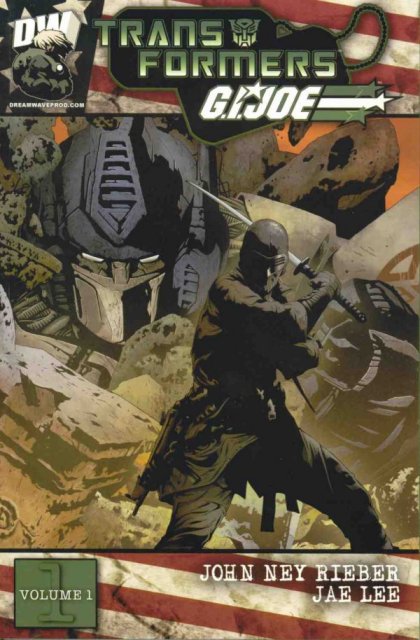
-
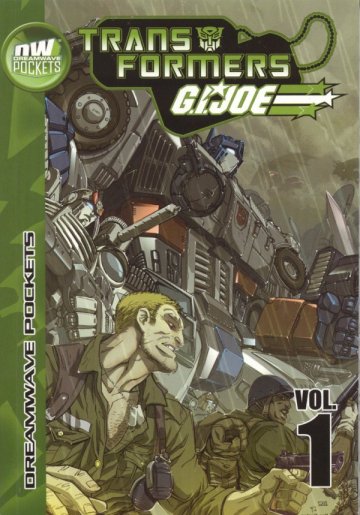
-
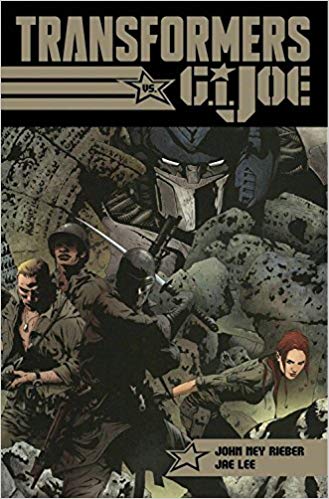 Tyrants Rise, Heroes Are Born; art by Jae Lee, Rob Armstrong and June Chung.
 -
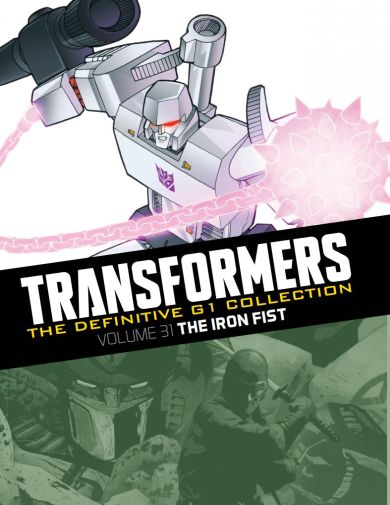 The Definitive G1 Collection Vol 31; Megatron art by Don Figueroa, retro art by Jae Lee and Rob Armstrong.


