Studio OX: Difference between revisions
Teletraan-X (talk | contribs) Teletraan-X Text Replacement Bom Bom => BomBom |
|||
| (36 intermediate revisions by 14 users not shown) | |||
| Line 1: | Line 1: | ||
[[Image: | [[Image:BotsConsObari.jpg|right|300px|thumb]] | ||
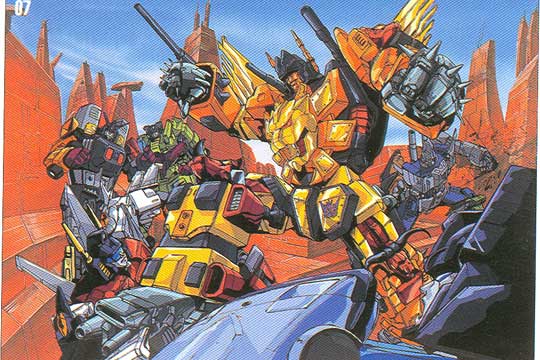
Founded by | Founded by [[Atsuhiko Sugita]] in 1985, '''Studio OX''' (スタジオ OX) was originally a freelance art studio that produced more "anime styled" ''Transformers'' art for ''[[TV Magazine]]'' and ''[[Comic BomBom]]'' throughout the early years of [[The Transformers (franchise)|Generation 1]] in Japan. In 1991 they became a company, providing production and conceptual artwork for various anime, primarily for reboots of older franchises, such as ''Cyborg 009: The Cyborg Soldier'', ''Tekkaman Blade'', and ''Getter Robo: Armageddon''. They also created some short OVA series like ''Idol Project'' and ''Wild Cardz''. Sugita left the studio in 2000, which was defunct in 2003. | ||
Their | Their ''Transformers'' character designs are notable for being far more detailed than [[Floro Dery]]'s models, as well as borrowing visual elements from Japanese mecha designs. Being an actual ''studio'' composed of numerous artists (most of whom went without individual credits, until the artwork was reprinted), the art direction of Studio OX's ''Transformers'' work was quite loose. Artists utilized their own unique styles, resulting in some pieces being very mechanically accurate, while others were more overtly stylized, in a manner popular for many mecha anime in the mid to late 80s. | ||
Studio OX's participation in the ''Transformers'' franchise was gradually phased out as the popularity of the series died down. By the time of ''[[Zone (franchise)|Zone]]'', nearly all [[story page]]s and magazine artwork was provided by [[Ban Magami]] with additional pieces of box artwork from [[Hidetsugu Yoshioka]] to round out the decreased page space. | Studio OX's participation in the ''Transformers'' franchise was gradually phased out as the popularity of the series died down. By the time of ''[[Transformers: Zone (franchise)|Zone]]'', nearly all [[story page]]s and magazine artwork was provided by [[Ban Magami]] with additional pieces of box artwork from [[Hidetsugu Yoshioka]] to round out the decreased page space. | ||
== | ==Artists== | ||
Although not all members of Studio OX were properly credited when their work originally appeared in magazines or reprints, most if not all did receive individual credits for the later art collections. Known contributors on the studio's ''Transformers'' work include: | |||
Although the | {{collist|2| | ||
*[[Shin Matsuo]] | |||
*[[Morifumi Naka]] | |||
*[[Tsuyoshi Nonaka]] | |||
*[[Masami Ōbari]] | |||
*[[Shinya Ohira]] | |||
*[[Akihide Saitō]] | |||
*[[Hirotoshi Sano]] | |||
*[[Atsuhiko Sugita]] | |||
*[[Asao Takahashi]] | |||
*[[Koichi Usami]] | |||
*[[Noritaka Suzuki]]<ref>Did not work on the ''Transformers'' brand until after the studio was closed.</ref> | |||
}} | |||
==Artwork collections== | ==Artwork collections== | ||
Several resource books have been printed in Japan collecting large portions of Studio OX artwork: | |||
*''[[Transformers Generations (guidebook)|Transformers Generations]]'' (Original and Deluxe printings) | |||
*''[[Transformers Visualworks]]'' | |||
==Gallery== | ==Gallery== | ||
<center><gallery> | <center><gallery> | ||
Image:DevastatorManga1.jpg|Devastatingly handsome. | Image:DevastatorManga1.jpg|Devastatingly handsome. | ||
Image:PredakingTVMag1.jpg| | Image:PredakingTVMag1.jpg| | ||
Image:Springerstudiooxcharactermodel.jpg|He never looked that good in the cartoon. | Image:Springerstudiooxcharactermodel.jpg|He never looked that good in the cartoon. | ||
Image:GestaltTrioTVMagazine.jpg| | Image:GestaltTrioTVMagazine.jpg| | ||
</gallery> | </gallery> | ||
''[[:Category:Images by Studio OX|Extended Studio OX gallery]]''</center> | |||
== | ==Footnotes== | ||
{{reflist}} | |||
*[http:// | ==External links== | ||
*{{w|スタジオOX|lang=ja|Studio OX at Wikipedia (Japanese)}} | |||
*[http://web.archive.org/web/20110217044000/http://www.allspark.com/content/view/8453/37/ Comic BomBom coverage at TFPulp] (archived, images defunct) | |||
[[Category:Companies]] | [[Category:Companies]] | ||
[[Category:Studio OX]] | |||
Latest revision as of 01:16, 25 January 2025

Founded by Atsuhiko Sugita in 1985, Studio OX (スタジオ OX) was originally a freelance art studio that produced more "anime styled" Transformers art for TV Magazine and Comic BomBom throughout the early years of Generation 1 in Japan. In 1991 they became a company, providing production and conceptual artwork for various anime, primarily for reboots of older franchises, such as Cyborg 009: The Cyborg Soldier, Tekkaman Blade, and Getter Robo: Armageddon. They also created some short OVA series like Idol Project and Wild Cardz. Sugita left the studio in 2000, which was defunct in 2003.
Their Transformers character designs are notable for being far more detailed than Floro Dery's models, as well as borrowing visual elements from Japanese mecha designs. Being an actual studio composed of numerous artists (most of whom went without individual credits, until the artwork was reprinted), the art direction of Studio OX's Transformers work was quite loose. Artists utilized their own unique styles, resulting in some pieces being very mechanically accurate, while others were more overtly stylized, in a manner popular for many mecha anime in the mid to late 80s.
Studio OX's participation in the Transformers franchise was gradually phased out as the popularity of the series died down. By the time of Zone, nearly all story pages and magazine artwork was provided by Ban Magami with additional pieces of box artwork from Hidetsugu Yoshioka to round out the decreased page space.
Artists
[edit]Although not all members of Studio OX were properly credited when their work originally appeared in magazines or reprints, most if not all did receive individual credits for the later art collections. Known contributors on the studio's Transformers work include:
Artwork collections
[edit]Several resource books have been printed in Japan collecting large portions of Studio OX artwork:
- Transformers Generations (Original and Deluxe printings)
- Transformers Visualworks
Gallery
[edit]-
 Devastatingly handsome.
 -
-
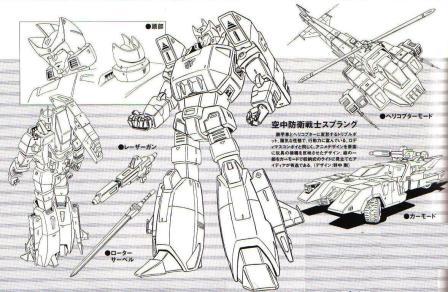 He never looked that good in the cartoon.
 -
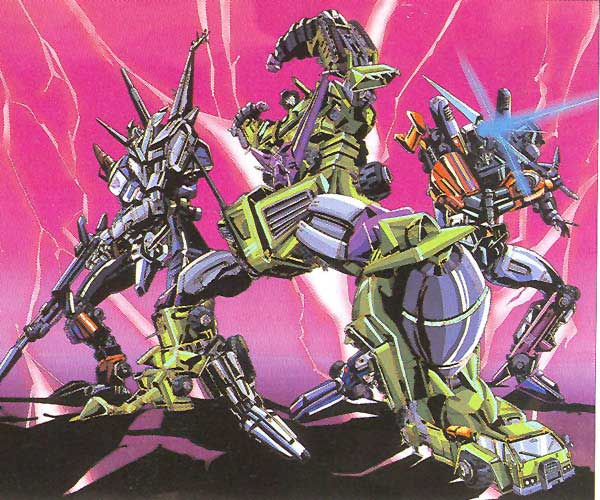


Footnotes
[edit]- ↑ Did not work on the Transformers brand until after the studio was closed.
External links
[edit]- Studio OX at Wikipedia (Japanese)
- Comic BomBom coverage at TFPulp (archived, images defunct)


