Holomatter: Difference between revisions
Near total re-write. Much of it was subtley incorrect or overly speculative. |
|||
| Line 1: | Line 1: | ||
:''Holomatter is a technology in the [[IDW Publishing|IDW]] portion of the [[Generation 1]] [[continuity family]].''' | :''Holomatter is a technology in the [[IDW Publishing|IDW]] portion of the [[Generation 1]] [[continuity family]].''' | ||
'''Holomatter''' is used by [[ | '''Holomatter''' is a solid-light projection technology, used by [[Autobot]]s operating on alien worlds. Holomatter projectors can create projected facsimiles of native species which are too small or [[human|fleshy]] for the Autobots to mimic with their mechanical [[altmode]]s. | ||
The | The holomatter avatar isn't just a friendly image to fool human beings; it's also the Autobot equivalent of a remotely operated vehicle, allowing Autobots to go places and perform actions that would otherwise be prevented by their size and the need to camouflage their true identities. Having an avatar in a location is like the Autobot being there himself. An avatar can function a considerable distance away from the controlling Autobot, even when separated by solid walls. The avatar can operate both outside the Autobot and within, acting as a vehicle mode "driver" for disguise purposes. | ||
Holomatter avatars are as solid as a real object and capable of full interaction with the real world. Although the actual strength of a holomatter avatar is yet to be established, Ratchet's handling of the [[SM-40]] in ''Infiltration'' Issue 3 indicates that they can carry and manipulate small objects with ease. | |||
[[Ratchet_(G1)#IDW_Comics_continuity|Ratchet]] mentions "holomatter generators".<ref>[[Infiltration (issue 2)]]</ref>, which all Autobots are presumably outfitted with. These devices are small enough to fit unobtrusively within a standard Transformer and, aside from the fake driver they project, give off no visual or auditory emissions. | |||
== Overload jolt == | == Overload jolt == | ||
In emergencies, a holomatter avatar can be used to deliver a massive electrical surge at very close range. This surge is powerful enough to momentarily disrupt the systems of a single [[Transformers|Transformer]], enough to cause disorientation and possibly unconsciousness | In emergencies, a holomatter avatar can be used to deliver a massive electrical surge at very close range. This surge is powerful enough to momentarily disrupt the systems of a single [[Transformers|Transformer]], enough to cause disorientation and possibly unconsciousness. The cost of this surge is the holomatter generators themselves; whether an [[Autobot]]'s internal systems will repair the damage given time <ref>[[Infiltration (issue 1)]]</ref> or whether repair facilities are required is unknown; both the general pacing of the ''Infiltration'' series and the absence of any "repair" scenes in the comics suggest the former. | ||
== Limitations and weaknesses == | == Limitations and weaknesses == | ||
Holomatter disguises are limited by their programmer's understanding of the lifeform they mimic. During their early time on Earth, the holomatter avatars of the Autobots wore a "creepy-fixed-smile"<ref>[[Infiltration (issue 1)]]</ref>; although Ratchet's avatar's upper face expressed worry, fear and resignation (and its eyes closed) during the Autobots' initial interactions with Hunter, Jimmy and Verity, its smile never disappeared. This lack of understanding may account for why otherwise "male" Autobots (for example, Bumblebee and Sunstreaker) have female avatars. It is not known if the Autobots can alter their voices to suit the gender of their avatar. After Optimus Prime arrived on Earth, Hunter gave the Autobots a "crash course in Earth culture"; Jazz noted that the Autobots never realized that humans found the smiles of their avatars disturbing. After this, the Autobots' holomatter avatars became much more expressive. | |||
Much like Pretender shells before them, holomatter avatars carry a strong connection to the consciousness of its generating Autobot. Damage to the avatar can cause severe impairment to the controlling Autobot if their consciousness is not withdrawn in time. <ref>[[Spotlight: Ultra Magnus]]</ref> | |||
Holomatter can be detected by devices called "holomatter readers", which [[Machination|The Machination]] appears to possess.<ref>[[Escalation, Part 4]]</ref> | Holomatter can be detected by devices called "holomatter readers", which [[Machination|The Machination]] appears to possess.<ref>[[Escalation, Part 4]]</ref> | ||
Revision as of 04:35, 13 November 2007
- Holomatter is a technology in the IDW portion of the Generation 1 continuity family.'
Holomatter is a solid-light projection technology, used by Autobots operating on alien worlds. Holomatter projectors can create projected facsimiles of native species which are too small or fleshy for the Autobots to mimic with their mechanical altmodes.
The holomatter avatar isn't just a friendly image to fool human beings; it's also the Autobot equivalent of a remotely operated vehicle, allowing Autobots to go places and perform actions that would otherwise be prevented by their size and the need to camouflage their true identities. Having an avatar in a location is like the Autobot being there himself. An avatar can function a considerable distance away from the controlling Autobot, even when separated by solid walls. The avatar can operate both outside the Autobot and within, acting as a vehicle mode "driver" for disguise purposes.
Holomatter avatars are as solid as a real object and capable of full interaction with the real world. Although the actual strength of a holomatter avatar is yet to be established, Ratchet's handling of the SM-40 in Infiltration Issue 3 indicates that they can carry and manipulate small objects with ease.
Ratchet mentions "holomatter generators".[1], which all Autobots are presumably outfitted with. These devices are small enough to fit unobtrusively within a standard Transformer and, aside from the fake driver they project, give off no visual or auditory emissions.
Overload jolt
In emergencies, a holomatter avatar can be used to deliver a massive electrical surge at very close range. This surge is powerful enough to momentarily disrupt the systems of a single Transformer, enough to cause disorientation and possibly unconsciousness. The cost of this surge is the holomatter generators themselves; whether an Autobot's internal systems will repair the damage given time [2] or whether repair facilities are required is unknown; both the general pacing of the Infiltration series and the absence of any "repair" scenes in the comics suggest the former.
Limitations and weaknesses
Holomatter disguises are limited by their programmer's understanding of the lifeform they mimic. During their early time on Earth, the holomatter avatars of the Autobots wore a "creepy-fixed-smile"[3]; although Ratchet's avatar's upper face expressed worry, fear and resignation (and its eyes closed) during the Autobots' initial interactions with Hunter, Jimmy and Verity, its smile never disappeared. This lack of understanding may account for why otherwise "male" Autobots (for example, Bumblebee and Sunstreaker) have female avatars. It is not known if the Autobots can alter their voices to suit the gender of their avatar. After Optimus Prime arrived on Earth, Hunter gave the Autobots a "crash course in Earth culture"; Jazz noted that the Autobots never realized that humans found the smiles of their avatars disturbing. After this, the Autobots' holomatter avatars became much more expressive.
Much like Pretender shells before them, holomatter avatars carry a strong connection to the consciousness of its generating Autobot. Damage to the avatar can cause severe impairment to the controlling Autobot if their consciousness is not withdrawn in time. [4]
Holomatter can be detected by devices called "holomatter readers", which The Machination appears to possess.[5]
Known Avatars
- Bumblebee - Brunette and smokin' white female in pink camisole.
- Hot Rod - "Cool yuppie" white male with brown hair in a ponytail and sunglasses.
- Ironhide - Older "military brass-type" white male with silver hair and mustache in a gray suit.
- Jazz - Young black male in a black suit.
- Ratchet - Blond middle-aged, sightly hefty white male. Wears EMT uniform (without jacket).
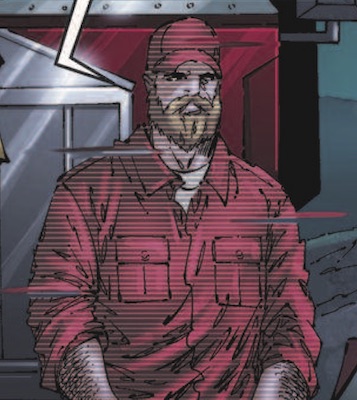
- Optimus Prime - Bearded trucker, well built, with white or blue shirt and baseball cap.
- Prowl - "Federal agent"-type: Red hair, receding hairline, middle-aged white male with dark sunglasses and a gray suit.
- Sunstreaker - Blonde female.
- Ultra Magnus - Nebulan scientist & security guard (he switches avatars during the story).
- Wheeljack - Balding "mad scientist"-type older white male with white hair, glasses, goatee.
-
Bumblebee
-
Ironhide
-
Jazz
-
 Optimus Prime
 -
Prowl
-
 Ratchet
 -
Sunstreaker
-
Wheeljack


