Instructions: Difference between revisions
New page: {{picsneeded}} All but the smallest Transformers toys come with an '''instruction booklet''' telling the consumer exactly how to convert their newly purchased plastic robot from o... |
mNo edit summary |
||
| (107 intermediate revisions by 40 users not shown) | |||
| Line 1: | Line 1: | ||
[[File:Bumblebee-instructions.jpg|upright=1.95|thumb|Basically, you make him do yoga.]] | |||
All Transformers [[toy]]s that can be <s>[[trademark|transformed]]</s> [[transformation (toys)|converted]] between [[alternate mode|different modes]] come with '''instructions'''. Usually, those are included in the form of a sheet of paper (once called "instruction booklet"); however, some smaller toys have them printed on the back of their packaging instead (usually only for toys that come packaged on blister cards). | |||
Instructions always give visual directions for how to convert the toy between its different modes and, if applicable, how to use its [[gimmick]]s and action features, either in the form of photos of the toy itself (or a [[prototype]]) or simplified line artwork. Additional text explanations were common in the [[The Transformers (toyline)|early days]] of the [[Transformers brand|brand]], but have since been dropped at least as far as [[Hasbro]]'s market is concerned. | |||
If the toy includes loose accessories, the instructions will also depict the entire content of the package. | |||
==Generation 1== | ==US ''Transformers'' instructions through the years== | ||
[[ | ===Generation 1=== | ||
[[File:Overbite-instructions.jpg|left|upright=1.4|thumb|Oh sure, he's a giant metal shark with arms and legs, but he's not an ''attack monster'' till you stick some guns on him.]] | |||
All toys from [[Hasbro]]'s 1984 ''[[The Transformers (toyline)|Generation 1]]'' line-up used full-color photos of the toys themselves to illustrate their instructions, with little arrows pointing out the required parts movements for the individual transformation steps. The toys used were actually either [[prototype]]s or recycled ''[[Diaclone]]'' or ''[[Micro Change]]'' production toys. This is most evident in the case of [[Bluestreak (G1)/toys|Bluestreak]], whose instructions depict him in the infamous blue and silver ''Diaclone'' color scheme, whereas the actual ''Transformers'' toy is entirely silver and sports a different deco. | |||
The | The [[Mini Vehicle|Mini-Cars/Mini-Vehicles]] and the [[Mini-Cassette]] two-packs featured instructions printed on the back of their blister cards, as did smaller toys from later years that also came packaged on cards. All the toys that came packaged in boxes, meanwhile, featured their instructions printed on a sheet of paper, officially called an "Instruction Booklet" (a name that was dropped after 1989), which was included inside the packaging. The sheets originally came in a format slightly larger than a playing card and could be folded out horizontally, printed on both sides. The instruction sheet for larger toys additionally also had to be folded out vertically. Carded [[combiner]] team members also came with additional instruction sheets, printed on a small, heavily folded sheet of paper, which showed how to convert all of them into their combined mode. Boxed team members simply had the same line art for the gestalt assembly printed on the back of their instruction sheets. Combiner giftsets had all instructions on one single sheet. | ||
[[File:G1BluestreakInstructionsSample.jpg|upright=1.66|thumb|Oh boy. What did ''[[Bluestreak (G1)/toys|this]]'' [[Misconceptions and urban legends about Transformers|start]].]]Starting in 1985, all new toys stopped using photos for their instructions, now using black and white line art depictions of the toys instead, with two-tone color shading to clarify which part was to be moved. Typically, Autobot toys featured gray and red highlights, whereas Decepticons were color-coded gray and purple. In subsequent years, the shading was limited to a single color, and the overall was reduced to the most necessary minimum. [[Micromaster]] Patrol four-packs also introduced alternate colors for highlighted parts that weren't directly faction-related. The [[Micromaster Combiner]] Squads and the [[Action Master]] single packs from 1990 even omitted highlight colors entirely, only featuring only black and white line art with red arrows indicating movement. | |||
[[ | All the Generation 1 toys included a verbal description of the action to be taken ("Grasp rear section of [[Blades (G1)|helicopter]] and extend back"), in addition to the visual illustration. With weapons in place and arms swung forward, the instructions would note in congratulatory fashion that "Blades is now ready to battle the evil Decepticons!" | ||
Generation 1 instruction booklets featured a "main" image of the character on their outermost fold as some kind of "cover" art. In 1984, this was a recycled version of the toy's [[package art]]; starting in 1985, the "cover" image also changed to line art, but the nature of this art would vary widely: Sometimes it was a simplified line art reproduction of the package art, or a slight variation thereof; other times, it was a straightforward line drawing of the toy; and in other cases, it was a unique composition, showing an articulated interpretation of the toy, or occasionally a different design altogether. These variations appeared with little regard to toy assortment or sub-line. For example, [[Snapdragon (G1)|Snapdragon]]'s instructions feature line art of his toy, while his [[case]]-mate, fellow [[Horrorcon]] [[Apeface]], has a line version of his box art. | |||
{{-}} | |||
<center><gallery> | |||
File:Instructionart-optimusprimeg1.jpg|1984 instructions featured the toy's [[package art]]. | |||
File:Instructionart-tracks.jpg|1985 instructions featured line art based on the package art. [[Tracks (G1)|Tracks]] is in a slightly different pose than his final box art. | |||
File:Instructionart-hotspot.jpg|Much of 1986 had straighforward line drawings of the toys. | |||
File:Instructionart-clones.jpg|1987 was marked by line drawings of the toys, but in poses the toys themselves couldn't achieve. | |||
File:Instructionart-nightbeat.jpg|1988: [[Nightbeat (G1)|Nightbeat]] uses his head lasers for the first (and [[Cheap Shots|almost last]]) time ever. | |||
File:Instructionart-bombburst.jpg|1988: the Pretenders got a double cover panel. The first wave Pretenders had straight line art of the toys... | |||
File:Instructionart-splashdown.jpg|...while the second wave got more of a character interpretation, with posing and altered proportions. | |||
File:Instructionart-hothouse.jpg|1989: [[Hot House (Micromaster)|Hot House]] is so important that he isn't even in the art! | |||
</gallery></center> | |||
{{-}} | |||
===Generation 2=== | |||
''[[Transformers: Generation 2 (toyline)|Generation 2]]'' changed very little on the instruction booklet format. Toys that came on genuine blister cards still had their instructions printed on the back of their cards while boxed toys had their instructions printed on the usual separate sheet. Some larger toys, however, came in clam-shells with cardbacks which were unique to the ''Generation 2'' line. Like their boxed brethren, these toys also included separate instruction sheets. | |||
The instructions themselves continued to use line drawings with additional written instructions, and the established wide variety of different-natured line drawings for their "cover" images. The ''quality'' of the cover art, however, took a sudden nosedive as the line neared its end. | |||
<center><gallery> | |||
File:Instructionart-optimusprimeg2.jpg|1994: Laser Optimus Prime has tidy art based on his toy... | |||
File:Instructionart-megatrong2combat.jpg|...while Combat Megatron has a character interpretation. | |||
File:Instructionart-hooligan.jpg|1995: Hooligan's art is not only terrible, but he's not even transformed correctly. | |||
</gallery></center> | |||
===Beast era=== | |||
[[File:Magmatron-instructions.jpg|upright=0.85|thumb|Yeeeeeeeah. Good luck figuring this one out, kids.]] | |||
''[[Beast Wars: Transformers (toyline)|Beast Wars]]'' continued to use line drawings of the toys with two-tone shading. Unlike in previous lines, the line art was often simplistic and somewhat crude, making it hard to follow at times—particularly as the toys became more and more intricate. The same applied to the "cover" images, which now depicted both the robot and [[alternate mode]]s, with the [[robot mode]]s usually depicted in poses that were actually possible with the toys, due to improved articulation. | |||
''Beast Wars'' introduced uniform [[size class]]es that are, by and large, still used today. The Basic and Deluxe figures, which came packaged on blister cards, once again featured their instructions printed on their cardbacks. Boxed toys (Mega and larger) came with the usual separate instruction sheet. | |||
'' | |||
Early ''[[Beast Machines: Transformers (toyline)|Beast Machines]]'' toys also used toy line art, at about the same level of quality and detail as ''Beast Wars''. With the 2001 lineup, however, Hasbro suddenly returned to photographic illustrations of the toys, now depicting photos of gray [[prototype]]s and the important parts for each transformation step highlighted in red (which was added in post-production). The [[Dinobot (BM)|Dinobots]] were an exception to this, as they still used line art for their instructions. | |||
'' | The ''[[Machine Wars: Transformers|Machine Wars]]'' toys ''all'' had their instructions printed on the back of their packaging, even larger toys such as Optimus Prime, [[Starscream (G1)/toys|Starscream]] or [[Soundwave (G1)/toys|Soundwave]] that came packaged in boxes. | ||
{{-}} | |||
==Transformers Universe | ===Robots in Disguise and Unicron Trilogy=== | ||
[[File:Scavenger-instructions.jpg|left|upright=1.1|thumb|STOMP/FRAPPEZ/ESTAMPILLA]] | |||
Toy instructions from the [[Transformers: Robots in Disguise (2001 toyline)|2001 ''Robots in Disguise'']] returned to using line art, but recycled the line art from Takara's Car Robots instructions, which featured a much greater level of accuracy and detail than the Beast Era line instructions, with highlighted parts in various shades of red or purple. The "cover" images also switched to more accurate line drawings. ''[[Transformers: Armada (toyline)|Armada]]'', ''[[Transformers: Energon (toyline)|Energon]]'' and ''[[Transformers: Cybertron (toyline)|Cybertron]]'', as well as the first ''[[Transformers: Universe (2003 toyline)|Universe]]'' line, ''[[Transformers: Alternators|Alternators]]'' and ''[[Transformers: Classics|Classics]]'', continued in the same fashion (though ironically, the toys initially became much simpler to transform with ''Armada''). With the corresponding proliferation of electronics during the ''Armada'' franchise, much of the instruction sheet was taken up by warnings and legal declarations regarding the batteries. | |||
With ''Robots in Disguise'', Hasbro also started to use [[multilingual packaging|trilingual packaging]] (English/French/Spanish) across the North American market, which extended to the packaging. Pressed for space, Hasbro abandoned the practice of printing instructions on the back of blister cards altogether, and even smaller carded toys like the simplistic [[Spychanger]]s and ''Armada'' [[Mini-Con]] three-packs now had their own instruction sheets inside their blister bubbles. It wasn't until the introduction of the [[Legends Class (2005)|Legends Class]] during ''Cybertron'' that instructions would be printed on the back of the packaging again, and even then only for single-packed Legends figures. | |||
==Movie== | As a result of the now trilingual instructions, the amount of written instructions was vastly reduced, now mostly limited to headers such as "change to robot" and small number of verbal descriptions for "key" steps, instead relying mostly on the images to provide the information. ''Cybertron'' finally saw a return to English-only instructions for the United States market, which also applied to the remainder of ''Universe'', new ''Alternators'' toys and ''Classics'', but additional written instructions never made a comeback. | ||
The Movie franchise toys continued to use one-sided sheets with detailed line art, but | |||
The format of the instruction sheets also changed with ''Robots in Disguise'', as the vertical fold no longer matched the instructions' horizontal rows, and many instructions had to be folded out primarily downwards rather than sideways. With the ''Alternators'' line, Hasbro started to print the instructions entirely on one side of the sheet, leaving the other side blank. With the launch of the ''Cybertron'' line, Hasbro also started to apply that format to their other ''Transformers'' lines, which also affected later toys from the original ''Universe'' line. The ''Cybertron'' Mini-Con two-packs were an unusual exception in that they still featured double-sided instructions. Larger toys (Ultra, Leader and Supreme Class figures), however, still continued to use double-sided instruction sheets. | |||
===Movie and beyond=== | |||
[[File:MovieBlackoutInstructionsCover.jpg|upright=0.85|thumb|[[Blackout (Movie)|Blackout]] is now ready to slaughter the heroic US military!]] | |||
The Movie franchise toys continued to use one-sided sheets with detailed line art, but replaced the line art "cover" images with gray-scaled [[stock photography|stock photos]] of airbrushed toy prototypes. This remained unchanged for ''[[Transformers Animated (toyline)|Animated]]'', the second ''[[Transformers: Universe (2008 toyline)|Universe]]'' line and ''[[Transformers: Revenge of the Fallen (toyline)|Revenge of the Fallen]]'', with only the background image the stock photos were super-imposed over changing with each line. US editions are in English only, but still without verbal instructions. | |||
Instructions for smaller toys still largely continue to be printed entirely on one side of the sheet, leaving the other side blank. Larger toys such as Ultra, Leader and Supreme Class figures or ''[[Transformers (2007 toyline)|Movie]]'' [[Bumblebee (Movie)/toys|Ultimate Bumblebee]], meanwhile, usually still have double-sided instructions. There's no cut-and-dry rule, however—[[Human Alliance]] Bumblebee from the ''[[Transformers: Revenge of the Fallen (toyline)|Revenge of the Fallen]]'' comes with double-sided instructions, while Human Alliance [[Sideswipe (Movie)|Sideswipe]] from the same assortment features a one-sided instruction sheet. With the [[Transformers (2010 toyline)|2010 ''Transformers'' line]], two-sides instructions have become a new standard, with the flip side now depicting the reverse transformation, rather than relying on a note such as "Reverse order of instructions to convert back into robot". | |||
With the launch of the ''[[Transformers: Dark of the Moon (toyline)|Dark of the Moon]]'' toy line, the instructions would see a change yet again. Instructions now feature grayscale unpainted prototypes (like later Beast Machines instructions), with the transformation steps highlighted in either red (Autobot) or purple (Decepticon). Most, if not all, instructions are double-sided and cover both going from the mode the toy is packaged in, and back again. Hasbro also began uploading video instructions on YouTube. Beginning with the [[Transformers: Robots in Disguise (2015 toyline)|''Robots in Disguise'' line]] and the [[Transformers: Generations#Combiner Wars|''Combiner Wars'' portion of the ''Generations'' line]], the instructions now use CAD renders of the toys. ''Robots in Disguise''{{'}}s Warrior-class toys, curiously, eschewed instruction sheets in favour of printing the instructions on the back of the card, while Crash Combiners (with far simpler transformations) have printed booklets. ''[[Titans Return (toyline)|Titans Return]]'' returned to using 3D CAD models as its predecessor did. ''[[Transformers: The Last Knight (toyline)|The Last Knight]]'' continued the trend. | |||
{{-}} | |||
==International instructions== | |||
===Japan (Takara/TakaraTomy)=== | |||
[[File:BinaltechHoundInstructions.jpg|thumb|110px|left|So much negativity for something so helpful!]] | |||
[[TakaraTomy|Takara's]] early ''[[Fight! Super Robot Lifeform Transformers (toyline)|Fight! Super Robot Lifeform Transformers]]'' toys used gray-scaled versions of the photos from Hasbro's corresponding ''[[The Transformers (toyline)|Generation 1]]'' instructions where available, and the same line artwork as found in Hasbro's instructions for the rest where available. Takara-only toys featured line artwork following the same style for their instructions. An unusual case was [[Megatron (G1)/toys|Megatron]], who used toy photos in ''addition'' to the mainly line-art-only instructions. | |||
For their ''[[Transformers: Generation 2 (toyline)|Generation 2]]'' instructions, Takara used gray-scaled photos of the actual toys, but returned to line art for their ''[[Beast Wars: Transformers (toyline)|Beast Wars]]'' instructions. Though the line art featured about the same crude ''quality'' as Hasbro's instructions, the line art wasn't actually the same. Some ''[[Beast Wars: Transformers (toyline)|Beast Wars Metals]]'' toys such as [[Ravage (G1)/toys|Jaguar]] used color photos of the toys (or colored [[prototype]]s) for their instructions. | |||
With ''[[Transformers: Robots in Disguise (2001 toyline)|Car Robots]]'', Takara returned to line drawings, but of a much higher detail and better quality than their ''Beast Wars'' instructions. Those same line drawings were later used by Hasbro for their ''Robots in Disguise'' port of the toys. For ''[[Transformers: Cybertron (toyline)|Galaxy Force]]'' instructions, Takara used photos of gray prototypes, highlighting the important parts for each transformation step in red, similar to Hasbro's later ''[[Beast Machines: Transformers (toyline)|Beast Machines]]'' instructions. | |||
[[File:ROTFBludgeon japanese instructions.jpg|thumb|upright=1.66|''Revenge of the Fallen'' Bludgeon's instructions showing verbal descriptions of the steps, even specifying his blades as a {{w|katana}} and a {{w|tantou}}.]] | |||
For their ''[[Transformers: Alternators|Binaltech]]'' line, Takara used actual stapled instruction booklets, where one had to flip through the individual pages. The instructions used negative line art with white lines on black backgrounds, with no highlight colors whatsoever. In addition, the line art was different (if not to say better and more clear and helpful) than that used for Hasbro's instructions for their Alternators versions of those same toys. In addition to the actual instructions themselves, those booklets also contained a small gallery of the toy with highlights and text descriptions of various features, a fictional "system description" of the Transformers character, a text-only chapter of [[Hirofumi Ichikawa]]'s "Binaltech Story" and technical details of the [[licensed vehicle alternate modes|real-life]] [[alternate mode|vehicle mode]]. | |||
Unlike Hasbro's instructions, Takara's instructions have never stopped using additional verbal descriptions of the individual transformation steps. | |||
{{-}} | |||
===International Hasbro instructions=== | |||
[[File:EuropeanROTFDuneRunnerInstructions.jpg|thumb|upright=1.95|(GB) Typical European instructions. (F) Des instructions Européenes typiques. (D) Eine typische europäische Anleitung. (E) Instrucciones europeas típicas. (P) Instruções tipícas europeias. (I) Tipiche istruzioni europee. (NL) Een typisch Europese handleiding. (S) Typiska europeiska instruktioner. (DK) Typisk europæiske instruktioner. (N) Typisk Europeiske instruksjoner. (FIN) Tyypillisiä eurooppalaisia ohjeita. (GR) Τυπικές Ευρωπαϊκες οδηγίες. (PL) Typowa europejska instrukcja. (H) Egy tipikus európai utasitás. (TR) Genel Avrupa Açıklaması. (CZ) Typický evropský návod. (SK) Typický európsky návod.]] | |||
Canadian and European ''[[The Transformers (toyline)|Generation 1]]'' were, for the most part, unchanged from their United States counterparts. However, Canadian instructions featured text descriptions in both English and French, which resulted in somewhat cluttered spaces. Toys released by Hasbro in Europe, meanwhile, featured a drastically reduced amount of verbal instructions depending on how many different languages the instructions had to cover—the more alternate languages in the same instructions, the less text the instructions featured. | |||
The "[[Classics (Europe)|Classics]]" re-issues of older toys released by Hasbro in Europe in 1990 and 1991 reused the original toys' instructions with minimal changes, including photographic illustrations for the toys originally released in 1984. | |||
With [[Transformers: Robots in Disguise (2001 toyline)|2001 ''Robots in Disguise'']], Hasbro used the same trilingual (English/French/Spanish) instructions for the Canadian, Mexican and United States market, with minimal text instructions. After Hasbro returned to English-only instructions for the US market, Canada and Mexico continued to get trilingual instructions, but like their US counterparts, they still lacked text descriptions. The same applies to European instructions, which haven't featured verbal instructions ever since the days of the European-exclusive tail-end Generation 1 toys, and have added more and more languages with subsequent lines (see "[[multilingual packaging]]" for more on this), which results in headers such as "Change to robot" cluttering a lot of space, while the individual instruction steps remain entirely text-less. | |||
{{-}} | |||
==Undocumented features== | |||
In some cases, instructions completely neglect to inform the owner of a toy about some of its features. This is different from actual ''problems'' with the instructions (see below), as this does not affect the functionality of the toy or make it harder to transform; knowledge of these features simply adds extra play value to the toy. In either case, the feature was clearly designed on purpose, and isn't simply a freak coincidence (such as various toys' standardized [[5 mm post|5 millimeter pegs]] being the same size as [[Mini-Con]] ports, and thus allowing for Mini-Cons to be attached to them). | |||
Sometimes this may be a partially abandoned [[gimmick]], or sometimes it can be minor elements of the transformation, such as the flip-out spikes or claws on ''[[Transformers (2007 toyline)|Movie]]'' Deluxe Class [[Barricade (Movie)/toys#Deluxe Class|Barricade]] and Leader Class [[Brawl (Movie)#Leader Class|Brawl's]] feet. Sometimes it can also be an additional possible configuration, such as [[Nightstick (G1)|Nightstick]] from ''[[Transformers: Universe (2008 toyline)|Universe]]'' [[Cyclonus (G1)/toys#Universe (2008)|Cyclonus]] being able to be attached to Cyclonus's wrist (with the hand not flipped out) in gun mode. | |||
Sometimes it can also be the compatibility of the toy with one or more separately available toys. For example, instructions for the "Dollar store" [[exclusive]] [[rebranding|rebranded]] re-releases of various ''[[Transformers: Energon (toyline)|Energon]]'' [[combiner]] components in ''[[Transformers: Universe (2003 toyline)|Universe]]'' packaging made no mention of their combining ability, unlike their previous ''Energon'' releases. This might be because not all components were re-released in ''Universe'' packaging, and not all of them in the same [[wave]]. Similarly, the abandoned combined mode for ''[[Transformers: Revenge of the Fallen (toyline)|Revenge of the Fallen]]'' [[Arcee (Movie)#Revenge of the Fallen|Arcee]], [[Chromia (ROTF)|Chromia]] and [[Elita-One (Movie)|Elita-1]] was not mentioned in any of the toys' instructions (Hasbro promised to publish these instructions online, but ultimately never followed suit). More oddly, the ''Revenge of the Fallen'' [[Legends Class (2005)|Legends Class]] [[Optimus Prime (Movie)/toys#Legends Class 2|Optimus Prime]] and [[Jetfire (Movie)#Legends Class|Jetfire's]] ability to combine was not acknowledged anywhere in their individual releases' instructions. | |||
Sometimes these omissions are glaringly bizarre: For example, the instructions for [[Transformers (2010 toyline)|2010 ''Transformers'']] Scout Class [[Breacher (TF 2010)|Breacher]] completely neglect to mention the fact that his [[weapon]] can be detached from the roof mount/back of the robot and attached to the side of either hand using a [[C joint|C-clip]]—''even though the weapon is shown attached to one of his hands in the official [[stock photography]] on the back of the toy's packaging!'' | |||
==Problems with modern-day instructions== | |||
[[File:MovStarscreamInstructionsWeird.jpg|thumb|left|upright=1.4|I'm supposed to do ''what'' exactly?]]As the toys became more complex, Hasbro's instructions became less and less helpful. In some cases, they are unclear on vital steps or even skip steps entirely. For example, when ''[[Transformers (2007 toyline)|Movie]]'' Voyager Class [[Starscream (Movie)/toys|Starscream's]] instructions try to show how to flip out the legs, the important steps occur on the ''opposite'' side of the body as opposed to the one the reader is looking at. Meanwhile, ''[[Transformers: Universe (2008 toyline)|Universe]]'' [[Prowl (G1)/toys|Prowl's]] instructions fail to point out that his feet can be pulled out in addition to being flipped out, despite showing them in their extracted state in the following step. | |||
Furthermore, in some cases the line art is based on early [[prototype]]s and depicts steps that aren't ''possible'' with the final toys, as some transformation steps, joints and features still present on the prototypes have been [[design change|gutted]] for budget reasons. For example, ''[[Transformers: Revenge of the Fallen (toyline)|Revenge of the Fallen]]'' Voyager Class Starscream's instructions refer to an additional joint inside the hand's palms that allows to fold them up in jet mode, and depict the forearm cannons in a position where they are moved forward when illustrating the push-button missile firing [[gimmick]], even though the actual toy's hands are cast in one piece, and the cannons are sculpted in place on the actual toy. | |||
[[File:UniSideswipeWrongRobotMode.jpg|thumb|upright=1.4|Seriously, Hasbro?]]In the case of [[retool]]s, Hasbro often fail to properly address the changes in the line artwork used for the instructions for those toys. For example, the instructions for ''[[Transformers: Alternators|Alternators]]'' retools such as [[Dead End (G1)|Dead End]], [[Swindle (G1)|Swindle]], [[Ravage (G1)/toys|Battle Ravage]] or [[Wheeljack (G1)/toys|Wheeljack]] reflect the changes in vehicle mode, but incorrectly still depict the original toys' head sculpts. An even worse example is ''[[Transformers: Universe (2008 toyline)|Universe]]'' [[Sideswipe (G1)/toys|Sideswipe]], a retool of ''Universe'' [[Sunstreaker (G1)/toys|Sunstreaker]], who not only sports a different head sculpt, but also uses a slightly ''different [[transformation scheme]]'', with the upper torso rotated by 180 degrees as compared to Sunstreaker. ''Neither difference is reflected in the instructions' line art'', which is simply recycled from Sunstreaker's instructions. | |||
''Revenge of the Fallen'' Leader Class [[Optimus Prime (Movie)/toys|Optimus Prime's]] instructions are infamous in the ''Transformers'' [[fandom]] for being vague and unclear, leaving out some steps in an attempt to economically use the space available on the instruction sheet. Evidently, the instructions were considered so poor that when [[TakaraTomy]] released their Buster Optimus Prime retool of this toy, they included supplementary photograph steps that were left out in the original instructions. Even worse is [[Transformers (2010 toyline)|2010 ''Transformers'']] Voyager Class Battle Blades Optimus Prime: The instructions show a way of concealing his head that ends up wedging it in place almost permanently inside his chest... ''unless'' one were to find and use the concealed hinge at the base of Prime's back (the roof of the sleeper) that the instructions make no mention of, despite it greatly simplifying the transformation. The instructions clearly show the hinge and yet ignore it completely—in fact, going strictly by the instructions and not making use of the hinge makes several steps of the transformation ''impossible'' due to parts getting into each other's way; or worse yet, they could clip through each other to get in place, thus ''damaging the toy''. In addition to that, the instructions fail to mention several other design elements that tremendously increase the ease of the transformation.<ref name="hftdprime">[http://www.allspark.com/forums/index.php?showtopic=73197 Allspark thread about the bad instructions of 2010 ''Transformers'' Voyager Class Battle Blades Optimus Prime.]</ref> | |||
Sometimes instructions are also just ''weird'' and seemingly random: ''Revenge of the Fallen'' [[Human Alliance]] [[Bumblebee (Movie)/toys|Bumblebee's]] instructions don't suggest rotating and unfolding the kneepads until the step that shows how to stand [[Sam Witwicky|Sam]] in Bumblebee's back so he can handle the shoulder launcher, as if Bumblebee was only supposed to have "proper" knees when Sam is riding in his back. Some of Hasbro's [[stock photography|stock photos]] also depict the incompletely transformed kneepads as part of the "proper" robot mode; then again, the photographer might have actually used the instructions as a reference. Also, the stock photos depicted on top of the instruction sheet itself show the knees folded out; but then again, Sam is riding in Bumblebee's back in those photos. | |||
Hasbro have recently addressed the increased difficulty with modern-day toys as well as the resulting problems for the instructions. A change in the instruction format was promised for 2010 which would supposedly address these problems.<ref name="tflqa">[http://www.transformerland.com/forum/viewtopic.php?t=3789 December 2009 Hasbro Q&A at Transformerland.com]</ref> Ultimately, this was (partly) reflected in the instructions of various ''Dark of the Moon'' toys, replacing the line-art of previous lines with photos of gray-scale prototypes, as well as illustrating the subtler portions of the transformations with alternate angles, highlighting certain elements like pegs and their respective peg-holes to show where they connect, and even the rare verbal instruction. Also, as mentioned before, most instructions are now double-sided, with Hasbro uploading video instructions online as well. | |||
{{-}} | |||
==Notes== | |||
[[File:GreekInstructionsCatapultRobot.jpg|thumb|upright=1.4|Changes from car to Greek catapult and back again!]] | |||
[[File:EBlurr.jpg|thumb|upright=1.4]] | |||
*With the second [[wave]] of the 2008 ''[[Transformers: Universe (2008 toyline)|Universe]]'' line, Hasbro changed multi-language text headers such as "Change to robot" in their European instructions from mixed case to upper case. Somehow, however, a weird error sneaked its way in: The Greek version of "Change to robot", previously correctly rendered as "Αλλαγή σε Ρομποτ" in mixed case, was changed to "ΑΛΛΑΓΗ ΣΕ ΚΑΤΑΠΕΛΤΗ" in uppercase... which translates as "Change to catapult". | |||
*Despite being usually grammatically correct in most instances, the wording isn't always the best: The German version of [[Ravage (G1)/toys|Ravage's]] instructions from ''Universe'' [[Hound (G1)|Hound]] translates the word "Beast" (a call-out to the ''[[Beast Wars: Transformers (franchise)|Beast Wars]]'' and their "[[beast mode]]s") as "Monster", rather than the more appropriate "Tier" ("animal"). Worse, the Slovakian version of "Changing to vehicle", "Zmena na automobil", uses "automobil" as a standard translation for "vehicle", including tank (''[[Transformers (2007 toyline)|Movie]]'' [[Brawl (Movie)|Brawl]]) and helicopter (''Movie'' [[Blackout (Movie)|Blackout]]) [[alternate mode]]s, even though the Slovakian word "automobil" specifically refers to cars. Likewise, "Tvar automobilu" translates as "shape of car", not "vehicle mode". | |||
*Instruction sheets will sometimes show unused or alternate head designs for toys. One of the earlier examples of this was ''[[Transformers: Energon (franchise)|Energon]]'' [[Prowl (Energon)|Prowl]]. The phenomenon became almost comical during the run of the 2010 ''[[Transformers (2010 toyline)|Transformers]]'' and ''[[Transformers: Generations (toyline)|Generations]]'' toylines, where it seemed instructions depicted the alternate heads more often than the actual heads of the toys they were packaged with. In some cases, fans have even been able to deduce ''entire future waves'' based on the 'pretools' shown in the instructions! | |||
*Some toys can be given unofficial configurations that diverge from the instructions, such as [[Constructicon Maximus]]' [[Duststorm (Energon)|Duststorm]]/[[Wideload (Energon)|Wideload]] arm can be given "fingers" by splitting open the feet, or [[Sixshot (G1)|Sixshot]]'s seventh transformation made by combining various portions of its different modes. | |||
{{-}} | |||
==External links== | ==External links== | ||
[http://www.botchthecrab.com/archive/instructions/ Botch the Crab's Generation 1 instructions archive] | *Official collection of ''Transformers'' instructions from the [https://consumercare.hasbro.com/en-us/instructions?q=%2Fen-us%2Finstructions%2F&q=Transformers&hsb_doc_search_button=SEARCH Hasbro consumer care site] | ||
*Official (smaller) collection of ''Transformers'' instructions from the [https://instructions.hasbro.com/en-us?search=transformers Hasbro site] | |||
*[http://www.botchthecrab.com/archive/instructions/ Botch the Crab's Generation 1 instructions archive] | |||
*[http://tfwiki.net/~fortmax/ FortMax's Instructions Archive] | |||
==References== | |||
{{reflist}} | |||
[[Category: | [[Category:Hasbro]] | ||
[[Category:TakaraTomy]] | |||
[[Category:Toys]] | |||
Latest revision as of 13:15, 4 September 2024

All Transformers toys that can be transformed converted between different modes come with instructions. Usually, those are included in the form of a sheet of paper (once called "instruction booklet"); however, some smaller toys have them printed on the back of their packaging instead (usually only for toys that come packaged on blister cards).
Instructions always give visual directions for how to convert the toy between its different modes and, if applicable, how to use its gimmicks and action features, either in the form of photos of the toy itself (or a prototype) or simplified line artwork. Additional text explanations were common in the early days of the brand, but have since been dropped at least as far as Hasbro's market is concerned.
If the toy includes loose accessories, the instructions will also depict the entire content of the package.
US Transformers instructions through the years
[edit]Generation 1
[edit]
All toys from Hasbro's 1984 Generation 1 line-up used full-color photos of the toys themselves to illustrate their instructions, with little arrows pointing out the required parts movements for the individual transformation steps. The toys used were actually either prototypes or recycled Diaclone or Micro Change production toys. This is most evident in the case of Bluestreak, whose instructions depict him in the infamous blue and silver Diaclone color scheme, whereas the actual Transformers toy is entirely silver and sports a different deco.
The Mini-Cars/Mini-Vehicles and the Mini-Cassette two-packs featured instructions printed on the back of their blister cards, as did smaller toys from later years that also came packaged on cards. All the toys that came packaged in boxes, meanwhile, featured their instructions printed on a sheet of paper, officially called an "Instruction Booklet" (a name that was dropped after 1989), which was included inside the packaging. The sheets originally came in a format slightly larger than a playing card and could be folded out horizontally, printed on both sides. The instruction sheet for larger toys additionally also had to be folded out vertically. Carded combiner team members also came with additional instruction sheets, printed on a small, heavily folded sheet of paper, which showed how to convert all of them into their combined mode. Boxed team members simply had the same line art for the gestalt assembly printed on the back of their instruction sheets. Combiner giftsets had all instructions on one single sheet.

Starting in 1985, all new toys stopped using photos for their instructions, now using black and white line art depictions of the toys instead, with two-tone color shading to clarify which part was to be moved. Typically, Autobot toys featured gray and red highlights, whereas Decepticons were color-coded gray and purple. In subsequent years, the shading was limited to a single color, and the overall was reduced to the most necessary minimum. Micromaster Patrol four-packs also introduced alternate colors for highlighted parts that weren't directly faction-related. The Micromaster Combiner Squads and the Action Master single packs from 1990 even omitted highlight colors entirely, only featuring only black and white line art with red arrows indicating movement.
All the Generation 1 toys included a verbal description of the action to be taken ("Grasp rear section of helicopter and extend back"), in addition to the visual illustration. With weapons in place and arms swung forward, the instructions would note in congratulatory fashion that "Blades is now ready to battle the evil Decepticons!"
Generation 1 instruction booklets featured a "main" image of the character on their outermost fold as some kind of "cover" art. In 1984, this was a recycled version of the toy's package art; starting in 1985, the "cover" image also changed to line art, but the nature of this art would vary widely: Sometimes it was a simplified line art reproduction of the package art, or a slight variation thereof; other times, it was a straightforward line drawing of the toy; and in other cases, it was a unique composition, showing an articulated interpretation of the toy, or occasionally a different design altogether. These variations appeared with little regard to toy assortment or sub-line. For example, Snapdragon's instructions feature line art of his toy, while his case-mate, fellow Horrorcon Apeface, has a line version of his box art.
-
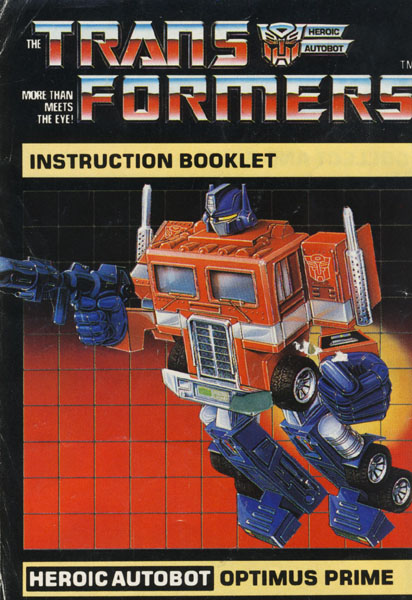 1984 instructions featured the toy's package art.
 -
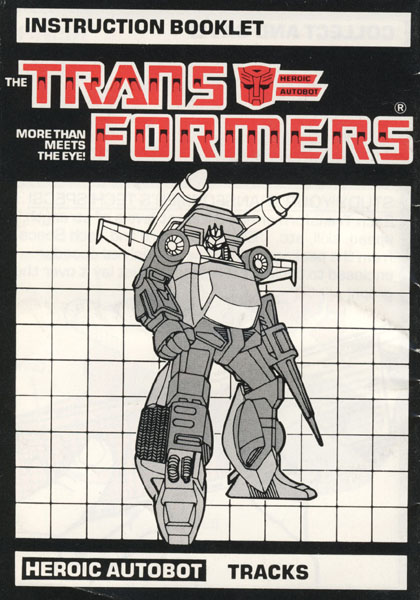 1985 instructions featured line art based on the package art. Tracks is in a slightly different pose than his final box art.
 -
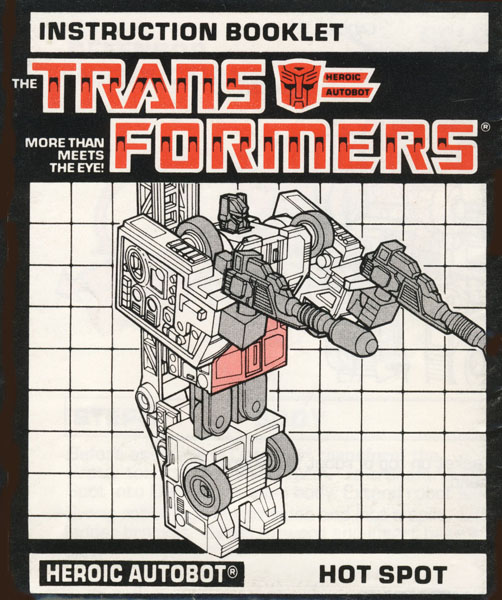 Much of 1986 had straighforward line drawings of the toys.
 -
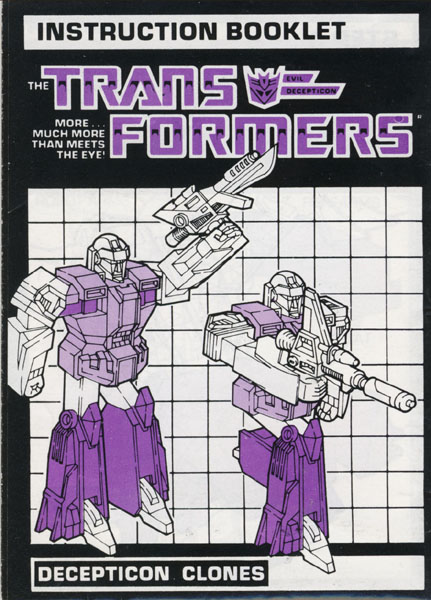 1987 was marked by line drawings of the toys, but in poses the toys themselves couldn't achieve.
 -
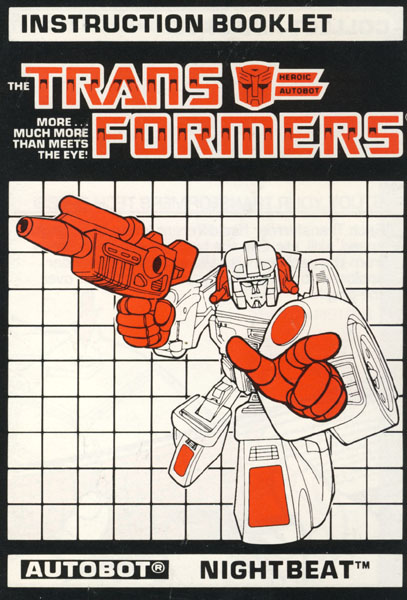 1988: Nightbeat uses his head lasers for the first (and almost last) time ever.
 -
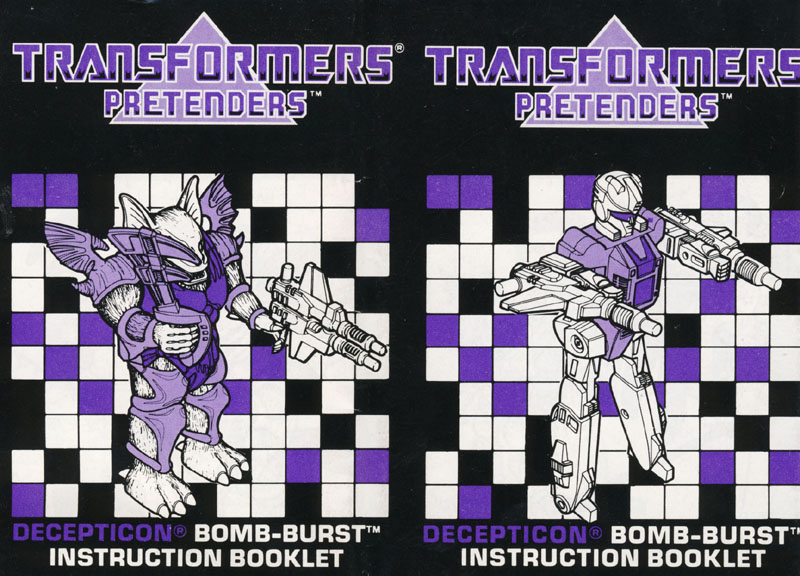 1988: the Pretenders got a double cover panel. The first wave Pretenders had straight line art of the toys...
 -
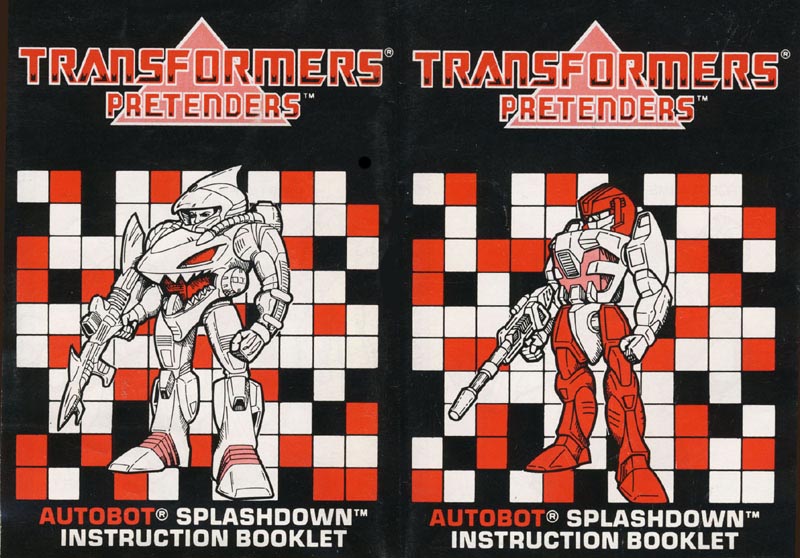 ...while the second wave got more of a character interpretation, with posing and altered proportions.
 -
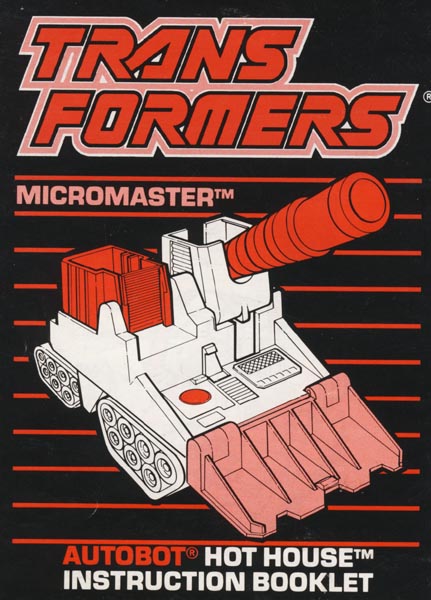 1989: Hot House is so important that he isn't even in the art!


Generation 2
[edit]Generation 2 changed very little on the instruction booklet format. Toys that came on genuine blister cards still had their instructions printed on the back of their cards while boxed toys had their instructions printed on the usual separate sheet. Some larger toys, however, came in clam-shells with cardbacks which were unique to the Generation 2 line. Like their boxed brethren, these toys also included separate instruction sheets.
The instructions themselves continued to use line drawings with additional written instructions, and the established wide variety of different-natured line drawings for their "cover" images. The quality of the cover art, however, took a sudden nosedive as the line neared its end.
-
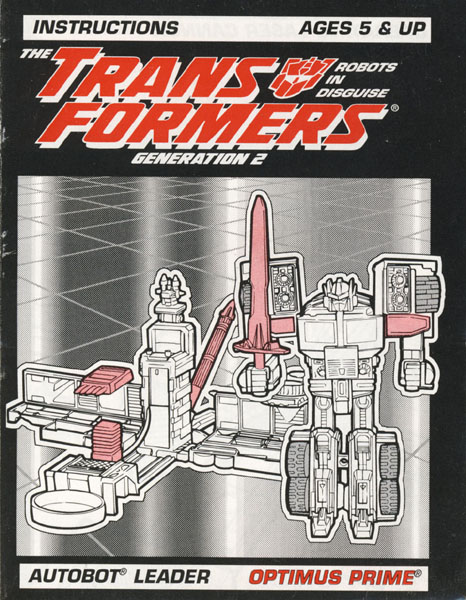 1994: Laser Optimus Prime has tidy art based on his toy...
 -
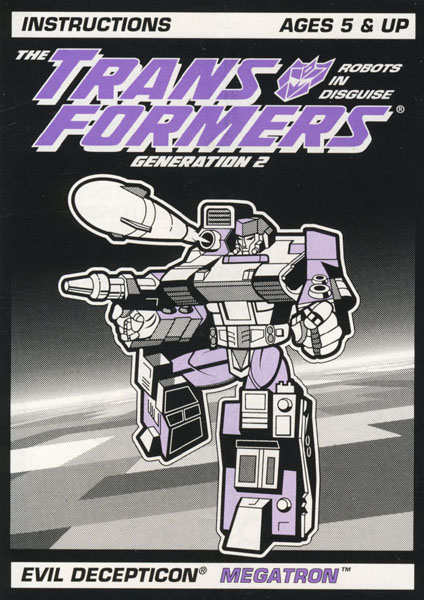 ...while Combat Megatron has a character interpretation.
 -
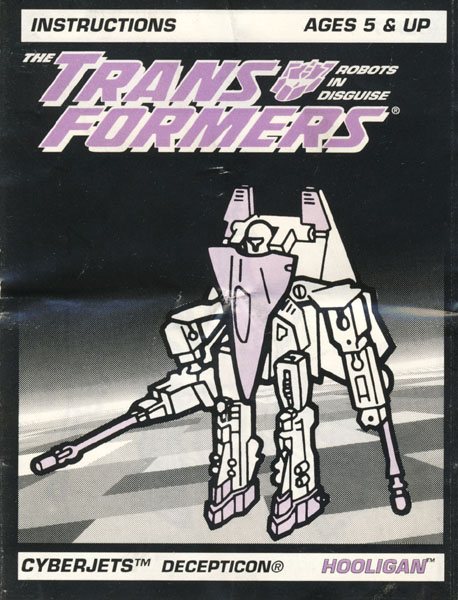 1995: Hooligan's art is not only terrible, but he's not even transformed correctly.


Beast era
[edit]
Beast Wars continued to use line drawings of the toys with two-tone shading. Unlike in previous lines, the line art was often simplistic and somewhat crude, making it hard to follow at times—particularly as the toys became more and more intricate. The same applied to the "cover" images, which now depicted both the robot and alternate modes, with the robot modes usually depicted in poses that were actually possible with the toys, due to improved articulation.
Beast Wars introduced uniform size classes that are, by and large, still used today. The Basic and Deluxe figures, which came packaged on blister cards, once again featured their instructions printed on their cardbacks. Boxed toys (Mega and larger) came with the usual separate instruction sheet.
Early Beast Machines toys also used toy line art, at about the same level of quality and detail as Beast Wars. With the 2001 lineup, however, Hasbro suddenly returned to photographic illustrations of the toys, now depicting photos of gray prototypes and the important parts for each transformation step highlighted in red (which was added in post-production). The Dinobots were an exception to this, as they still used line art for their instructions.
The Machine Wars toys all had their instructions printed on the back of their packaging, even larger toys such as Optimus Prime, Starscream or Soundwave that came packaged in boxes.
Robots in Disguise and Unicron Trilogy
[edit]
Toy instructions from the 2001 Robots in Disguise returned to using line art, but recycled the line art from Takara's Car Robots instructions, which featured a much greater level of accuracy and detail than the Beast Era line instructions, with highlighted parts in various shades of red or purple. The "cover" images also switched to more accurate line drawings. Armada, Energon and Cybertron, as well as the first Universe line, Alternators and Classics, continued in the same fashion (though ironically, the toys initially became much simpler to transform with Armada). With the corresponding proliferation of electronics during the Armada franchise, much of the instruction sheet was taken up by warnings and legal declarations regarding the batteries.
With Robots in Disguise, Hasbro also started to use trilingual packaging (English/French/Spanish) across the North American market, which extended to the packaging. Pressed for space, Hasbro abandoned the practice of printing instructions on the back of blister cards altogether, and even smaller carded toys like the simplistic Spychangers and Armada Mini-Con three-packs now had their own instruction sheets inside their blister bubbles. It wasn't until the introduction of the Legends Class during Cybertron that instructions would be printed on the back of the packaging again, and even then only for single-packed Legends figures.
As a result of the now trilingual instructions, the amount of written instructions was vastly reduced, now mostly limited to headers such as "change to robot" and small number of verbal descriptions for "key" steps, instead relying mostly on the images to provide the information. Cybertron finally saw a return to English-only instructions for the United States market, which also applied to the remainder of Universe, new Alternators toys and Classics, but additional written instructions never made a comeback.
The format of the instruction sheets also changed with Robots in Disguise, as the vertical fold no longer matched the instructions' horizontal rows, and many instructions had to be folded out primarily downwards rather than sideways. With the Alternators line, Hasbro started to print the instructions entirely on one side of the sheet, leaving the other side blank. With the launch of the Cybertron line, Hasbro also started to apply that format to their other Transformers lines, which also affected later toys from the original Universe line. The Cybertron Mini-Con two-packs were an unusual exception in that they still featured double-sided instructions. Larger toys (Ultra, Leader and Supreme Class figures), however, still continued to use double-sided instruction sheets.
Movie and beyond
[edit]
The Movie franchise toys continued to use one-sided sheets with detailed line art, but replaced the line art "cover" images with gray-scaled stock photos of airbrushed toy prototypes. This remained unchanged for Animated, the second Universe line and Revenge of the Fallen, with only the background image the stock photos were super-imposed over changing with each line. US editions are in English only, but still without verbal instructions.
Instructions for smaller toys still largely continue to be printed entirely on one side of the sheet, leaving the other side blank. Larger toys such as Ultra, Leader and Supreme Class figures or Movie Ultimate Bumblebee, meanwhile, usually still have double-sided instructions. There's no cut-and-dry rule, however—Human Alliance Bumblebee from the Revenge of the Fallen comes with double-sided instructions, while Human Alliance Sideswipe from the same assortment features a one-sided instruction sheet. With the 2010 Transformers line, two-sides instructions have become a new standard, with the flip side now depicting the reverse transformation, rather than relying on a note such as "Reverse order of instructions to convert back into robot".
With the launch of the Dark of the Moon toy line, the instructions would see a change yet again. Instructions now feature grayscale unpainted prototypes (like later Beast Machines instructions), with the transformation steps highlighted in either red (Autobot) or purple (Decepticon). Most, if not all, instructions are double-sided and cover both going from the mode the toy is packaged in, and back again. Hasbro also began uploading video instructions on YouTube. Beginning with the Robots in Disguise line and the Combiner Wars portion of the Generations line, the instructions now use CAD renders of the toys. Robots in Disguise's Warrior-class toys, curiously, eschewed instruction sheets in favour of printing the instructions on the back of the card, while Crash Combiners (with far simpler transformations) have printed booklets. Titans Return returned to using 3D CAD models as its predecessor did. The Last Knight continued the trend.
International instructions
[edit]Japan (Takara/TakaraTomy)
[edit]
Takara's early Fight! Super Robot Lifeform Transformers toys used gray-scaled versions of the photos from Hasbro's corresponding Generation 1 instructions where available, and the same line artwork as found in Hasbro's instructions for the rest where available. Takara-only toys featured line artwork following the same style for their instructions. An unusual case was Megatron, who used toy photos in addition to the mainly line-art-only instructions.
For their Generation 2 instructions, Takara used gray-scaled photos of the actual toys, but returned to line art for their Beast Wars instructions. Though the line art featured about the same crude quality as Hasbro's instructions, the line art wasn't actually the same. Some Beast Wars Metals toys such as Jaguar used color photos of the toys (or colored prototypes) for their instructions.
With Car Robots, Takara returned to line drawings, but of a much higher detail and better quality than their Beast Wars instructions. Those same line drawings were later used by Hasbro for their Robots in Disguise port of the toys. For Galaxy Force instructions, Takara used photos of gray prototypes, highlighting the important parts for each transformation step in red, similar to Hasbro's later Beast Machines instructions.

For their Binaltech line, Takara used actual stapled instruction booklets, where one had to flip through the individual pages. The instructions used negative line art with white lines on black backgrounds, with no highlight colors whatsoever. In addition, the line art was different (if not to say better and more clear and helpful) than that used for Hasbro's instructions for their Alternators versions of those same toys. In addition to the actual instructions themselves, those booklets also contained a small gallery of the toy with highlights and text descriptions of various features, a fictional "system description" of the Transformers character, a text-only chapter of Hirofumi Ichikawa's "Binaltech Story" and technical details of the real-life vehicle mode.
Unlike Hasbro's instructions, Takara's instructions have never stopped using additional verbal descriptions of the individual transformation steps.
International Hasbro instructions
[edit]
Canadian and European Generation 1 were, for the most part, unchanged from their United States counterparts. However, Canadian instructions featured text descriptions in both English and French, which resulted in somewhat cluttered spaces. Toys released by Hasbro in Europe, meanwhile, featured a drastically reduced amount of verbal instructions depending on how many different languages the instructions had to cover—the more alternate languages in the same instructions, the less text the instructions featured.
The "Classics" re-issues of older toys released by Hasbro in Europe in 1990 and 1991 reused the original toys' instructions with minimal changes, including photographic illustrations for the toys originally released in 1984.
With 2001 Robots in Disguise, Hasbro used the same trilingual (English/French/Spanish) instructions for the Canadian, Mexican and United States market, with minimal text instructions. After Hasbro returned to English-only instructions for the US market, Canada and Mexico continued to get trilingual instructions, but like their US counterparts, they still lacked text descriptions. The same applies to European instructions, which haven't featured verbal instructions ever since the days of the European-exclusive tail-end Generation 1 toys, and have added more and more languages with subsequent lines (see "multilingual packaging" for more on this), which results in headers such as "Change to robot" cluttering a lot of space, while the individual instruction steps remain entirely text-less.
Undocumented features
[edit]In some cases, instructions completely neglect to inform the owner of a toy about some of its features. This is different from actual problems with the instructions (see below), as this does not affect the functionality of the toy or make it harder to transform; knowledge of these features simply adds extra play value to the toy. In either case, the feature was clearly designed on purpose, and isn't simply a freak coincidence (such as various toys' standardized 5 millimeter pegs being the same size as Mini-Con ports, and thus allowing for Mini-Cons to be attached to them).
Sometimes this may be a partially abandoned gimmick, or sometimes it can be minor elements of the transformation, such as the flip-out spikes or claws on Movie Deluxe Class Barricade and Leader Class Brawl's feet. Sometimes it can also be an additional possible configuration, such as Nightstick from Universe Cyclonus being able to be attached to Cyclonus's wrist (with the hand not flipped out) in gun mode.
Sometimes it can also be the compatibility of the toy with one or more separately available toys. For example, instructions for the "Dollar store" exclusive rebranded re-releases of various Energon combiner components in Universe packaging made no mention of their combining ability, unlike their previous Energon releases. This might be because not all components were re-released in Universe packaging, and not all of them in the same wave. Similarly, the abandoned combined mode for Revenge of the Fallen Arcee, Chromia and Elita-1 was not mentioned in any of the toys' instructions (Hasbro promised to publish these instructions online, but ultimately never followed suit). More oddly, the Revenge of the Fallen Legends Class Optimus Prime and Jetfire's ability to combine was not acknowledged anywhere in their individual releases' instructions.
Sometimes these omissions are glaringly bizarre: For example, the instructions for 2010 Transformers Scout Class Breacher completely neglect to mention the fact that his weapon can be detached from the roof mount/back of the robot and attached to the side of either hand using a C-clip—even though the weapon is shown attached to one of his hands in the official stock photography on the back of the toy's packaging!
Problems with modern-day instructions
[edit]
As the toys became more complex, Hasbro's instructions became less and less helpful. In some cases, they are unclear on vital steps or even skip steps entirely. For example, when Movie Voyager Class Starscream's instructions try to show how to flip out the legs, the important steps occur on the opposite side of the body as opposed to the one the reader is looking at. Meanwhile, Universe Prowl's instructions fail to point out that his feet can be pulled out in addition to being flipped out, despite showing them in their extracted state in the following step.
Furthermore, in some cases the line art is based on early prototypes and depicts steps that aren't possible with the final toys, as some transformation steps, joints and features still present on the prototypes have been gutted for budget reasons. For example, Revenge of the Fallen Voyager Class Starscream's instructions refer to an additional joint inside the hand's palms that allows to fold them up in jet mode, and depict the forearm cannons in a position where they are moved forward when illustrating the push-button missile firing gimmick, even though the actual toy's hands are cast in one piece, and the cannons are sculpted in place on the actual toy.

In the case of retools, Hasbro often fail to properly address the changes in the line artwork used for the instructions for those toys. For example, the instructions for Alternators retools such as Dead End, Swindle, Battle Ravage or Wheeljack reflect the changes in vehicle mode, but incorrectly still depict the original toys' head sculpts. An even worse example is Universe Sideswipe, a retool of Universe Sunstreaker, who not only sports a different head sculpt, but also uses a slightly different transformation scheme, with the upper torso rotated by 180 degrees as compared to Sunstreaker. Neither difference is reflected in the instructions' line art, which is simply recycled from Sunstreaker's instructions.
Revenge of the Fallen Leader Class Optimus Prime's instructions are infamous in the Transformers fandom for being vague and unclear, leaving out some steps in an attempt to economically use the space available on the instruction sheet. Evidently, the instructions were considered so poor that when TakaraTomy released their Buster Optimus Prime retool of this toy, they included supplementary photograph steps that were left out in the original instructions. Even worse is 2010 Transformers Voyager Class Battle Blades Optimus Prime: The instructions show a way of concealing his head that ends up wedging it in place almost permanently inside his chest... unless one were to find and use the concealed hinge at the base of Prime's back (the roof of the sleeper) that the instructions make no mention of, despite it greatly simplifying the transformation. The instructions clearly show the hinge and yet ignore it completely—in fact, going strictly by the instructions and not making use of the hinge makes several steps of the transformation impossible due to parts getting into each other's way; or worse yet, they could clip through each other to get in place, thus damaging the toy. In addition to that, the instructions fail to mention several other design elements that tremendously increase the ease of the transformation.[1]
Sometimes instructions are also just weird and seemingly random: Revenge of the Fallen Human Alliance Bumblebee's instructions don't suggest rotating and unfolding the kneepads until the step that shows how to stand Sam in Bumblebee's back so he can handle the shoulder launcher, as if Bumblebee was only supposed to have "proper" knees when Sam is riding in his back. Some of Hasbro's stock photos also depict the incompletely transformed kneepads as part of the "proper" robot mode; then again, the photographer might have actually used the instructions as a reference. Also, the stock photos depicted on top of the instruction sheet itself show the knees folded out; but then again, Sam is riding in Bumblebee's back in those photos.
Hasbro have recently addressed the increased difficulty with modern-day toys as well as the resulting problems for the instructions. A change in the instruction format was promised for 2010 which would supposedly address these problems.[2] Ultimately, this was (partly) reflected in the instructions of various Dark of the Moon toys, replacing the line-art of previous lines with photos of gray-scale prototypes, as well as illustrating the subtler portions of the transformations with alternate angles, highlighting certain elements like pegs and their respective peg-holes to show where they connect, and even the rare verbal instruction. Also, as mentioned before, most instructions are now double-sided, with Hasbro uploading video instructions online as well.
Notes
[edit]

- With the second wave of the 2008 Universe line, Hasbro changed multi-language text headers such as "Change to robot" in their European instructions from mixed case to upper case. Somehow, however, a weird error sneaked its way in: The Greek version of "Change to robot", previously correctly rendered as "Αλλαγή σε Ρομποτ" in mixed case, was changed to "ΑΛΛΑΓΗ ΣΕ ΚΑΤΑΠΕΛΤΗ" in uppercase... which translates as "Change to catapult".
- Despite being usually grammatically correct in most instances, the wording isn't always the best: The German version of Ravage's instructions from Universe Hound translates the word "Beast" (a call-out to the Beast Wars and their "beast modes") as "Monster", rather than the more appropriate "Tier" ("animal"). Worse, the Slovakian version of "Changing to vehicle", "Zmena na automobil", uses "automobil" as a standard translation for "vehicle", including tank (Movie Brawl) and helicopter (Movie Blackout) alternate modes, even though the Slovakian word "automobil" specifically refers to cars. Likewise, "Tvar automobilu" translates as "shape of car", not "vehicle mode".
- Instruction sheets will sometimes show unused or alternate head designs for toys. One of the earlier examples of this was Energon Prowl. The phenomenon became almost comical during the run of the 2010 Transformers and Generations toylines, where it seemed instructions depicted the alternate heads more often than the actual heads of the toys they were packaged with. In some cases, fans have even been able to deduce entire future waves based on the 'pretools' shown in the instructions!
- Some toys can be given unofficial configurations that diverge from the instructions, such as Constructicon Maximus' Duststorm/Wideload arm can be given "fingers" by splitting open the feet, or Sixshot's seventh transformation made by combining various portions of its different modes.
External links
[edit]- Official collection of Transformers instructions from the Hasbro consumer care site
- Official (smaller) collection of Transformers instructions from the Hasbro site
- Botch the Crab's Generation 1 instructions archive
- FortMax's Instructions Archive


