Super Dimension Fortress Macross
Super Dimension Fortress Macross (超時空要塞マクロス Chōjikū Yōsai Makurosu)[1] is a 1982 multimedia project created by Shōji Kawamori which has spawned decades of anime television episodes, mecha toys, and music songs. Relevant to this wiki, Macross is the source of the original, much-beloved Jetfire toy design, notable for its "perfect transformation" (完全変形 kanzen henkei) in having a revolutionary level of animation accuracy for a triple-mode mecha toy all the way back in 1982.
The Macross brand has continued with new entries every so often, notably with Macross 7 in 1994, Macross Frontier in 2008, and Macross Delta in 2016.
Story
In the year 1999, a massive derelict spaceship crash-lands on Earth in the south Pacific Ocean, confirming to humankind that they are not alone in the universe. Over the next decade, a United Nations Government (統合政府 Tōgō Seifu) is formed to deal with the threat of the ship's creators, reverse-engineering the technology found aboard the alien ship to create the U.N. Spacy (統合宇宙軍 Tōgō Uchūgun), humankind's first spaceworthy military service. From the baseline of the F-14 Tomcat comes the VF-1 Valkyrie, a next-generation variable fighter (可変 戦闘機 kahen sentōki) and the alien capital ship itself is repaired and remodeled to become the SDF-1 Macross. Finally, in 2009, the giant Zentradi (ゼントラーディ人) arrive to take possession of the lost warship and to investigate if this strange world may be home to their long-lost creators, the Protoculture (プロトカルチャー). At this point, an accident strands the human crew of the SDF-1 at the edge of the solar system and ignites war with the Zentradi, and humanity will never be the same again.
Notably, Macross chief director Kawamori takes a flexible approach to "canon", somewhat akin to Star Wars creator George Lucas's willingness to embrace modifications in HD remastering. Newer entries of Macross are allowed to change up prior details as long as the broad strokes remain the same because Kawamori tailors storytelling techniques to the parameters of the medium at hand, be it a television series or a theatrical film.
Mecha

The VF-1 Valkyrie features three different modes: battroid (robot mode), GERWALK[2] (in-between mode), and fighter (vehicle mode). The VF-1 can equip attachments for extra ammunition and fuel capacity. It also features variations distinguished by the battroid head design, differentiated among squad leaders, aces, and grunts.
- Hikaru Ichijyo (一条 輝 Ichijō Hikaru) - the young male protagonist of the series
- In the TV series, Hikaru starts out with a VF-1J in white with red highlights before inheriting Roy's VF-1S.
- Roy Focker (ロイ・フォッカー) - the leader of Skull Squadron
- Roy flies a VF-1S in white with yellow highlights.
- Maximilian "Max" Jenius (マクシミリアン・ジーナス) - the ace pilot of Skull Squadron
- In the TV series, Max initially flies a VF-1A in white with blue highlights before switching to a VF-1J in blue with white highlights.
- Hayao Kakizaki (柿崎速雄 Kakizaki Hayao) - the inexperienced redshirt
- In the TV series, Kakizaki flies a VF-1A in white with tan highlights.
- Milia Fallyna (ミリア・ファリーナ) - the newcomer alien ace who defected from her own people
- When she joins humanity, Milia flies a VF-1J in red with white highlights.
Macross in Transformers


Takatoku collapsed as a company circa early 1984, and their assets would soon be bought out by Bandai, who then subsequently licensed the large VF-1S Super Valkyrie (as well as Beetras and Dorvack molds) to Hasbro, who was desperately needing molds to fill out the 1985 product line of the unexpectedly popular Transformers in North America and Europe.
As Bandai at the time was only concerned about business in Japan, Hasbro was free to sell the large VF-1 mold as a Transformers figure in non-Japan markets.
Jetfire's enduring popularity has seen many new incarnations of the trademark over the decades, culminating in the 2019 Siege Commander Class figure, a highly-accurate recreation of his 1985 animation model, free of any legal complications with other companies.
Legacy cameos
-
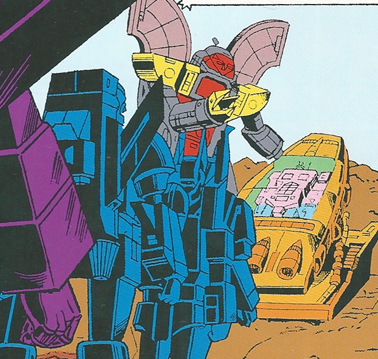 1986 comic artist error of Jetfire's toy design
 -
 2013 Kre-O online manga cameo
 -
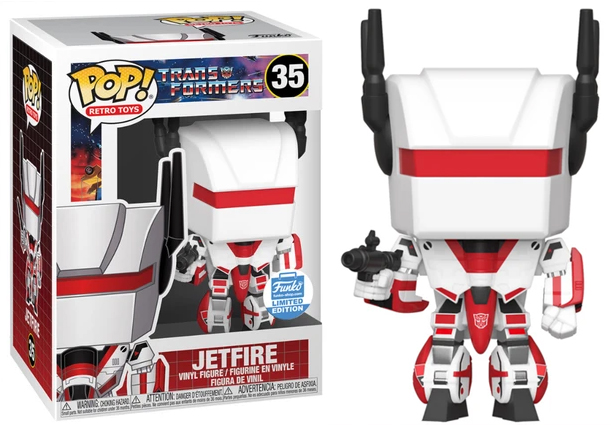 2021 Funko Pop vinyl figure


Attempted interference by a terrible company
Back in the 1980s, a U.S. real estate company called Harmony Gold ventured into the anime adaptation industry. They purchased the overseas rights to the 1982 Macross TV series as well as two unrelated series to create a hodgepodge project called Robotech. (Back in the day, Power Rangers-style story manglings were much more common in the U.S. industry.) However, they were unable to market the 1/55 VF-1S toy because that mold's overseas rights had been licensed by Hasbro. Haha!
Since the 1980s, Harmony Gold has accomplished nothing of substance with the rights to Macross. They have promised for over a decade that a live-action Robotech film is in the works, but nothing manifests. Except for suing anyone who tries to make VF-1-style product without their say-so, even when said merchandise only vaguely resembles the VF-1 Valkyrie because the real-life F-14 Tomcat is not a hard idea to come up with. In 2013, Harmony Gold sued Hasbro for making a non-transforming G.I. Joe and the Transformers Jetfire toy, but noted copyright "damages [were] difficult to ascertain", and the suit was dismissed in favor of Hasbro against Harmony Gold. Good riddance!
Because of Harmony Gold's ridiculous stranglehold over the distribution (or rather, the lack thereof) of Macross material outside of Japan, not even Macross fans in countries right next to Japan could receive full-fledged first-party distribution of Macross material throughout the 2000s and 2010s. No joke: While Asian Transformers fans enjoyed various official localizations of Transformers television series and theatrical films during this time, nothing of the sort happened with Macross while they lived right door next to Japan. After Big West and Studio Nue were finally able to assert some control in 2021, many Macross stories began streaming on Disney+ outside of Japan in 2024...but not the original series. Because of Harmony Gold.
Look, we're going to be honest. We of the TFWiki have no sympathy to attempt fairness toward Harmony Gold because they do not deserve any. And we are hardly the only sector of online fandom of Japanese franchises to feel this way. Shoji Kawamori himself dislikes Robotech. Enough said about that.[3]
Notes
- In the 1980s, the VF-1 molds underwent several licensed uses by overseas companies, similar to the distribution of Takatoku-based molds for Beetras and Dorvack.
References
- ↑ Official translations vary on whether there should be a "The" at the beginning in the English title in front of "Super Dimension Fortress Macross".
- ↑ "GERWALK" is an acronym for "Ground Effective Reinforcement of Winged Armament with Locomotive Knee-joint".
- ↑ [1] fullfrontal.moe interview by Dimitri Seraki and Arnaud Bastie at Gallery AaMo in June 2019:
"In America, they have a modified version of Macross, which is called Robotech. Nowadays, there are a lot of people who are fans of Robotech without knowing that Macross exists. How do you feel about it?"
S. Kawamori: "I don’t understand, nor do I accept the fact that they took and modified my work without even asking. I can not comprehend how a pirated version like this exists. However, I feel I was very fortunate that many other people from other countries around the world were able to see Macross."
"Harmony Gold has a lot of new project around Robotech in America. I think they are working on a new movie, for example, do you take any credits from the American Robotech works?"
S. Kawamori: "I don’t want to talk about it. Please support the official Macross releases."
External links
- Official website (Japanese)
- Official Twitter page (Japanese)
- Official Twitter page
- Super Dimension Fortress Macross at Wikipedia
- Macross Mecha Manual fan database


