Transformers brand: Difference between revisions
No edit summary |
mNo edit summary |
||
| (64 intermediate revisions by 28 users not shown) | |||
| Line 1: | Line 1: | ||
[[ | {{disambig3|Transformers}} <br> | ||
[[File:Transformers 2014 logo.png|center|475px]] <br> | |||
The '''''Transformers'' brand''' is the umbrella term for all products or media involving the [[Transformer|transforming alien robots]] from the planet [[Cybertron (planet)|Cybertron]] developed in 1984 by [[Hasbro]] and [[Marvel Comics|Marvel Entertainment]] (then Marvel Entertainment Group) under license from [[TakaraTomy|Takara]], including any lineal descendants thereof. | The '''''Transformers'' brand''' is the umbrella term for all products or media involving the [[Transformer|transforming alien robots]] from the planet [[Cybertron (planet)|Cybertron]] developed in [[1984]] by [[Hasbro]], [[Griffin Bacal]], and [[Marvel Comics|Marvel Entertainment]] (then Marvel Entertainment Group) under license from [[TakaraTomy|Takara]], including any lineal descendants thereof. However, beginning around the early 2000s, the franchise became more of an international collaboration between Takara and Hasbro. | ||
''Transformers'' has been in almost continuous circulation since its launch | ''Transformers'' has been in almost continuous circulation since its launch {{#expr:{{CURRENTYEAR}}-1984}} years ago, never absent from American toy shelves for more than 18 months; and even during those relatively brief periods of absence from American retail, it would still continue in other parts of the world. Unlike many 80s brands relaunched in the 2000s to capitalize on the 20-year nostalgia cycle, the ''Transformers'' brand is truly evergreen. As a result, it has grossed Hasbro more than $1 billion {{w|United States dollar|USD}} since its launch. <ref>The late Hasbro executive, [[Brian Goldner]], in the special features of the ''[[Transformers (film)|Transformers]]'' DVD.</ref> | ||
Related articles: | Related articles: | ||
* [[ | * [[Franchises]] | ||
* [[Toy]] | * [[Toy]] | ||
==Spelling and capitalization== | ==Spelling and capitalization== | ||
In the various ''Transformers'' [[ | In the various ''Transformers'' [[logo]]s used over the decades, the word is often split across two lines, with no hyphen, thus suggesting (by the rules of normal punctuation) that it's two words: "''Trans Formers''". This is reinforced by an [[:Image:STARS-FanClubUK-Advert.jpg|advert]] for the UK offshoot of the [[S.T.A.R.S.]] fanclub, which explicitly spells it as "''TRANS FORMERS''". Other logos are explicitly {{w|Camel case|bicapitalized}}: "''TransFormers''". Further, when Hasbro is being strict about the word's [[trademark]] status, they write it in allcaps: "''TRANSFORMERS''". | ||
Despite all that, it's generally agreed that the correct rendering is "Transformers", and that's the way it appears in this wiki. | Despite all that, it's generally agreed that the correct rendering is "''Transformers''" (which has been officially used by Hasbro on occasion, too <ref name="spelling">[https://www.tfw2005.com/boards/attachments/optimus11-jpg.27523745/ 1986 "Movie Edition" certificate]</ref>), and that's the way it appears in this wiki. | ||
The official logos of the [[The Transformers (franchise)|original series]] explicitly used a definite article for the [[The Transformers (toyline)|toyline]] and the [[The Transformers (Marvel comic)|Marvel comic]], arguably making the franchise's official name "'''''The''' Transformers''" during its early years. (The [[The Transformers (cartoon)|cartoon]], meanwhile, used it inconsistently: Whereas the opening credits for all four seasons omitted it, with the exception of the end of the season 2 opening credits, the [[commercial bumper]]s ''did'' use it.) Following an increasingly inconsistent use for the toyline (oftentimes even between the packaging and [[instructions]] for ''the same toy''!), the word "The" was finally (mostly) rendered obsolete in 1989 with the introduction of a new logo, although it would see a return many, ''many'' years later as part of the titles of various comic books by [[IDW Publishing]], including [[The Transformers (IDW)|two]] [[The Transformers: Robots in Disguise|different]] series simply named "''The Transformers''". | |||
[[ | |||
<gallery widths="225" heights="84"> | |||
File:TheTransformers Logo.jpg|An Autobot face does not a hyphen make. | |||
File:MarvelTheTransformers Logo1.png|The "the" would eventually become obsolete. | |||
File:MarvelTheTransformers Logo2.png|Old school new school. | |||
File:Transformers 1999 Logo.jpg|New school. | |||
File:Transformers 2000s Logo.png|Also known as PascalCase. | |||
File:TF2007Logo.png|New school old school. | |||
File:2010-2014-Transformers-Logo.png|New new school old school. | |||
File:Transformers 2014 logo.png|Keeping it simple. | |||
</gallery> | |||
==Recognition in the wider world== | ==Recognition in the wider world== | ||
[[File:Transformers-cosplayers.jpg|thumb|250px]] | |||
''Transformers'' is a genuine cultural phenomenon. When the online [[fandom]] came together in the 1990s, it was fun and feasible to try and list all the appearances and references made to ''Transformers'' in popular culture, and [https://www.angelfire.com/ego/zobovor/pop_culture.html some fans did]. However, after the 80s nostalgia boom of the early 21st century brought ''Transformers'' back to the public eye and the incredibly successful [[live-action film series]] made the series a household name that was impossible to miss, Transformers are now absolutely ''fricking everywhere'', and such a list is no longer a remotely feasible thing for {{SITENAME SHORT}} to try to catalog. Odds are, it would require a wiki all on its own! | |||
Some diverse prominent examples of public figures name-dropping ''Transformers'' include [[Prime Minister of the United Kingdom|UK Prime Minister]] {{w|Gordon Brown}} <ref>[https://www.telegraph.co.uk/news/politics/labour/4208838/Browns-hero-is-Transformer-Optimus-Prime.html The Telegraph (Jan-09-09)]</ref> and [[United States Army|US Army]] Generals <ref>[https://usatoday30.usatoday.com/news/world/iraq/2003-03-21-weblog.htm USA Today (May-20-05)]</ref> commenting on one or another aspect of the brand. The brand has also made numerous appearances in other media, ranging from straight clips of the cartoon (such as in the film {{w|Léon: The Professional|Léon}}) to original comedic sketches and parodies (the two most well-known authors of which are easily ''{{w|Family Guy}}'' and ''{{w|Robot Chicken}}''.) | |||
Transformers | The ''Transformers'' brand has become so well known that the [https://www.oed.com Oxford English Dictionary] has added the following sense to its entry for TRANSFORMER n.: | ||
<blockquote>Chiefly in ''plural''. With capital initial. A proprietary name for a type of children's toy, first manufactured in Japan, consisting of a model robot which can be transformed into another toy (as a motor vehicle, gun, etc.) by manipulating its component pieces.</blockquote> | |||
The specific "proprietary" note, coupled with an explicit reference to [[Hasbro]] in the name etymology, probably means this poses no threat for Hasbro's exclusive claim of the [[trademark]] (Oxford gives the same treatment to [[Mattel]]'s ''Barbie''). Since the OED's policy is to never discard material, this means that Transformers are now a permanent part of the historical record of the English language. Take ''that'', ''{{w|ThunderCats}}!'' | |||
[[SETI]] have also said alien hunters should look for artificial intelligence rather than organic life. Score! <ref>[https://www.bbc.com/news/science-environment-11041449 BBC News article on the search for artificial alien life, Aug-23-2010]</ref> | |||
==References== | |||
{{reflist|2}} | |||
== | ==External links== | ||
* [https://www.facebook.com/transformers Facebook page] | |||
* [https://www.youtube.com/@TransformersOfficial YouTube] | |||
* [https://www.instagram.com/transformersofficial/ Instagram] | |||
[[Category:Franchises| ]] | [[Category:Franchises| ]] | ||
Latest revision as of 01:39, 11 June 2024
| The name or term "Transformers" refers to more than one character or idea. For a list of other meanings, see Transformers (disambiguation). |

The Transformers brand is the umbrella term for all products or media involving the transforming alien robots from the planet Cybertron developed in 1984 by Hasbro, Griffin Bacal, and Marvel Entertainment (then Marvel Entertainment Group) under license from Takara, including any lineal descendants thereof. However, beginning around the early 2000s, the franchise became more of an international collaboration between Takara and Hasbro.
Transformers has been in almost continuous circulation since its launch 42 years ago, never absent from American toy shelves for more than 18 months; and even during those relatively brief periods of absence from American retail, it would still continue in other parts of the world. Unlike many 80s brands relaunched in the 2000s to capitalize on the 20-year nostalgia cycle, the Transformers brand is truly evergreen. As a result, it has grossed Hasbro more than $1 billion USD since its launch. [1]
Related articles:
Spelling and capitalization
[edit]In the various Transformers logos used over the decades, the word is often split across two lines, with no hyphen, thus suggesting (by the rules of normal punctuation) that it's two words: "Trans Formers". This is reinforced by an advert for the UK offshoot of the S.T.A.R.S. fanclub, which explicitly spells it as "TRANS FORMERS". Other logos are explicitly bicapitalized: "TransFormers". Further, when Hasbro is being strict about the word's trademark status, they write it in allcaps: "TRANSFORMERS".
Despite all that, it's generally agreed that the correct rendering is "Transformers" (which has been officially used by Hasbro on occasion, too [2]), and that's the way it appears in this wiki.
The official logos of the original series explicitly used a definite article for the toyline and the Marvel comic, arguably making the franchise's official name "The Transformers" during its early years. (The cartoon, meanwhile, used it inconsistently: Whereas the opening credits for all four seasons omitted it, with the exception of the end of the season 2 opening credits, the commercial bumpers did use it.) Following an increasingly inconsistent use for the toyline (oftentimes even between the packaging and instructions for the same toy!), the word "The" was finally (mostly) rendered obsolete in 1989 with the introduction of a new logo, although it would see a return many, many years later as part of the titles of various comic books by IDW Publishing, including two different series simply named "The Transformers".
-
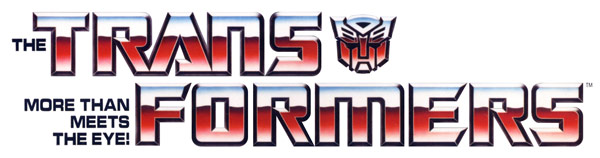 An Autobot face does not a hyphen make.
 -
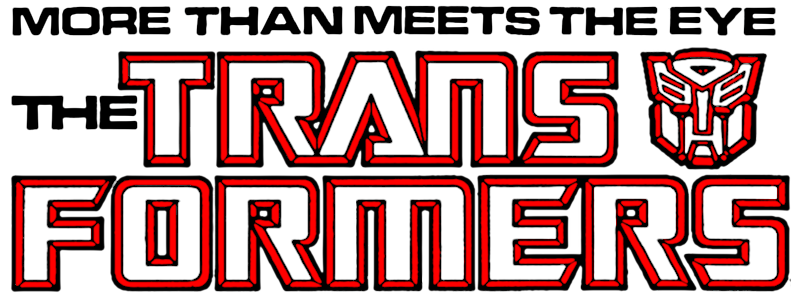 The "the" would eventually become obsolete.
 -
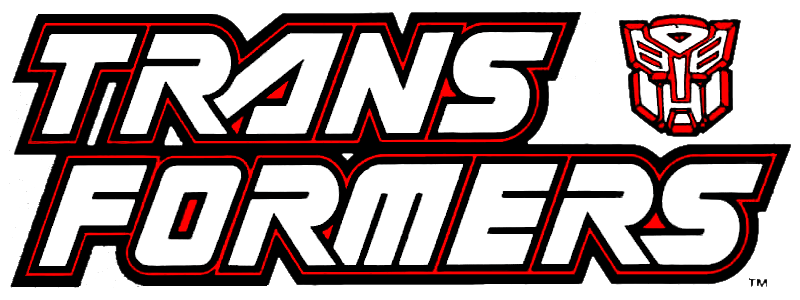 Old school new school.
 -
 New school.
 -
 Also known as PascalCase.
 -
 New school old school.
 -
 New new school old school.
 -
 Keeping it simple.


Recognition in the wider world
[edit]
Transformers is a genuine cultural phenomenon. When the online fandom came together in the 1990s, it was fun and feasible to try and list all the appearances and references made to Transformers in popular culture, and some fans did. However, after the 80s nostalgia boom of the early 21st century brought Transformers back to the public eye and the incredibly successful live-action film series made the series a household name that was impossible to miss, Transformers are now absolutely fricking everywhere, and such a list is no longer a remotely feasible thing for TFWiki.net to try to catalog. Odds are, it would require a wiki all on its own!
Some diverse prominent examples of public figures name-dropping Transformers include UK Prime Minister Gordon Brown [3] and US Army Generals [4] commenting on one or another aspect of the brand. The brand has also made numerous appearances in other media, ranging from straight clips of the cartoon (such as in the film Léon) to original comedic sketches and parodies (the two most well-known authors of which are easily Family Guy and Robot Chicken.)
The Transformers brand has become so well known that the Oxford English Dictionary has added the following sense to its entry for TRANSFORMER n.:
Chiefly in plural. With capital initial. A proprietary name for a type of children's toy, first manufactured in Japan, consisting of a model robot which can be transformed into another toy (as a motor vehicle, gun, etc.) by manipulating its component pieces.
The specific "proprietary" note, coupled with an explicit reference to Hasbro in the name etymology, probably means this poses no threat for Hasbro's exclusive claim of the trademark (Oxford gives the same treatment to Mattel's Barbie). Since the OED's policy is to never discard material, this means that Transformers are now a permanent part of the historical record of the English language. Take that, ThunderCats!
SETI have also said alien hunters should look for artificial intelligence rather than organic life. Score! [5]
References
[edit]- ↑ The late Hasbro executive, Brian Goldner, in the special features of the Transformers DVD.
- ↑ 1986 "Movie Edition" certificate
- ↑ The Telegraph (Jan-09-09)
- ↑ USA Today (May-20-05)
- ↑ BBC News article on the search for artificial alien life, Aug-23-2010


