Universal stream: Difference between revisions
mNo edit summary |
|||
| Line 56: | Line 56: | ||
* '''Lambda'''—covers, still images, and advertisements (there's [[IDW Publishing|so many]] Lambdas these days that Vector Prime stopped keeping track {{storylink|Ask Vector Prime}}) | * '''Lambda'''—covers, still images, and advertisements (there's [[IDW Publishing|so many]] Lambdas these days that Vector Prime stopped keeping track {{storylink|Ask Vector Prime}}) | ||
* A minus symbol at the beginning of a universal stream's number indicates that this particular reality is a '''negative polarity universe''', where the morals and personalities of Cybertronians are radically inverted. Thus far, [[Primax -408.24 Epsilon|only]] [[Malgus -411.27 Zeta|three]] [[Gargent -1185.01 Alpha|negative]] polarity universes have been revealed, but [[Vector Prime (Cybertron)|Vector Prime]] has hinted at the existence of many more, with the caveat that they are not as common as "positive polarity universes." {{storylink|Ask Vector Prime}} | * A minus symbol at the beginning of a universal stream's number indicates that this particular reality is a '''negative polarity universe''', where the morals and personalities of Cybertronians are radically inverted. Thus far, [[Primax -408.24 Epsilon|only]] [[Malgus -411.27 Zeta|three]] [[Gargent -1185.01 Alpha|negative]] polarity universes have been revealed, but [[Vector Prime (Cybertron)|Vector Prime]] has hinted at the existence of many more, with the caveat that they are not as common as "positive polarity universes." {{storylink|Ask Vector Prime}} | ||
* In the case of sources with | * In the case of sources with multiple universes that could be connected to them (such as story collections and anthologies, multiple versions of a video game, or comic book cover variants) a one or two-letter suffix is added to the number to indicate the actual source material. For example, from the ''[[Transformers Legends (book)|Transformers Legends]]'' anthology, [[Aurex 1104.30-DB Zeta]] is the "[[Lonesome Diesel]] short story by [[David Bischoff]], while [[Aurex 1104.30-JH Zeta]] is the "[[Fire in the Dark]]" short story by [[John Helfers]]. | ||
So, for example, '''Primax 984.17 Alpha''' refers to the continuity of the [[The Transformers (cartoon)|original Generation 1 cartoon]], with '''"Primax"''' referring to the Generation 1 continuity family, '''"984.17"''' indicating the first episode's airdate of [[September 17]], [[1984]], and '''"Alpha"''' denoting an animated series. Using this information, we could, in theory, determine the names of yet-unnamed universes on our own—for example, the "[[Decepticon Dark Commander Grand Scourge]]" pack-in comic would be "Primax 915.0 Gamma". | So, for example, '''Primax 984.17 Alpha''' refers to the continuity of the [[The Transformers (cartoon)|original Generation 1 cartoon]], with '''"Primax"''' referring to the Generation 1 continuity family, '''"984.17"''' indicating the first episode's airdate of [[September 17]], [[1984]], and '''"Alpha"''' denoting an animated series. Using this information, we could, in theory, determine the names of yet-unnamed universes on our own—for example, the "[[Decepticon Dark Commander Grand Scourge]]" pack-in comic would be "Primax 915.0 Gamma". | ||
Revision as of 21:53, 6 November 2015

"Heh heh. Cool."
A universal stream is the designator used by the TransTech to describe a single universe/dimension/reality within the Multiverse. The TransTech have catalogued 15,962,782 universal streams (1,176,325 of which have "come to termination"), grouping related universes into what are known as universal clusters and devising a classification system used to give each individual stream an alphanumeric designation.
Universal clusters
There are six "main" universal clusters:

- Primax—the Generation 1 continuity family. Points of commonality between universal streams in this cluster involve the forces of Optimus Prime and Megatron battling over the resources of Earth. It also also includes the Beast Era, a possible future which both factions evolve into the small and semi-organic Maximals and Predacons.
- Viron—the 2001 Robots in Disguise continuity family, a small cluster in which Optimus Prime's Autobots combat Megatron's Predacons.
- Aurex—the Unicron Trilogy continuity family. In this cluster, the Autobots and Decepticons struggle over such power-boosting items as Mini-Cons and Cyber Planet Keys while also contending with the threat of Unicron.
- Tyran—the live-action movie continuity family, a violent cluster in which the search for the lost AllSpark brings the Autobots and Decepticons to Earth, and humanity becomes heavily involved in the conflict.
- Malgus—the Animated continuity family, a cluster in which the war has ended and Cybertron is at peace, and Optimus Prime's Autobots are superheroes on a near-future version of Earth.
- Uniend—the Aligned continuity family, a cluster where Cybertron was poisoned by Dark Energon and temporarily left uninhabitable by Megatron in his war against Optimus Prime. Although previously separate from the rest of the multiverse, its quantum membrane was recently punctured by the passage of the Dark Spark. Later events in this cluster's streams involve Bumblebee taking command of a small team of Autobots to fight Steeljaw.
Other minor clusters include:

- Fornax—the Kre-O continuity family, home to modular brick-built Transformers.
- Iocus—a cluster essentially made up of overlapping aspects of other clusters, it is home to forgettable side-merchandise like Hero Mashers, Bot Shots, Construct-Bots, Battle Masters, and Attacktix, populated by 'bots functionally indistinct from their counterparts elsewhere in the multiverse, giving the outward appearance of worlds in which characters from different universes exist side-by-side.
- Nexus—the technologically advanced cluster where the TransTech world of Axiom Nexus resides.
- Quadwal—the "real world", in which Transformers exist primarily as toys.
- Yayayarst—the Go-Bots continuity family, home to the Go-Bots of Botropolis.
Clusters in the farthest reaches of the multiverse only tenuously connected to the Transformers include:

- Cymond—the continuity family of various TakaraTomy non-Transformers franchises, right on the border between the Multiverse and the wider Megaverse.
- Gargent—the GoBots continuity family, home to the Guardians and Renegades of Gobotron.
- Lukas—the Star Wars Transformers continuity family, where the Jedi battle the Sith using transforming mecha. This cluster is said to have "thin barriers", and overlaps with realities from elsewhere in the Omniverse.
- Rovio—the Angry Birds Transformers continuity family, a cluster where the dimensionally-displaced "EggSpark" accidentally changed the natives of Piggy Island into the Autobirds and Deceptihogs.
- Xobitor—the Robotix continuity family, home to the Protectons and Terrakors of Skalorr.
Deciphering the terminology
- For further information, see: List of universal streams
Each universal stream's name consists of three parts, beginning with the continuity family of origin, a number that indicates the "real world" date of creation, and a Greek letter that denotes the form of media. Supplied by writers Greg Sepelak, Trent Troop, and Jim Sorenson, the list of Greek letters and the media to which they refer are:
- Alpha—animated series
- Beta—tech spec/toy/pack-in comic only ("box")
- Gamma—comic book series
- Delta—motion picture/live action
- Epsilon—club/convention fiction
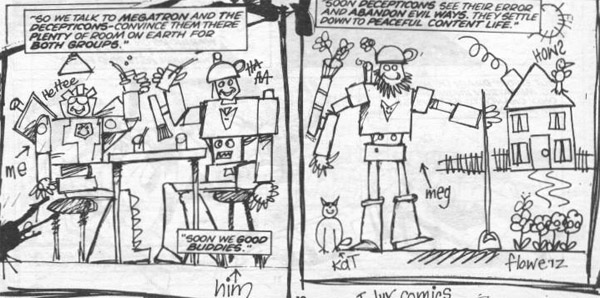
Basically, you could classify this as a universe, Primax 490.07-G Gamma cos it's a comic that Grimlock drew in a comic from 7th April 1990.
Someone will do it too. - Zeta—text stories, storybooks, and other prose works (printed)
- Eta—radio/audiocentric universes, books on tape
- Theta—live performance/spoken word
- Iota—Internet-only information (not involved with club/convention)
- Kappa—games (video and otherwise)
- Lambda—covers, still images, and advertisements (there's so many Lambdas these days that Vector Prime stopped keeping track Ask Vector Prime)
- A minus symbol at the beginning of a universal stream's number indicates that this particular reality is a negative polarity universe, where the morals and personalities of Cybertronians are radically inverted. Thus far, only three negative polarity universes have been revealed, but Vector Prime has hinted at the existence of many more, with the caveat that they are not as common as "positive polarity universes." Ask Vector Prime
- In the case of sources with multiple universes that could be connected to them (such as story collections and anthologies, multiple versions of a video game, or comic book cover variants) a one or two-letter suffix is added to the number to indicate the actual source material. For example, from the Transformers Legends anthology, Aurex 1104.30-DB Zeta is the "Lonesome Diesel short story by David Bischoff, while Aurex 1104.30-JH Zeta is the "Fire in the Dark" short story by John Helfers.

So, for example, Primax 984.17 Alpha refers to the continuity of the original Generation 1 cartoon, with "Primax" referring to the Generation 1 continuity family, "984.17" indicating the first episode's airdate of September 17, 1984, and "Alpha" denoting an animated series. Using this information, we could, in theory, determine the names of yet-unnamed universes on our own—for example, the "Decepticon Dark Commander Grand Scourge" pack-in comic would be "Primax 915.0 Gamma".
Alternate terminology
While the TransTech use this system, people within the clusters often do not. They may use other terms or none at all:
- The GoBots of Gargent 984.08 Alpha refer to an alternate reality as a "Level", as depicted in the Challenge of the GoBots cartoon and later TF-canonized by "Renegade Rhetoric". Their universe is the 1st level, the dread reality ruled by Queen Exor's Insectagons is the 21st level, and Primax 207.0 Epsilon was dubbed the 22nd level in "Withered Hope".
- The Alternity used to use the term "World" and the Transformers of Cloud World (Primax 514.29 Gamma) still do. They've thus dubbed Primax 903.0 Beta as BT World, Primax 785.06 Alpha as OG World, Aurex 103.10 Alpha as MD World and one odd one as Flatworld.
- The Autobots of Primax 085.0 Eta call universal streams "Strata", with Gargent 087.0 Kappa called Strata 22 in "Ask Vector Prime".
- The Quintessons call the universe of Menonia, Menonia as that's what the locals call it.
- Various dimensions aren't counted under this terminology and are given more descriptive names by their discoverers: "the X-Dimension", "limbo", "the Dead Universe", and the extremely descriptive "Alpha Q's universe" among others.
How many streams?
The size of the multiverse is vast and unknown. While the TransTech have records of just shy of sixteen million universes, there are certainly many more. When the Autobots of universal stream Aurex 402.24 Gamma began scanning alternate realities when their Optimus Prime became lost in the multiverse, they worked through 75,890,007 realities in addition to their own before locating him. Worlds Collide, Part 4 of 4 Dimensional traveller Bug Bite from Gargent 984.08 Alpha, meanwhile, has claimed that there are over fifteen quadrillion concurrent realities, Games of Deception though it seems likely this figure includes the entire Omniverse.
Don't Cross the Streams

Spatial-temporal powers like the TransTech, Alternity and Flaternity, and Cloud World could hop reality willy-nilly, and Unicron moves to new universes after he devours or is driven from one. Primus and Unicron can pluck you out of your reality and put you in another, and "Rhythms of Darkness!", "Worlds Collide", and the Universe War all involve one or both sending agents to another reality.
For most of the multiverse, however, crossing from one universe to the other is bloody hard. Many never make contact with another universe and those that do, may only do so temporarily and in circumstances hard to replicate. There does exist dedicated technology to link one world and a specific other, as the Quintessons used with Menonia.
In late 2015, the TransTech themselves lost their ability to visit or observe most realities after a cosmic event.
Major streams

Nearly two hundred streams have been named, over half of which are Primax realities. Among all of the known universes, however, there are nine known "pillar" realities, a set of universes that can be thought of as "foundational", with unusually high amounts of branching points and quantum echos. Ask Vector Prime These nine streams are:
- Primax 984.0 Gamma—the Marvel The Transformers U.S. comic.
- Primax 984.17 Alpha—The Transformers cartoon.
- Primax 496.22 Alpha—the Beast Wars/Beast Machines cartoons.
- Viron 901.8 Alpha—the 2001 Robots in Disguise cartoon.
- Aurex 802.23 Alpha—the Armada/Energon/Cybertron cartoons.
- Primax 1005.19 Gamma—the IDW Generation 1 comics.
- Tyran 707.04 Delta—the live-action Transformers films.
- Malgus 1207.26 Alpha—the Animated cartoon continuity.
- Uniend 911.05 Alpha—the Prime/2015 Robots in Disguise cartoons.


