Misconceptions and urban legends about Transformers: Difference between revisions
From MediaWiki
Jump to navigationJump to search
It's 2016. Who brings this up anymore? |
Anonymous X (talk | contribs) |
||
| Line 78: | Line 78: | ||
:This common but explicitly false idea probably stems from the many casual fans who grew up with the original ''Transformers'' line but stopped paying much attention around 1986, when the animated ''[[The Transformers: The Movie]]'' debuted and the ''Transformers'' craze began to die down. Many such fans regained some interest in ''Transformers'' many years later, particularly with hype surrounding the [[Transformers (film)|2007 live-action movie]]. Seeing the phrase "Generation 2" batted around in fandom, it might seem natural to assume it refers to the big changeover that happened with the animated film. It certainly didn't help that, early in the life of [[Dreamwave Productions|Dreamwave]], [[Pat Lee]] shared in this misconception, leading other new arrivals to the fandom to ape his use of the term. | :This common but explicitly false idea probably stems from the many casual fans who grew up with the original ''Transformers'' line but stopped paying much attention around 1986, when the animated ''[[The Transformers: The Movie]]'' debuted and the ''Transformers'' craze began to die down. Many such fans regained some interest in ''Transformers'' many years later, particularly with hype surrounding the [[Transformers (film)|2007 live-action movie]]. Seeing the phrase "Generation 2" batted around in fandom, it might seem natural to assume it refers to the big changeover that happened with the animated film. It certainly didn't help that, early in the life of [[Dreamwave Productions|Dreamwave]], [[Pat Lee]] shared in this misconception, leading other new arrivals to the fandom to ape his use of the term. | ||
:While the original animated movie certainly marked a change from one "generation" of toys to another, along with some new design trends, the phrase "Generation 2" refers to [[Transformers: Generation 2 (franchise)|a very specific franchise]], marketed from 1992 to 1995—years after the animated film had come and gone. Its relative obscurity probably contributes to the mis-attribution of the term, as ''Generation 2'' marks a low point in popularity for ''Transformers'' as a whole. | :While the original animated movie certainly marked a change from one "generation" of toys to another, along with some new design trends, the phrase "Generation 2" refers to [[Transformers: Generation 2 (franchise)|a very specific franchise]], marketed from 1992 to 1995—years after the animated film had come and gone. Its relative obscurity probably contributes to the mis-attribution of the term, as ''Generation 2'' marks a low point in popularity for ''Transformers'' as a whole. | ||
===Beast Wars=== | |||
*'''Beast Wars didn't originally have the Transformers branding attached to it.''' | |||
*While the early [[Beast Wars: Transformers (toyline)|Beast Wars]] toy packaging had the Transformers brand name in smaller type than the (much larger) Beast Wars logo, the Beast Wars toy range was ''always'' '''Beast Wars: Transformers''' from day one. Later on, with the release of the [[Transmetal]]s and [[Fuzor]]s subranges, the Transformers name was placed on front of Beast Wars, and increased the size and prominence of the Transformers name on the packaging. Also a source of this confusion for people in the [[United Kingdom]] is that Beast Wars figures were available in multilingual packaging as either Beast Wars Biocombat' or 'Beast Wars Anti-Mutants', further reducing the prominence of the Transformers branding, and that British commercial broadcaster [[GMTV]] edited the Transformers name out of the title sequence on their airings of the [[Beast Wars: Transformers (cartoon)|television series]]. | |||
===2001 ''Robots in Disguise''=== | ===2001 ''Robots in Disguise''=== | ||
Revision as of 15:40, 13 January 2016

Over the years, many misconceptions and urban legends have sprung up within Transformers fandom, often resulting from such factors as fuzzy childhood memories, inaccurate catalog illustrations, and mistranslations of foreign material.
Toys
Generation 1
- Transformers is (only) a cartoon from the Eighties that has been brought back into vogue recently.
- A misconception usually held by casual fans or nostalgic adults is that Transformers went away some time around 1986 (or 1987, or 1988—pick your year). People who stumbled across a newer incarnation of the Transformers franchise before 2007 commonly assumed that it had only recently popped back up as an attempt to cash in on '80s nostalgia. From 2007 onwards, people who were (obviously) aware of the live-action film series commonly believed that it was the 2007 movie that brought the franchise back from limbo. Neither assumption is correct.
- In fact, the Transformers brand has been continuous since 1984 (there was a brief gap between 1990 and 1993 as far as the United States market was concerned, but the brand still continued with new products in other markets). It includes many lines of toys, cartoons and comics that span nearly three decades, with no sign of stopping, as Hasbro considers it a core brand. Each line has experienced varying degrees of success, rebooting when its target audience gets too old or uninterested in the toyline and fiction.
- Some of this misconception is based on the fact that most of the original audience stopped watching and following the franchise after its cancellation, or even before (as it wasn't "cool" to be kiddy once puberty hit). Without any exposure to the market, the toyline and the new cartoons, they simply assume that Transformers has sunk in popularity, quality and/or sales, since it's not what they remember.
- It is true that Transformers hit a low point of popularity in the early 1990s, with the cancelation of Generation 1 and the unremarkable sales of Generation 2. But the successor Beast Wars line re-established the brand for a new generation beginning in 1996, and Transformers has been a dominant toy franchise ever since. While it's true that the live-action movies caused a major hike in popularity for the brand, they didn't revive a long-forgotten franchise; rather, they merely turned a steadily successful toy series into a major worldwide multimedia phenomenon.
- Generation 1 obviously has the best toys, cartoons and characters.
- Casual fans likewise tend to assume automatically that the original 1980s iteration of Transformers is the best and most successful line to date, with all other successors being unpopular and/or unsuccessful ventures.
- While it's hard to measure the overall success of every line in all its aspects, the original line has been surpassed in both quality and sales multiple times over. In factors such as realistic alternate forms, durability, articulation, action features, and complexity, various later toylines have all exceeded Generation 1. And while fiction can't be measured objectively, many fans will swear up and down by some of the later incarnations of Transformers.
- Arguably, Transformers is in an endless cycle of creating new fans who share new opinions on what is "teh greatest".
- Powermaster Optimus Prime was the first, original Optimus Prime toy.


- This one claims that the Powermaster Optimus Prime toy, originally released in 1988, is the original, first Optimus Prime toy ever released, rather than the earlier, non-Powermaster toy, which is an entirely different mold and was originally available in 1984. This phenomenon is particularly common in eBay auctions, where Powermaster Optimus Prime toys are frequently advertised as "ORIGINAL Optimus Prime".
- The reasons for this misconception are obvious: Numerous people arrived late to the party—that is, became fans of the original Transformers line after the real original Optimus Prime toy had vanished off the shelves in 1986 (the cartoon was still shown in reruns on TV). Any of them looking for a toy of the iconic Autobot leader would only find the Powermaster toy on store shelves starting in 1988. Fast-forward to 20 years later, and people who weren't really paying a lot of attention to the brand for the past few years, now looking to sell off their childhood toys, would naturally conclude that the toy they got as a kid was the original Optimus Prime toy.
- The phenomenon is even more widespread in countries such as Germany, where the cartoon wasn't officially shown on TV until 1989(!). By that point, the original toy, which had originally been released by Milton Bradley in the European market in 1985, was long gone off the shelves. Thus, the only Optimus Prime toy available to kids who had only just become fans because of the cartoon was the Powermaster version. Admittedly, gray imports of the Mexican version of the original toy by IGA were also available in European stores around this time, and Hasbro themselves would release the original toy again two years later as part of their European-exclusive Classics line of reissues. However, the Powermaster Optimus Prime toy was still a lot more widespread.
- 20th Anniversary Optimus Prime was the Optimus Prime toy available in the 1980s/Alternators are the same toys that were available in the 1980s.
- This misconception usually comes from people who, upon seeing the 20th Anniversary Optimus Prime toy (which was originally released in 2003/2004), honest-to-god swear it's the toy they had when they were a kid. Similarly, there are also people who believe that the toys from the Alternators line are the same toys they had as kids, when they're most likely confusing them with the original Autobot Cars, which are about half the size.
- The reasons for this aren't too hard to guess: People were a lot smaller when they were kids, so obviously the original Transformers toys seemed a lot larger to them. Since these fans didn't repeatedly hold or play with their Transformers while growing up, they weren't constantly adjusting to the toys' size in relation to their own. This resulted in blurred memories of outright gargantuan Transformers toys available in the 1980s. (One might wonder how tall those people would remember Fortress Maximus being.)
- When confronted with the original toys—now relatively small because the fans have grown up—these people often reject them, insisting the "original" toys were larger (occasionally even accusing the real original toys of being downsized knockoffs). Showing them the Alternators or 20th Anniversary Optimus Prime, on the other hand, will bring back warm (albeit incorrect) memories.
- A "giant"-sized Optimus Prime toy was available during Generation 1.
- A variant of the above of sorts. In at least a few cases, claims regarding a "giant" Generation 1 Prime may stem from dim memories of coming across oversized Optimus Prime knockoffs that were made in Korea—or because they had the normal Prime as kids, when they (the former kids) were about half the height they are now (see above). Other people also may have blurred memories of the Powermaster Optimus Prime toy's larger robot mode when combined with his trailer.
- The release of 20th Anniversary Optimus Prime didn't exactly help matters either (again, see above).
- "Bumblejumper" is a fan name for a yellow version of Cliffjumper./Bumblejumper was sold both on Bumblebee and Cliffjumper cards.

- As part of the launch of the Generation 1 toyline in 1984, Hasbro released two Autobot Minicar toys, Bumblebee and Cliffjumper, both of which had vehicle modes that used Choro-Q-like proportions. Bumblebee was based on a classic Volkswagen Beetle, whereas Cliffjumper was based on a Porsche 924 Turbo. In all the official advertising as well as the cartoon series and the Marvel comics, Bumblebee was consistently colored yellow, whereas Cliffjumper was colored red (not counting one-off coloring and animation errors). However, Hasbro also released a red Bumblebee and a yellow Cliffjumper, both of which used the same cardbacks as the regular versions.
- In addition, Hasbro also released a third mold using a similar body structure and transformation scheme, based on a Mazda Familia 1500XG. This toy had originally been available as part of Takara's Microchange line, but was not officially advertised as a Transformers toy. (Note that this toy is not to be confused with Hubcap, a yellow retool of Cliffjumper released in 1986.) To this very day, only yellow samples of this toy in Transformers packaging have surfaced, all of them on "Cliffjumper" cards. The color variants for Bumblebee and Cliffjumper continued to be available with the 1985 assortment (which featured rubsigns and the Mini Vehicle toys packaged in robot mode rather than in vehicle mode), whereas no samples of the Mazda Familia in 1985 packaging have surfaced thus far.
- Fans later started to refer to the Mazda Familia mold by portmanteau names such as "Bumblejumper", "Cliffbee" and "Bumper". The last of these names was eventually made official when a character based on the toy made appearances in the ongoing Generation One Volume 1 comic series by Dreamwave Productions and in the Megatron Origin mini-series by IDW Publishing. However, fans who know about the Bumblebee/Cliffjumper color variants, but are unaware of the existence of the Mazda Familia mold, occasionally incorrectly assume that the name "Bumblejumper" refers to the yellow color variant of Cliffjumper... which is simply referred to as "yellow Cliffjumper" by most fans.
- A now-rare (and thus valuable) blue variant of Bluestreak was available during Generation 1.

- The very earliest Generation 1 toy catalogs used a photo of a blue-sided Diaclone Fairlady Z to represent Bluestreak; photographs of the same toy were used for Bluestreak's own instruction booklet. The same blue-sided color scheme was also used on his box art; which was in turn shown on every 1984 instruction booklet as a sample tech spec.
- All this gave rise to a long-standing myth that a blue Bluestreak toy was sold under the Transformers brand during Generation 1, with some people going so far as to "remember" owning blue Bluestreaks as children, or at least knowing someone else who did. Adding to the confusion, ToyFare magazine has a long history of listing the supposed blue Bluestreak as a "foreign variant" in its monthly price guide.
- However, actual samples of a blue-sided Bluestreak in a sealed Transformers box have never appeared, and the collectors who have been at it since the very beginning and amassed insane numbers of rare Transformers have never seen one.
- Oddly enough, numerous other Transformers toys from that era were depicted in both catalogues and packaging art with colors they were never released in —Perceptor, Astrotrain, the Constructicons, for example— yet Bluestreak is the only one to be (mis)remembered in this manner, perhaps because his name is Bluestreak, so he had to have been blue, right?
- A show-accurate Skyfire toy was available during Generation 1.

- Due to some legal entanglements, Jetfire was renamed "Skyfire" for the original The Transformers cartoon, with a character model that bore only a vague resemblance to the toy. Some confused viewers seem to have come away assuming that there had to be a show-accurate Generation 1 toy by the name of Skyfire. (The Classics Jetfire toy is actually designed as a mix between the original toy and the cartoon character model.)
- Some Generation 1 toy molds were in use as long ago as 1974.
- Some Microchange-derived toys have the text "©1974 TAKARA" stamped on them, and as a result are occasionally sold on eBay with descriptions such as "original 1974 Ravage". However, the date 1974 refers to the introduction of the original Microman franchise due to the way Japanese IP law worked at the time; the first Microchange toys weren't even designed until the early 1980s.
- A winged variant of Sludge was available during Generation 1.
- A Sludge knockoff that featured wings and a pterodactyl-like beast head was fairly commonplace during the Generation 1 era, and in some cases people who owned this knockoff as children seem to have misremembered it as being a Hasbro or Takara-produced variant.[1]
- A Unicron toy was available during Generation 1.

- No toys of Unicron were available (or even produced beyond prototype) until 2003. In fact, the mere existence of those prototypes wasn't actually officially confirmed until many years later. The first official Unicron toy to be released came out as part of the Armada line in 2003 and was a brand new mold, not based on an old, unused prototype.
- The fictional existence of a Generation 1 Unicron toy is likely based on schoolground one-upmanship: if one kid had a larger toy such as Metroplex or Scorponok, a rival kid would claim to have a Unicron toy in order to appear cooler, but would most likely retire to his bed a sobbing mess, knowing in his heart that one day God would punish him for being a HUGE FIBBER.
- What could also have attributed to this misconception was the voice actor for Unicron himself, Orson Welles. He died before the movie's release and the part in the 1986 movie was his last for his death in 1985. He loathed the part and could not even remember his character's name; he was quoted as saying, "I play a big toy who attacks a bunch of smaller toys," mistakenly assuming there was a toy for him.
- The reissue Soundwave toys released by Takara are reverse-engineered from Soundblaster because the original molds are lost.
- Both the The Transformers Collection and Encore Soundwave releases have different tape buttons and hinges than the ones found on the vintage Hasbro release. While the vintage Hasbro Soundwave had inset controls and an internal tape deck hinge, the Takara reissues have a large button block that serves as a pivot point for an external tape deck hinge. The supposed reason for this is the mold for the original versions of the buttons and door are lost or worn out, so a new single tape door was made to work with the Soundblaster mold.
- In fact, the buttons and hinge used on the reissue Soundwaves were originally a retooled running change variant of Takara's original 1985 release of Soundwave. The further Soundblaster retool was based on the later Japanese version of Soundwave, as were the reissues. Presumably, the original mold in its original condition is lost - but this happened long before Takara retooled Soundwave into Soundblaster.
- A few years ago, a crazy old man claimed he had created the original Transformers toys.
- In 2005, the Transformers fandom learned, by way of a newspaper article posted by an internet fan site, of the existence of Henry Orenstein, a former toymaker. Although the main focus of the article was Orenstein's then-current achievements in the field of poker, it also implied that Orenstein had "created" the original Transformers toys, and even featured a photo that depicted a somewhat confused-looking Orenstein holding 20th Anniversary Optimus Prime, with his facial impression strongly implying that he had never seen this particular toy before. Many fans subsequently assumed that this was a deluded old man who believed he had created the concept of Transformers toys, even though the fandom knew full well by this point that the original toys were originally created in Japan. His status as the "creator" of the Transformers toy line was subsequently repeated in several other articles about the man, possibly directly based on its mention in the original 2005 article.
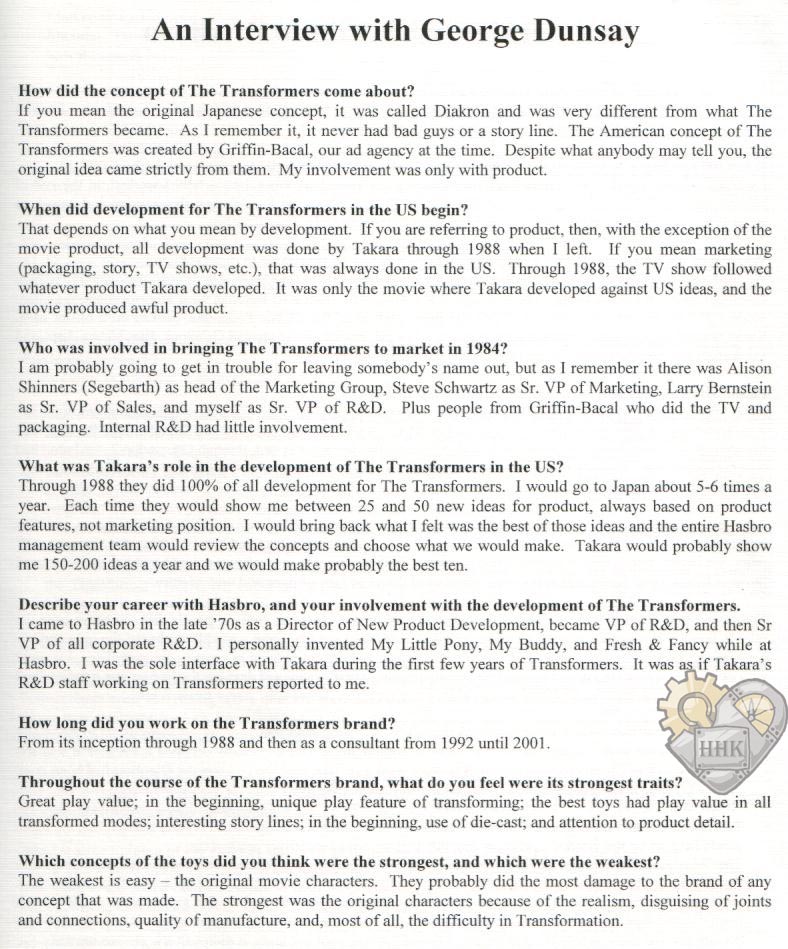
- The fact is that Orenstein had worked for Hasbro during the 1980s, and was the person who had convinced George Dunsay, then Hasbro's Vice President of R&D, to acquire the rights to a (more or less) innovative type of Japanese toys, which would eventually become known as the original Transformers toys. In addition, Orenstein shares the original patent for the rubsigns with Dunsay. Aside from that, his contribution to the Transformers brand is marginal at best. Obviously, the writer of said newspaper article had only marginal knowledge of the history of the Transformers brand, was told what was most likely nothing more than an anecdote by Orenstein (his biography is full of fascinating episodes, by the way), and subsequently inflated it massively with hyperbole, possibly in an attempt to gain more attention to his article due to the popularity of the brand, even before the 2007 movie. The only question is, where did the photographer get the 20th Anniversary Optimus Prime toy from?
Generation 2
- "Generation 2" means "after The Transformers: The Movie."
- This common but explicitly false idea probably stems from the many casual fans who grew up with the original Transformers line but stopped paying much attention around 1986, when the animated The Transformers: The Movie debuted and the Transformers craze began to die down. Many such fans regained some interest in Transformers many years later, particularly with hype surrounding the 2007 live-action movie. Seeing the phrase "Generation 2" batted around in fandom, it might seem natural to assume it refers to the big changeover that happened with the animated film. It certainly didn't help that, early in the life of Dreamwave, Pat Lee shared in this misconception, leading other new arrivals to the fandom to ape his use of the term.
- While the original animated movie certainly marked a change from one "generation" of toys to another, along with some new design trends, the phrase "Generation 2" refers to a very specific franchise, marketed from 1992 to 1995—years after the animated film had come and gone. Its relative obscurity probably contributes to the mis-attribution of the term, as Generation 2 marks a low point in popularity for Transformers as a whole.
Beast Wars
- Beast Wars didn't originally have the Transformers branding attached to it.
- While the early Beast Wars toy packaging had the Transformers brand name in smaller type than the (much larger) Beast Wars logo, the Beast Wars toy range was always Beast Wars: Transformers from day one. Later on, with the release of the Transmetals and Fuzors subranges, the Transformers name was placed on front of Beast Wars, and increased the size and prominence of the Transformers name on the packaging. Also a source of this confusion for people in the United Kingdom is that Beast Wars figures were available in multilingual packaging as either Beast Wars Biocombat' or 'Beast Wars Anti-Mutants', further reducing the prominence of the Transformers branding, and that British commercial broadcaster GMTV edited the Transformers name out of the title sequence on their airings of the television series.
2001 Robots in Disguise
- The Robots in Disguise toyline was known as "Transformers 2000" in Japan.
- As information about the then-new Car Robots toyline began to trickle out of Japan in 2000, early rumors purportedly from Japanese sources indicated that it was officially named "Transformers 2000".[2] It's possible those Japanese sources were also going by early, inaccurate rumors or perhaps a soon-to-be-discarded working title for the line. The idea persisted with many Western fans well after the true name of the show was revealed, encouraged by online import retailers (who were equally misinformed) using the title to promote pre-orders on their sites.
- Robots in Disguise Side Burn was so complex, the toy's designer later apologized.
- Basically. Car Robots Speedbreaker was the first Transformers toy designed by Hironori Kobayashi, and it kind of shows. In a later interview, he admitted that the development process was a "painful experience" and an "admonition" to do better in the future.[3]
Alternators
- A yellow version of Alternators Tracks was released to North American stores (but then recalled by Hasbro).

- When Hasbro (and Takara) originally announced the Alternators version of Tracks in 2004, the toy's vehicle mode's primary color was yellow. This caused the ire of a significant portion of the fandom, which insisted that the toy had to be blue, like its Generation 1 predecessor.
- However, while Takara did release their Binaltech version of the toy in yellow, stolen samples of the Hasbro version eventually surfaced which were indeed blue rather than yellow. Hasbro eventually confirmed at OTFCC 2004 that the initial idea had been to release the toy in yellow first, and then later as a running change variant in blue, like Takara would ultimately do. However, Hasbro had encountered problems at the test shot stage, where it became evident that some of the toy's innards were shining through the yellow plastic. As a result, plans for a release of the yellow version were scrapped, and it was decided to release the blue version from the get-go.
- However, around the time when the yellow version of ("Autobot") Tracks was originally supposed to arrive in stores, rumors started circulating that some stores (usually Walmart) had indeed received a shipment of the toy, but were then asked by Hasbro to send back the entire batch. Some variants of this rumor later even claimed having seen a cell photo from the friend of a friend depicting a yellow Alternators Tracks in packaging on top of a case sporting a "RETURN TO SENDER" note. Conveniently, circumstance always prevented these people from taking a photo and sharing it with the internet public.
- Needless to say, no substantial evidence has ever surfaced to back up these claims. Furthermore, there are several factors that make this story extremely doubtful: First, Hasbro—in their own words—discovered the problems with the see-through yellow plastic at the test shot stage (which is the entire point of this part of the production run). Why would they actually bother to continue the production run, print the packaging, pack the toy and send it to stores and then decide to recall it? Never mind that toy recalls are usually done due to safety concerns, not because of looks. Also, we've seen "leaked" (read: stolen) packaged samples of pretty much every single Alternators toy several months prior to its official release. Yellow Tracks? The last thing we saw of him was an unpackaged, painted sample with (intentionally) off-color Autobot insignia and "NOT FOR SALE" markings. In all the years since the toy's alleged stealth shipment to stores, not a single packaged sample has surfaced. Years later, longtime TFW2005 member Napjr, who hails from Mexico, admitted that he might have inadvertently helped spreading this rumor, originally started by a fake sighting by another Mexican fan.[4]
- The only "packaged" versions of a yellow Alternators Tracks we ever got to see were internet pranks of the "yellow Binaltech Tracks in photoshopped Hasbro box" variety. Which, of course, didn't help matters at all.

- Hasbro omitted Alternators Windcharger's gun barrel for safety reasons.
- When the first stolen test shots of Alternators Windcharger surfaced in 2004, the toy sported an extraordinarily long gun barrel (which doubled as the vehicle mode's drive shaft). The toy was ultimately released without the barrel, which was not shown or mentioned anywhere on the packaging or in the instructions. Indeed, Windcharger's weapon accessory was officially identified as a "shield" on the back of the packaging (in addition to the actual, ragtop roof shield). Takara, on the other hand, later released their own Binaltech version of the toy (named Overdrive) with the full barrel, prominently shown in the official promotional photos.
- The initial fan theory upon seeing the barrel-less toy was that Hasbro had gutted it for safety reasons, under the notion that the long barrel might pose a choking hazard. Even though this was refuted by actual experts on toy safety standards, the rumor still persisted. An official response from Hasbro's customer service department to an e-mail inquiry (published on a fan site's message board) confirmed that the reason for the barrel's omission was "so the accessory would not look like a weapon".[5] Eventually, Hasbro (in the presence of Takara representatives) would confirm the full story at BotCon 2005: It had indeed been Honda, specifically their North American branch, that had asked to remove the gun barrel and all references to "weapons" from the toy, its packaging and included paperwork. Honda's Japanese department, on the other hand, had no such concerns, which is why Takara were able to release the Binaltech version with the barrel intact.
Masterpiece
- Masterpiece Convoy has more diecast parts than 20th Anniversary Optimus Prime/Masterpiece Convoy is made almost entirely out of diecast/20th Anniversary Optimus Prime is made entirely out of plastic.
- This misconception was started by now defunct Hong Kong-based online retailer Action-HQ[6] and might have been extrapolated from the Alternators toys, which are made entirely out of plastic (except for the rubber tires) for their Hasbro releases, whereas their Japanese Binaltech counterparts feature a few parts made out of die-cast metal.
- In fact, however, the amount of die-cast metal parts versus injection-molded plastic parts is the same between 20th Anniversary Optimus Prime and his Japanese Masterpiece Convoy counterpart. The only differences between the two toys (not counting the packaging) are the shortened smokestacks for Hasbro's 20th Prime and the addition of painted battle damage that is missing from the Takara version.
Transformers Collection

- Takara's Transformers Collection had something to do with Dreamwave.
- In 2002, Takara launched their series of Generation 1 reissues named Transformers Collection, also commonly referred to as "bookbox reissues" or even "Dreamwave reissues" among fans. The reason for that is simple: The package art, especially for early releases such as Meister or Prowl, was directly taken from the covers of and promotional posters for Dreamwave's first Generation One mini-series drawn by Pat Lee. A common misconception among fans at that time was that Takara was coordinating their reissues with Dreamwave. Some even tried to predict upcoming reissues based on the existing Dreamwave covers. Yet Mirage and Sunstreaker never materialized.
- In fact, probably the main reason why Takara recycled Pat's Dreamwave artwork of those characters for the packaging of their reissues was its coincidental availability: The artwork had already been created and paid for, so why commission new art when they could just use what already exists? Furthermore, only about half of the TFC reissues actually sported "Dreamwave" package art, whereas the rest did use newly-commissioned art drawn by Japanese artist Hirofumi Ichikawa, who has never in his life worked for Dreamwave and had been drawing in this style long before Pat Lee rose to his brief "superstar artist" fame.
Prime
- Transformers: Prime was not initially planned to have any toys.
- The toy line for Transformers: Prime was very delayed, debuting roughly a year after the associated cartoon had premiered. Previously, at a BotCon 2010 panel about the then-upcoming Prime cartoon, a Hasbro representative had made a statement that they weren't talking about toys just then. Transformers fandom being what it is, a widespread belief developed that Hasbro was never going to make Prime toys at all. As additional information gradually surfaced, this evolved into a rumor that Prime would only have a small number of toys, with some further speculating that they would also be limited to the Deluxe size class (since initially only Deluxes had been seen). The eventual revelation of a full Prime toyline caused the belief to evolve once more, with the new theory being that there wasn't originally going to be a Prime toyline, but Hasbro changed their minds due to demand.
- The reality, as usual, was much less apocalyptic. The statement from the Hasbro Studios panel was never intended to refer to anything except the panel itself—the people in that room weren't going to be discussing toys at that panel. (In fact, Eric Siebenaler expressed excitement about Bulkhead's toy at the very same panel.) As for the delay in the line's launch, put simply, this was for appearance's sake. Hasbro wanted to establish Prime as a strong fictional franchise, rather than merely a glorified toy commercial, and reasonably concluded that launching a toyline immediately would detract from that goal. There was a point when a few Prime toys were planned to be released under the Transformers: Generations banner, but since Generations was at that time exclusively Deluxes, the aforementioned Bulkhead (a Voyager) indicates that this idea had already been abandoned when the rumors started.
- In short, this is just a matter of fans jumping to conclusions based on misinterpreted statements.
Europe (all generations)
- Optimus Prime's toy was originally not released in Europe due to a trademark conflict.

- In 1985, Hasbro launched the Transformers line on the European continent, using the domestic subsidiaries of Milton Bradley, whom Hasbro had recently merged with, to distribute the toys in countries such as France, the Netherlands, Belgium and Germany. The "MB"-branded Transformers toys were released in two waves before the packaging started to sport "Hasbro" logos in 1986. However, the first wave was a rather odd line-up, with many prominent characters missing, among them Optimus Prime. Instead, MB declared Jetfire the leader of the Autobots and even depicted him as such in a pack-in mini-comic. Furthermore, Dutch comic book publisher Junior Press, which published a translated version of the Marvel Transformers comic, initially renamed Optimus Prime into "Jetfire" for all his comic appearances. Optimus Prime's toy was eventually released with the second wave of MB-branded Transformers, and the Junior Press comics subsequently referred to him by his correct name. The reason for Optimus Prime's initial omission from the MB line-up is claimed to be due to a trademark conflict: A Swedish manufacturer of kitchen utensils named "Optimus" allegedly made the use of the name unfeasible for the time being. This theory was widely accepted by the majority of the Transformers fandom for many years.
- It wasn't until several years later that the theory was put into question, if not to say completely refuted: A manufacturer of kitchen utensils usually does not operate in the "toys" field, thus making a trademark conflict unlikely to begin with. The rumor originates from an editor's note in the Junior Press comic trying to explain the "Optimus"/"Jetfire" name confusion and subsequent rectification, which claims that the Transformers were originally two toy lines by different manufacturers in the United States, and MB had only released one of them in the Netherlands, while the "copyright" to the name "Optimus Prime" belonged to the other manufacturer. Many years later, this editor's note (including the incorrect use of the term "copyright" rather than "trademark") was cited by a Dutch fan who added his own speculation (without marking it as such) about the "Optimus" company in a response to a website article about the MB Transformers, thus spawning the urban myth that was subsequently accepted by the fandom.[7]
- A much more likely explanation for the entire two-wave MB line-up that brings more sense to another odd portion of the Junior Press editor's note is the fact that a French company named Joustra released their own version of Takara's Diaclone line in many of the same markets as MB would release their Transformers toys in. The theory suggests that because of Joustra's exclusive contract with Takara, any toys from their Diaclone line-up were initially off-limits for MB's Transformers line-up.[8] A related theory suggests that Joustra's parent company, Ceji, got into financial trouble at the time, prompting them to sign a deal with MB to allow them to use their existing (but still unsold) Diaclone stock and release it in Transformers packaging instead. This explains why the second wave of MB-branded Transformers matches up almost perfectly with Joustra's Diaclone line-up.[9]
- The Generation 1 Seacon Overbite was released under the name "Jawbreaker" in some European markets.

- This appears to originate from the fact that issue 152 of the Marvel UK comics, the first appearance of the Seacons, refers to Overbite as "Jawbreaker", a name repeated in his appearance in issue 160 and an "A to Z" profile in the Transformers Annual 1989. In the early days of the Transformers online fandom, when information about (and scans of) the UK comics were made available to a larger number of American fans for the first time, they concluded that this must mean that the toy had been released under a different name in Europe—which is not entirely unfounded: Generation 1 toys had been released under alternate names in Canada and Italy; and many of the tail-end G1 toys that were released following the cancellation of the line on the United States market were also available in several name variants in various European markets. A further variation of this rumor even cited legal (possibly trademark) reasons as an explanation for the alleged name change.
- However, no substantial evidence has ever surfaced to back up this rumor; in fact, European fans, when questioned, all claimed to recall that the toy was called "Overbite" when released in their respective countries (except for Italy, where GiG actually didn't release the Seacons at all). Furthermore, the letters page in issue #164 of the UK comic features a question by a confused (British) reader who inquires about the "Jawbreaker" name, since the toy was called "Overbite" when released in the UK (which then results in a made-up-on-the-spot explanation on behalf of the Marvel staff to reconcile both names).
- So, why did the story identify the character as "Jawbreaker"? It's likely that writer Simon Furman simply got a few names mixed up, since the Overbite toy's instructions refer to his weapon as a "Jawbreaker cannon", and his weapon mode for Piranacon is called "Jawbreaker weapon" in the Piranacon assembly instructions. That, or "Jawbreaker" was an early working name for Overbite. Or, as his first appearance was very early in the year, when the story was written Marvel UK had received incomplete information about a toy that was not yet on sale.
- Some toys were exclusively (or predominantly) available in the United Kingdom (sometimes also the Netherlands).
- This likely stems from the fact that during the early days of the Transformers online fandom, when information from European countries was shared with American fans, two of the most active fanbases (or, at least, fanbases with members who were capable of, and interested in, engaging in conversations using the English language) as far as Europe was concerned were based in the UK and in the Netherlands. As a result, when information about toys (or toy variants) that were not available in the United States was spread, there simply were no fans from Germany or France around to confirm that the toys in question had also been officially available in their respective countries. (Although to be fair, it's quite possible that some toys, such as the Milton Bradley-branded Generation 1 toys, were indeed released in bigger quantities in the Netherlands than in Germany or France.)[10]
- As a result, the red variant of Tracks was initially branded a "Netherlands" release, as were some the Mexican toys originally produced by IGA for the Mexican market that were later imported to Europe through gray channels and sold in at least half a dozen countries (most notably exotic variations such as blue versions of Bumblebee and Cliffjumper). Meanwhile, tail-end G1 releases after the toyline had been cancelled as far as the United States market was concerned, such as the Action Master Elites, the "Classics" reissues, the Turbomasters or the Obliterators, were often referred to as "UK exclusives" (and are occasionally still to this very day), even though all of them were also available in numerous other countries—some of them even in Canada and Australia!
- Simply put, there are very few toys that were actually exclusive to a single European country: Alternators Meister and Cybertron Megatron have both only been released in Italy as far as the European (but not the American, or Australian, or Asian) market is concerned. Even the red "Powerlinx" version of Armada Thrust, which had originally been available as a "USA Edition" in Japan and was later found in Israel of all places, also has confirmed sightings for Italy, Portugal, Spain and the United Kingdom. The toy was even found in Australia, but only in stores that also occasionally sell toys imported from other countries, and again in European packaging, oddly enough.
- The first genuine "UK exclusives" were released as part of the accompanying toyline for the 2007 Transformers live action movie, namely a three-pack containing the Deluxe Class toys Autobot Jazz, Protoform Optimus Prime and Decepticon Brawl, and a two-pack, named "Towed to Safety", which contained the first of the two Deluxe Class Bumblebee molds and Longarm (not to be confused with the Screen Battles—aka "Battle Scenes"—"Final Stand" set, which was also available in the UK), both of them in their original decos. Meanwhile, other multi-packs or minor variants of toys from the 2007 movie toyline that were available in the UK but not in the United States were also available in other places, such as Japan, Hong Kong, Australia or other European countries again.
- A green variant of Trailbreaker was available in some European countries.
- This belief seems to stem from the fact that IGA's Mexican version of Hoist (which, like most Mexican Transformers, was widely available on the European gray market circa 1989, as mentioned above) used the same head sculpt as Trailbreaker. But like the "Blue" Bluestreak, no samples of an actual green version of the Trailbreaker mold actually sold as "Trailbreaker" have been found.
Takara vs. Hasbro
- Takara (alternatively, Hasbro) are solely responsible for designing, developing and manufacturing (all, or certain specific) Transformers toys.
- This was true only for the original Generation 1 toys, and possibly also the Generation 2 toys. Most of the toys from 1984 to 1986 were imported (and, occasionally, slightly altered) versions of already-existing Japanese toys originally designed and released by Takara. Following that, Takara developed new toys both for the Japanese and the Western market, now specifically with Transformers in mind. The primary exceptions are a handful of toys licensed from other Japanese companies (Jetfire, Whirl and Roadbuster, for example), and the 1986 toys for the animated movie, which were mostly based on designs by Floro Dery.
- However, ever since 1988,[11] most "main" line toys released both in Japan and the Western hemisphere (such as the Unicron Trilogy, Alternators, the 2007 Movie line and Universe/Henkei! Henkei!) have been designed and developed in cooperation between Hasbro (or its subsidiary Kenner) and Takara (now TakaraTomy). (For the specifics of this joint venture development process, see the article about toys.)
- Still, numerous reasons have led some people to assume incorrectly that all Transformers toy lines were solely developed by only one of the two companies:
- The Western public and mainstream media, naturally, tend to be unaware of the existence of Takara (TakaraTomy these days). It's therefore logical to assume that Hasbro, the company responsible for distributing Transformers toys outside Japan, is also solely responsible for developing and manufacturing the toys. The fact that Hasbro regularly chooses not to mention their Japanese business partner in official press releases and interviews hasn't exactly helped matters, either.
- On the other hand, Western anime fans are used to Japanese companies being solely responsible for designing robot toys, which are then imported and sold by Western companies. For lack of better knowledge, those people then simply assume the same also applies to Transformers toys — namely, that Takara does all the design and engineering work on their own, and Hasbro is merely the Western distributor of those toys. The fact that the back of Hasbro's packaging for Transformers toys sports a small note saying "Manufactured under license from Takara Co., Ltd." (changed to "TOMY Company, Ltd." on more recent toys) is occasionally cited as "proof" that Takara is the sole manufacturer of Transformers toys as well. A long paper trail of evidence to the contrary[12] has not been able to convince those people of the flaws in their conspiracy theory — rather, some of them have even postulated the existence of a so-called "Hasbro PR machine", whose sole purpose is to convince Transformers fans that Hasbro actually has a larger part in the development of Transformers toys than is actually the case.[13]
- That being said, there are indeed a few toys originally developed by either Hasbro or Takara without the other one's involvement, and then later picked up by the other company, but they're fewer than usually assumed: For Takara, those include the new molds for Beast Wars II, Beast Wars Neo and Car Robots, plus various mostly short-lived, collector-aimed, niche market lines (such as the new Robotmasters molds, the Smallest Transforming Transformers, the Hybrid Style toys etc.); for Hasbro, those are mostly either toys originally based on fiction-based franchises that did not originate with Hasbro (such as Animorphs or the Star Wars Transformers and their later successor, Transformers: Crossovers), cross-brand lines within Hasbro where the Transformers toys only make up one part of the overall lineup (such as the Titanium Series and the Robot Heroes figures) and a few very rare "main" line Transformers toys such as the Generation 2 Power Masters and Grimlock, Swoop, Alpha Quintesson, Energon Kicker and High Wire from Energon.
- Takara's Japanese-market releases are always of intrinsically better quality than their U.S. counterparts. (E.g., they have sweeter exclusives, and are always more show-accurate, have more accessories, and have tighter quality control.)
- This one depends a bit on the speaker, as it can either be a genuine misconception, a matter of opinion, or at worst, willful snobbery. But, like any broad generalization, it does have some basis.
- "Better quality" can refer to the fact that Japanese versions of individual toys sometimes have clear plastic instead of painted-on windows like Movie Bumblebee, or have vac-metallized parts where the equivalent U.S. release doesn't, like Energon Optimus Prime/Grand Convoy. Or, "better" quality can refer to the fact that Japan is a less litigious society, with different toy safety laws, and Takara can thus give Prime toys old-school long smokestacks, which are now shortened in the U.S. for safety reasons. These laws also mean that Masterpiece Megatron is freely available in Japan, but hard to get in the U.S. (the exact opposite of real handguns, ironically).
- "More show-accurate decos" does have some basis, as Takara frequently releases its toys later than Hasbro does Stateside, and thus they are better able to reflect discrepancies between late-run changes to a character's coloration in a show (such as with the original Rattrap or Armada's Tidal Wave). The most extreme example of this was Beast Wars Returns, the Japanese release of Beast Machines, which was years later than in the U.S., allowing Takara to add a lot of the deco that was added to the characters by Mainframe Entertainment that was not accurate to the original toys.
- "More accessories" mostly comes from the fact that some of Takara's releases have some extra accessories, but the only cases of this before the reissues were Fortress Maximus's two swords, Megatron's sword and bullets (even though the Japanese release lacked the barrel, scope and stock extensions) and clear cases from the various cassettes. Japanese reissues have included additional accessories from the cartoon (the axe, chain mace, Energon cubes and gun mode Megatron in the Transformers Collection reissues of Optimus and Megatron, Insecticons and Starscream, respectively, the Matrix from New Year's Convoy). Some Super Link releases came with redecoed Energon weapons as well. Henkei! Henkei! Hot Rod came with two missile launchers and missiles not included with Universe Hot Shot due to budget constraints, and featured the original tooling for the rear bumper for their inclusion. In contrast, Henkei! Henkei! Lambor was lacking the supercharger engine accessory Universe Sideswipe came with—TakaraTomy officially confirmed that they had deliberately omitted the optional piece of accessory to make the toy more "G1-accurate".[14]
- "Sweeter exclusives" is really a matter of taste. If endless redecos of Generation 1 toys as completely unprecedented Generation 1 characters, buying $40 worth of toys you got a month ago for a single Mini-Con, and shelling out half your mortgage for Lucky Draw gold chrome figures is what floats your boat, then yeah, Japan has better exclusives.
- "Tighter quality control" is a total myth. Takara products are manufactured under much the same production conditions as Hasbro's: Pretty much everything for both markets is made in China—in fact, according to Hasbro Australia representatives and Hasbro designer Eric Siebenaler, all of the Transformers toys jointly developed between Hasbro and Takara/TakaraTomy are manufactured at factories contracted to the Japanese toy company. This means Takara is (at least indirectly) responsible for whatever quality control problems occur with Hasbro-released toys. Takara's standards of quality control for their domestically-released toys are just as likely to let mistakes creep through. Just ask any buyer of Henkei! Henkei! Thundercracker how well his weapons stay attached to the arms. And let's not even get started on Masterpiece Rodimus Convoy's first production run.
- The fields in which Takara genuinely excels Hasbro are comparably minor: Takara's stock photography generally tends to be more impressive than Hasbro's, without obvious mistransformations and awkward poses, and at the same time looks more representative of the actual toy due to less reliance on blatant digital touch-ups. Likewise, Takara's instructions tend to be more detailed and useful than Hasbro's.
Other

- "Repackaged" toys are literally unsold toys sent back to Hasbro, taken out of the old packaging, put into new packaging and then sent back to stores.
- Every so often, a Transformers toy line features seemingly identical toys in multiple different packaging versions, such as multi-packs containing toys that were previously available separately. In addition, some toy lines also feature rebranded items, namely toys that were originally released under one line, but are later re-released as part of another line with virtually no changes to the toy itself, only the packaging it is available in. The final stages of the original Universe line took the concept of "rebranding" to a new level, featuring numerous straight re-releases of toys from the since-ended Energon and Cybertron lines, among many others. Since then, it has been repeated with the 2006 Classics line, the 2008 Universe line, the 2010 Transformers line and many others. Because a common fandom term for those releases is "repackages", a popular misconception claims that those toys are literally "repackages": namely, unsold toys sent back to Hasbro, taken out of their old packaging, put into new packaging and then sent back to (different) stores. (The same train of thought also—very rarely—suggests that "repaints", another common fan term for redecos, are literally "repaints", i.e. existing toys painted over in new colors, rather than new production runs from the same toolings using new plastic colors.)
- Needless to say, this theory is dubious for various reasons. Generally, old unsold toys are not sent back to Hasbro. They either remain in the store until someone finally decides to buy them, or the store somehow dumps them, such as by selling them off to closeout chains. And even if Hasbro did regularly get sent back huge shipments of unsold toys, they'd be highly unlikely to go through the effort (and additional cost) of literally repackaging them. Hasbro confirmed this in January of 2009, stating that due to the toys being manufactured in Asia, it would be a waste of time and money to repackage them only to sell them at the same price-point.[15] Thus, they are not repackaged old product, but new production runs of previous product. These days, this misconception should be much easier to dispel: Every toy now features a manufacturing date stamp etched into the figure, as well as a product code tampographed onto the figure, thus proving that a figure was manufactured more recently than its superficially identical predecessor.

- A new toy that is vaguely reminiscent of an older toy is a retool of said toy.
- Hasbro likes to redeco toys a lot (usually to recoup the R&D costs for developing the original mold). They also like to release redecos of toys from older lines in newer lines. In some instances, Hasbro also don't just redeco a toy, they retool it (or create new toolings for new parts that replace parts of the old version of the toy)—sometimes to improve a feature or fix an error, but sometimes also to give the toy new features or gimmicks, or simply to make it different enough from the original version so owners of the original version would be interested in buying the "retool" as well.
- Some of those retools are comparably minor (such as Final Battle Jazz from the 2007 Movie line), whereas others can be pretty elaborate. Sometimes the retools are so elaborate that the line between "retool" and "new mold" gets blurred. The most drastic instances in this regard would be K-9 from Beast Wars (based on Wolfang from the same line) and Dark Crumplezone from Cybertron (based on the original Cybertron Crumplezone toy), both of which have most, if not all of their parts entirely retooled. Another borderline case would be the Armada Mini-Cons Mirage and Swindle, which were released around the same time and are based on the same basic design, share a similar body structure and have very similar alternate modes.
- However, sometimes fans definitely get too far decrying a new toy a "retool" (or "remold"). Toys that share some superficial design similarities, coupled with similar transformation schemes, are often mistaken for retools even though they're simply that: Similar toys based on the same general design, maybe even directly influenced by the older toy, but nothing more. For more examples, see: retool.
- Hasbro lost the rights to a lot of G1 Transformers names. That is why you see toys named "Autobot Jazz" or "Decepticon Brawl" these days. Takara is more competent than Hasbro and doesn't need to change their toys' names.
- That's not quite how name rights —aka trademark— work. There are indeed instances where another company has snatched a trademark, making it unavailable for Hasbro's use. The reason is because trademarks need to be consistently used in commerce (roughly once every year or so), or it could be considered "abandoned", making it open for grabs should another company try to claim it. "Hot Rod" is unavailable to Hasbro because Mattel holds several similar trademarks, "Bluestreak" was too similar to Gendron's "Toledo 'Blue Streak'" trademark, and a company named Lanard held the trademark "Shockwave" until a few years ago. This prompted Hasbro to use substitute names for toys based on these characters, such as "Rodimus Major" and "Rodimus" for Hot Rod, "Silverstreak" for Bluestreak and "Shockblast" for Shockwave (Hasbro has since managed to reacquire the "Bluestreak" and "Shockwave" trademarks).
- Meanwhile, the names with prefixes such as "Autobot" or "Decepticon"? Those are usually non-compound single real words from the English language. Hasbro's legal department considers them too "generic" to be easily defensible as trademarks, hence the addition of prefixes such as "Autobot Jazz", "Decepticon Brawl "or "Constructicon Devastator" for better protection. This does not work with names already trademarked by another company–otherwise, Bandai could release a toy named "Megazord Optimus Prime" tomorrow, and Hasbro couldn't do anything about it.
- For a while, it seemed like these trademark quibbles were limited to Hasbro, and Takara was somehow exempt due to a different market situation. However, the Henkei! Henkei! line saw the emergence of quite a few "Cybertron", "Destron" and "Stuntron" prefixes, implying that the trademark situation on the Japanese market was changing, and starting with the Movie line, TakaraTomy (now adopting Hasbro names instead of their established Japanese-market names) began to use "Autobot" and "Decepticon" prefixes. With Revenge of the Fallen and United, TakaraTomy even used prefixes for names Hasbro has been able to use without prefixes.
- Hasbro is responsible for your local store not having the newest toys right now.
- Hasbro actually has almost nothing to do with distribution (when Product A arrives in Store B) beyond making sure the manufactured product leaves the factories and shipyards of China at the desired time. Once the items arrive on US shores, they are almost immediately sent from the ships to the distribution centers for the retail chains that ordered them. From there, it's more truck rides to various regional warehouses, which is all controlled by the retailers, not Hasbro. After that, the schedule for taking product from those warehouses and putting it on shelves is dictated by each chain's inventory system.
- It's conceivable that Hasbro could take more control of the situation, but that would require chains like Wal-Mart to release the vise-like death grip they have on manufacturers' nuts that lets them dictate how the system works—and they're sooooooo not doing that.
- Hasbro should totally cater to the wishes of older collectors, as they purchase the most Transformers product.
- Fans would like to think they've got some sway over the direction of the Transformers brand. After all, they've been buying toys for many years (as opposed to the limited purchasing span of most children), and they buy many more toys than any individual child. And in truth, Hasbro does pay attention to the desires and discussions of its older buyers, even designing certain line segments like Alternators or Classics and its successors with collectors as the primary target audience.
- Collectors, however, simply can't compare to the vast numbers of children out there whose parents buy Transformers for them. The bulk of Transformers product is purchased for and/or by young children, and if a company like Hasbro wants to stay in business and keep making money (and by extension, more toys), it must design and market its products accordingly. No accurate figures exist on the collector/children ratio, but estimates mentioned at BotCon panels range from around 10% to 20% of all purchases coming from older collectors—enough to be worth listening to, but not at all the driving force behind the brand. Past toylines have shown that betting too much on sales from adult collectors can be disastrous.
- Furthermore, it's not as though the fans speak with a unified voice. More often, for every fan pushing for one particular idea, there's another fan who thinks that same idea is boring or awful.
Fiction
Generation 1
General
- Transformers were meant as a "genderless" race. Arcee and the other female Transformers were added to the brand because feminists complained about the Transformers all being male.
- When Bob Budiansky was assigned to work out the character details for the toys, he initially intended some of them to represent female characters, like Ratchet. However, he was not given permission by Hasbro to include females because the company feared it would have a negative impact on the sales of those toys.[16]
- For the comics, this was not a big deal, even though Budiansky still slipped in a female Cybertronian in the form of Aunty. For the cartoon however, Hasbro's interests had to be matched with those of the TV networks that would broadcast The Transformers. Since television requires a bigger investment than comics, but also offers the potential for a much better payoff, it is of interest for a TV network to broadcast material that reaches the highest possible demographic. Women make up half the population, so TV networks want at least one (hero) female character to bring in their views. Female characters were considered for inclusion in the cartoon as in its earliest planning stages, but story editors Bryce Malek and Dick Robbins chose not to pursue this angle until "The Search for Alpha Trion" introduced Elita One and her Female Autobots. In other Transformers cartoons, Female Override and Sari Sumdac have also been added to their respective series because of network demands, whereas Airazor, Strika and Botanica were a request from the writers to Hasbro.
- Despite persistent stories, there is no documented instance of feminists demanding the inclusion of female Transformers (and likely, they've got something better to do than complain about another generic boys show like there are hundreds of). There is, however, a comic story called "Prime's Rib!" which presents Arcee's introduction to the Autobot ranks as an attempt by Optimus Prime to appease human feminists. While the story is obviously satire, through hearsay it has become believed by some that it is what actually happened.
The original cartoon
- The original The Transformers series was redubbed anime which originated in Japan, just like Battle of the Planets, Voltron, Robotech and other such shows screened in the '80s.
- Although most moderate-to-hardcore fans are well aware that this is a fallacy, there are those more casual fans (or those who have not rewatched the Generation 1 cartoon since childhood) who are under the misconception that The Transformers was an anime.
- Although the original toyline and thus the characters' basic visual designs were taken from Japanese-originated products, the original characters, names, factions and entire story premise of the whole Transformers franchise were developed in the United States by Hasbro, Marvel and eventually Sunbow. Although the animation was farmed out to Japanese (and later also Korean and Filipino) studios, the writing and original voice recording of all four seasons of the original series plus The Movie was entirely done in America.
- This misconception probably stems from distant childhood memories of the cartoon, the fact that shows like the aforementioned Robotech were redubbed anime and the Transformers' obvious Japanese influences. This may also be due to passing exposure to the 2001 Robots in Disguise cartoon and the Unicron Trilogy shows which, viewed as an adult, are very obviously redubbed anime.
- This is in part related to the misconception that all Transformers toys are solely designed, developed and manufactured by Takara, and all Hasbro ever does is to put them in new packaging and distribute them in the Western market (see above). Because this is true for other Japanese robot toylines, and therefore it must also apply to Transformers.
- The Headmasters was going to be dubbed into English and shown in America.
- In America, "Season 4" consisted of "The Rebirth", a 3-episode mini-series. In Japan, "The Rebirth" was ignored, and a full-fledged series titled The Headmasters continued the story instead. Rumors once swirled in the fandom of an American-led dub of The Headmasters series; the dub was largely finished, goes the story, till the materials were lost in a warehouse fire.
- Given the meandering pace of the series (common for Japanese shows but anathema to American sensibilities), the presence of numerous characters who had no toy equivalent on US shelves, the incompatibility with the "Nebulan" head characters, the number of Japanese cultural references, and the very existence of "The Rebirth", this rumor seems unlikely on the surface.
- More to the point, no official confirmation or other evidence has ever surfaced to back it up. In all likelihood the rumor was probably a Chinese Whisper from the fact that the laughably-bad English language Omni Productions dub (or "Star TV" dub) was screened on UK satellite TV during the 1990s.
The Transformers: The Movie

- There exists an "uncut version" of The Transformers: The Movie containing all sorts of non-kid-friendly content.
- These stories stem mainly from the fact that many home-video releases of The Transformers: The Movie omit two relatively minor instances of characters using profanity, which during the 1990s resulted in some alt.toys.transformers posters advertising "uncut" VHS copies of the movie for sale, thus either intentionally or unintentionally creating the myth of a really foul-mouthed and ultra-violent alternate version of The Transformers: The Movie. At least one poster claimed to have uncut reels of the original film showing a number of violent scenes,[17] but, unsurprisingly, was unwilling to provide any form of proof.[18] So have ended all claims of uncut footage from the film.
- A much stranger rumor, whose origins are unclear, claims that the original theatrical cut of The Transformers: The Movie depicted Optimus Prime crumbling into dust after dying, and that that scene was cut by the distributor in mid-release because children were traumatized by the imagery. Interestingly, the "Death of Optimus Prime" track on the original soundtrack album does contain ten extra seconds of music. At the end, just before the song's final low-octave percussion sequence, there is a very distinct series of notes that appears nowhere else in the song and is not in the onscreen version. However, no other evidence of this "lost" animation sequence exists among the many storyboards, preliminary animations, interviews, varying formats, etc., that have come to light. The myth could be related to the death of Starscream, a few scenes later, where Starscream does indeed crumble to dust after being shot by Galvatron; time and distance could lead fans to confuse the two scenes.
- These claims should not be confused with the extra storyboarded scenes and early script revisions which have come to light over the years, which do in fact contain a lot more violence. But no evidence exists that any of these sequences, even those that made it to storyboard, were ever animated. Especially given the expense of producing full animation.
- See also: The Transformers: The Movie#Edits.
- Some portions of Unicron's dialogue were recorded by an actor other than Orson Welles.
- A common rumor in the Western fandom claimed that Unicron's final lines ("Destiny... you cannot destroy my.. destiny!") were recorded by Leonard Nimoy, based on claims that those lines sounded "different" from the rest of Orson Welles' lines.[19] Compounding the rumor is the fact that Welles died shortly after recording his TF:TM lines[20] (and indeed, one version of the rumor has Welles actually dying before completing his lines). Despite being debunked repeatedly (including by Susan Blu and Wally Burr, both of whom should know), this one still pops up from time to time.[21][22]
- The Transformers: The Movie/Scatman Crothers coined the term "ginormous", which has since been added to several dictionaries.
- In The Transformers: The Movie, Jazz, voiced by Scatman Crothers, described Unicron as "a ginormous, weird-looking planet". The word "ginormous", a portmanteau of "gigantic" and "enormous", was officially added by the Merriam-Webster Online dictionary in 2007.[23]
- Some fans believe that Crothers had coined the term, which is incorrect for several reasons. Even putting aside the notion that under this theory, Crothers is assumed to have ad-libbed the line (rather than simply reading it from Ron Friedman's script), the term has actually been around for much longer, being listed in the Oxford English Dictionary as a "British informal" word that has existed since at least the 1940s, and was originally military slang.[24]
- The Transformers: The Movie was never released in Japan.
- It is true that The Transformers: The Movie was not released in Japan at the same time it was released in Hasbro's markets, with Japanese fans instead getting the Scramble City: Mobilization OVA to explain the changes going into the third season of the show (second for Japan). But The Movie ultimately made it to Japanese theaters in August 1989. The various discrepancies between it and subsequent Japan-only Generation 1 fiction (such as who didn't survive the movie) are largely a matter of the Japanese animators and writers being unaware of the precise details of the film.[25][26][27]
- The Transformers: The Movie was released in Japan under the title "Matrix Forever".
- "Matrix Forever" is actually the shortened and slightly mistranslated title of a 20-minute video created to promote the Japanese release of The Transformers: The Movie, but some Western fans have been confused into thinking that The Transformers: The Movie itself was renamed "Matrix Forever".[28]
Japanese Generation 1 fiction
- In Japanese continuity, Megatron and Galvatron are two separate characters.
- There are a few instances of Japanese fiction (and advertising) that would seem to support this notion, all of which can be attributed to a lack of communication between Hasbro and Takara prior to the release of The Transformers: The Movie. All of them were ultimately ignored by the "primary" fiction, namely the (dubbed) third season of the cartoon (named Transformers: 2010 in Japan) and the accompanying manga, which followed the Western story concept of Galvatron being a reformatted Megatron.
- The second issue of The Story of Super Robot Lifeforms: The Transformers manga depicts Galvatron commanding a legion of automatons created in Megatron's image, which some non-Japanese-speaking fans misinterpreted as depicting Galvatron and Megatron co-existing.[29]
- In Japanese continuity, the Destrons (Decepticons) were invaders from a planet called Destron.
- The Autobots were renamed "Cybertrons" in the Japanese translation, resulting in a misconception that the Destrons (Decepticons) must hail from somewhere other than the planet Cybertron. However, the Japanese translation also used slightly different spellings for the faction, "Cybertron" (literally: サイバトロン, "Sa-i-ba-to-ro-n"), and the planet, (literally: セイバートロン, "Se-i-baa-to-ro-n"), commonly interpreted as "Seibertron" by Western fans, in order to avoid confusion, even though both words originally started out based on the English name "Cybertron".[30]
- This rumor presumably originates from an article a Thomas Wheeler had written for Attic's Collectible Toys and Values Monthly during the hiatus between the G1 and G2 toylines. According to that article, Hasbro chose not to follow this element of the story because of the similarity between the term "Destron" and G.I. Joe's "Destro" character. Of course, seeing as the story originated in America to begin with and was only dubbed into Japanese later on, this doesn't make a lot of sense. In later years, Wheeler wrote toy reviews for Master Collector's website, which occasionally also display a certain lack of knowledge about various toys and the Transformers brand's overall history, so it doesn't seem entirely out of place for him.
- Black Shadow and Blue Bacchus are both members of a "Space Mafia".
- Black Shadow and Blue Bacchus, two characters from Victory, both have their function listed as "Space Gangster". An early fan translation of their on-package bios misinterpreted the Japanese word for "gangster" to mean "Mafia", hence the belief that a "Space Mafia" exists in the Japanese Generation 1 universe.
- Metrotitan is a zombie version of Metroplex.
- Metrotitan was a Destron redeco of Metroplex from the Zone portion of Japanese Generation 1 continuity. For unclear reasons, Western fans believe that Metrotitan was a "zombified" version of Metroplex, and a stranger variation on this rumor holds that Metrotitan was somehow "regrown" from one of Metroplex's legs.[30]
European Generation 1 fiction
- Starscream and Shrapnel are female characters in the French dub of Generation 1.
- This rumor is only partly true. The Transformers cartoon used three different dub teams for the French version: one for the TV show's dub broadcast in Quebec, one for the TV show's dub broadcast in France and one for the 1986 movie used in both countries. Neither of the TV show's dubs depict Starscream as a female as he uses a distinctively male voice;[31][32] however, the movie's dubbing team used a female voice for Starscream, and at one point Megatron calls Starscream "une imbécile" (articles in French are gender-specific), clearly cementing Starscream's movie status as a female.[33] All the same is also true for Shrapnel, who is even referred to as "Mademoiselle Shrapnel" by Kickback in the movie.
- The German version of The Transformers: The Movie was edited and didn't depict Starscream's death scene.
- German TV didn't air a dubbed version of the original The Transformers cartoon until 1989. The Transformers: The Movie was aired for the first time on German TV in 1994, with only one repeat. For unknown reasons, a rumor was circulating for several years claiming that Starscream's death was considered too "violent" for German TV standards for children's programs and had therefore been edited out.[34] However, recordings of the TV airing still exist, which don't feature any obvious edits other than Spike's infamous "swear" line. Furthermore, a German DVD edition of the movie released in 2004 that features an entirely different dub also depicts Starscream's death in all its glory.
- An Earthforce story was written to promote the non-combining Constructicon toys.
- The comic story "Desert Island Risks!" from issue 264 of the Marvel UK G1 comic reveals that the Constructicons have somehow lost their ability to combine into Devastator. As a result, they try to build another Devastator as a new robot.
- Some fans mistakenly believe that this is somehow related to a re-release of the Constructicons (now in yellow) that were available in Europe after the Generation 1 toyline had ended in the USA. Those Constructicons omitted the extra parts necessary to form Devastator; and furthermore, Hook and Scavenger (neither of them officially named in this version; all six toys came on multi-purpose cardbacks simply named "Constructicon") were retooled to omit the tabs that were necessary for combining them (and Bonecrusher) when forming Devastator. Since the toys couldn't combine into Devastator anymore, fans believe that the Earthforce comic story was intended to serve as an "explanation" for this.
- The problem with this theory, however, is that the yellow "Euro" Constructicon toys were released in 1992; the comic story, however, had already come out in early 1990. If anything, "Desert Island Risks!" was based on the Action Master version of Devastator, which no longer consisted of six individual Constructicons. (Also, the individual Constructicons don't even appear in the story.)
Beast Wars
- In Japanese Beast Wars continuity, Optimus Primal and Megatron were the same characters as their Generation 1 namesakes.
- While Beast Wars Megatron and Optimus Primal were identified in early packaging as new incarnations of Generation 1 Megatron and Optimus Prime in the Western release of the toyline, the Japanese dub of the Beast Wars cartoon remained consistent with the original English language version in keeping the characters separate. In the Japanese dub of "The Agenda (Part 2)", Beast Wars Megatron, while relating the tale of the Golden Disk to Ravage, even describes Generation 1 Megatron as "My ancestor Megatron".[35]

- The characters of the Beast Wars II and Beast Wars Neo cartoons hail from the same time-period as the cast of Beast Wars.
- Beast Wars II and Beast Wars Neo remain at present the only Japanese-exclusive Transformers cartoons to have never been subtitled in their entirety, either officially or by fans. As such, even here on TFWiki, knowledge of their absolute specifics is far from 100%. But this particular misconception does have a nugget of truth in it: The first pack-in catalog included with the Japanese Beast Wars toys did indeed present Lio Convoy and Galvatron as contemporaries of Beast Wars Optimus Primal and Megatron. Subsequently, the Hasbro toy bios of Transmetal 2 Cybershark and Dinobots Magmatron further complicated matters by making vague yet recognizable references to the two Japanese cartoons: Cybershark's bio alluded to the Beast Wars II Seacons, and Magmatron's bio recalled both Beast Wars Neo's hunt for the Angolmois capsules and the character's "Emperor of Destruction" title; both likely derived from the original misconception.
- In truth, however, the thirty-sixth episode of the Beast Wars II cartoon established that the planet Gaea, on which the series was set—which was clearly intimated to be a future version of Earth—had been lifeless for tens of thousands of years. As the Beast Wars characters hailed from a time only 300 years after the Generation 1 era, when Earth was still populated, this made it apparent that their native time was long after that of the Beast Wars cast. A scant few weeks later, the Beast Wars II movie corroborated this with a guest appearance from Optimus Primal, who was treated as a figure of legend, and not a present-day equal of Lio Convoy's (though, many a fan initially interpreted this as supporting the above-mentioned misconception of Optimus Primal being the same person as Optimus Prime in Japan). Nearly a decade later, a fan translation of TakaraTomy's 2007 timeline, which clearly dated Beast Wars II and Neo shows to tens of thousands of years after the home-time of the Beast Wars cast, was the first exposure many English-speaking fans had to this idea, having long taken the catalog as immutable canon for the cartoon, but that is now firmly relegated to the status of a micro-continuity. As for the aforementioned toy bios, the references they made were thankfully parsed vaguely enough to mean little, if anything at all, to those unaware of either Japanese series, and many Hasbro toy bios from the Beast Era were already often contradictory to the material presented in the cartoons to begin with, to the point that the bios can be and generally are considered part of a separate continuity all on their own.
- In contrast to the Beast Wars II cartoon, though, the third chapter of the Beast Wars II manga, set in a different continuity from the cartoon, did follow the catalog's lead by showing Optimus Primal existing on Cybertron at the same time as Lio Convoy. Similarly, the Beast Wars II and Neo casts appear as contemporaries of the Beast Wars characters in IDW Publishing's The Gathering and The Ascending comic books, which was likely less a deliberate choice and more a product of the original misconception (except, here, the timeline of these comics treats the events that parallel those of Beast Wars II and Beast Wars Neo as having happened before the home time-period of the Beast Wars instead of during or after, which was a deliberate choice).
- In Beast Wars II, Apache is a drunkard as part of a Native American stereotype.
- Apache did indeed get drunk in the first episode of the Beast Wars II cartoon, but only in grief, believing (erroneously) that his actions earlier had caused the death of Lio Convoy (which didn't happen). He did not get drunk again for the duration of the cartoon, nor did he ever do so in the manga. Outside of that, the Native American stereotype "common" to Japanese fictions is a stoic, silent, and often mystical warrior—none of which could be used to describe Apache accurately at all.
- That's not to say there aren't some ethnic stereotypes in BWII that could be considered pretty offensive.
- Amusingly enough, in the sixth installment of the Beast Wars II manga, Lio Convoy gets drunk for no apparent reason and ends up trashing Apache's room.
Beast Machines
- A Beast Machines writer said, "Real heroes don't use guns."
- Beast Machines was the first (but not the last) Transformers series to explicitly avoid all hand-held projectile weaponry. While the villains still had traditional "blasters" mounted on their bodies, some of the heroes' weapons were more esoteric (such as Blackarachnia's energy-web attack, activated by putting her hands on the ground, or Optimus Primal's gauntlets, powered by absorbing enemy fire). According to story editor Bob Skir, this creative decision was agreed upon between the story editors, Fox Kids, Mainframe Entertainment, and Hasbro,[36] and it is indeed reflected in the toys as well.
- Note that many Maximals had weaponry that was functionally no different from a "gun"—compare Botanica's hip-mounted energy cannons, Nightscream's back-mounted sonic blaster, or Optimus Primal's chest-mounted energy disc launcher to Jetstorm's shoulder-mounted ray guns or Strika's wrist-mounted energy... tossing thingies.
- On his website, Skir also elaborated on his own position as a writer choosing if or how to portray gun use, including this statement: "Our heroes use their wiles and resourcefulness, plus a few cool weapons. Guns? I've never been a fan of them myself, and do not write heroes who need them."[37] Some fans interpreted Skir as condemning all gun use, even in the real world, no matter the circumstances. This led to the misquote, "Real heroes don't use guns,"[38] which remains a notoriously persistent error in the fandom. Skir, responding to the controversy, said on his site that "there are heroes who do need guns (such as the Punisher). Spider-Man doesn't need guns. Neither does the Hulk. And neither do Optimus, Cheetor, Black Arachnia[sic], et al."[36]
- Notably, the series immediately following Beast Machines did return to classic hand-held gun use among both heroes and villains. However, the more recent Animated series has again eschewed guns, probably because of its younger target audience.
2001 Robots in Disguise
- The Japanese Car Robots cartoon was a direct sequel to Beast Wars Neo.
- Some fans seem to have concluded, based on the similar animation style and overall tone, that the Car Robots cartoon was meant to pick up where Beast Wars Neo had left off, but all indications are that Car Robots wasn't meant to take place in any pre-existing TF continuity. But now Takara says it's in the Generation 1 continuity.[39]
Transformers (2007)

- The movie series takes place in the Generation 1 timeline in Japan.
- This is another one of those instances where one TakaraTomy thing, very early in the life cycle of a new Transformers franchise, will say one thing about said franchise, and then literally everything else ever will say another.
- When the live-action movie series was getting started, TakaraTomy went live with their "World of Transformers" web site. The website timeline made the rather bizarre claim that the 2007 live-action movie also somehow took place in the Japanese Generation 1 continuity in 2007, but this was not reflected by the accompanying flow-chart, and was established to not be the case by the Kiss Players timeline (which noted that the movie-verse Autobots and Decepticons came from another universe when they appeared in a Beast Wars crossover). And of course, nothing else ever attempted to make the connection.
- So... technically, in one micro-continuity this is true. Everywhere else? Not so much.
- Transformers was nearly rated R by the MPAA.
- In the spring of 2007, it was reported that Disturbia, a then-upcoming DreamWorks film starring Shia LaBeouf and produced by Steven Spielberg, had received an R rating from the Motion Picture Association of America. That film's rating was eventually lowered to PG-13 on appeal, but in the meantime some Transformers fans became confused and believed that it was Transformers that had been rated R, leading to some heated discussion on Transformers message boards.

- Brawl is named in the credits.
- The Decepticon tank, who was named "Devastator" in a subtitle in the movie, ended up being named "Brawl" in Hasbro's toy line. Both Hasbro and the screenwriters, Alex Kurtzman and Roberto Orci, have expressly favored the toy's name, referring to the name in the movie as an "error".
- Since the character has a "speaking" line in the movie, some fans claim that the voice actor is named in the ending credits, and the character's name is stated as "Brawl" there. In fact, however, there's no credit at all for the character, under either name, as he has no voice actor, his "speaking role" being little more than echo-y electronic gibberish.

- The Decepticons' hologram is Tom Banachek.
- Several Decepticons in the movie are seen using a holographic "pilot"/"driver" based on the same short-haired, mustache-clad human with an intense stare, only wearing different clothes to match their respective alternate modes. Since Tom Banachek, the head of Sector Seven's Advanced Research Division, also sports a mustache, a short-cropped hairstyle and a pretty intense stare, many fans mistakenly believe that the Decepticons' hologram is meant to look like him.
- There are two problems with that. One, the Decepticons' hologram, dubbed "Moustache Man" in the credits, is played by real-life United States Air Force Major Brian Reece, whereas Tom Banachek is portrayed by established actor Michael O'Neill.
- Two... how would the Decepticons know who Banachek even was to model a hologram after him?
Animated
- The Japanese dub of Transformers Animated presents it as a prequel to the live-action movies.
- This appears to have some basis: Back in March 2010, the then-recent edition of TV Magazine published some early pre-release information about the Japanese dub of the Animated cartoon. Among the details announced was the name-change of Bulkhead to "Ironhide", and changing his character to be closer in personality to Ironhide from the live-action movies. The article allegedly also claimed that because Optimus Prime was not Supreme Commander of the Autobots in Animated, the cartoon would be "set chronologically before the live action movies".[40]
- In actuality, however, not much of this has been reflected in the dub itself: Aside from the aforementioned renaming of Bulkhead into "Ironhide", there's nothing in the Japanese dub that ties the Animated cartoon any closer to the live-action movies than its American counterpart.
Revenge of the Fallen
- Barricade's return?
- A common misconception among fans is that Barricade's Saleen Mustang alternate mode was spotted on the set of Revenge of the Fallen, possibly as part of the alleged "disinformation campaign" director Michael Bay repeatedly insisted he had initiated. In fact, however, a truck transporting three "Barricade" prop vehicles was spotted in Culver City, California, in March 2008, more than two months before principal shooting for Revenge of the Fallen started.[41] There's been no indication that this had any significance other than moving the prop cars... someplace. Barricade would not make his reappearance until the next movie, Dark of the Moon.
Prime
- The High Moon Studios games are part of G1.
We really did look very closely at Generation 1 stuff and tried to capture what for us was the essence of the characters.Sean Miller, Director Character and Animation, Gameinformer interview
- With its designs aiming at a video gamer audience who grew up with Generation 1, the development team for War for Cybertron took a great deal of inspiration from the original cartoon for such things as characters and the design aesthetic for Cybertron.[42] A commercial even depicted Shockwave ordering Soundwave to play a song made famous by the original animated movie. Furthermore, War for Cybertron toys were sold as part of the Generations toyline that featured Generation 1-styled characters. These factors led many to believe the game was actually part of Generation 1.
- To be fair, there was and is virtually no information available to the average fan that War for Cybertron is not part of Generation 1. Hasbro has essentially been folding War for Cybertron into their modern continuity, and have been informing dedicated fans of this fact through question and answer sessions.[43] The War for Cybertron comic adaptation and online timeline actually are adaptations from Transformers: Exodus, which is the basis for the new modern continuity fiction.
- Canonically, both WfC and its sequel Fall of Cybertron are in the Aligned continuity, but beyond suggestions and mandatory changes from Hasbro, High Moon Studios doesn't seem to care about Hasbro's declarations of canon. In the art book for the sequel to WfC, The Art of Transformers: Fall of Cybertron, the only influences of the concept art and designs mentioned are G1 related. Dreamwave, the original cartoon, and other concepts and ideas from Generation 1 are cited, but the fact that Cliffjumper's head is based off of Prime Cliffjumper's is not mentioned, nor are the modifications to Optimus Prime's gun, Megatron's new body, Tox-En, or the other assorted influences from Prime.
- War for Cybertron/Fall of Cybertron is a prequel to the G1 cartoon.
- With its designs aiming at a 20-something audience who grew up on the original cartoon, many gamers would be forgiven for mistaking War for Cybertron for a prequel, and it doesn't help that the developers at High Moon Studios advertised the game as such. More savvy fans would recognize that the game is generally irreconcilable with the cartoon (or any other Generation 1 continuity for that matter): the circumstances of Optimus Prime's rise to power would contradict "War Dawn", and Optimus's predecessor does not possess the Matrix, unlike his cartoon counterpart. The Autobots left Cybertron because the Core shut down, not because energy sources were depleted, and characters like Jetfire, Breakdown, Cyclonus, the Aerialbots and Trypticon wouldn't be on Cybertron or even exist. Additionally, the game draws inspiration from other continuities, including characters not from Generation 1 like Slipstream and Demolishor. The game does share a lot of similarities with Dreamwave's War Within series (where Jetfire and Trypticon are present), but it cannot take place in that continuity either.
Companies
Marvel Comics
- John Romita designed the Generation 1 character models.
- The rumor here comes about through a misreading of the credits to The Transformers Universe. Legendary Marvel Comics artist John Romita, Sr. was listed as "Art Director", leading readers to assume that he was in charge of designing or developing the various character models used in the series (and reprinted in said comic). However, Romita was actually the Art Director for Marvel Comics as a whole at the time. The majority of the character models were in fact done by Floro Dery, who went uncredited.[44]
TakaraTomy
- Takara was taken over by Tomy.
- In 2005, it was announced that Takara, longtime Japanese manufacturer/distributor of Transformers toys, and former competitor Tomy would merge into a new company, named TakaraTomy, as of March 1, 2006. Some fans misinterpreted the media coverage, believing that Takara had been bought out by rival Tomy. This was not helped by official press releases declaring Tomy the "surviving company", Tomy having the majority of shares, and the merged company simply going by the name "Tomy" outside Japan.
- The name issue is easily explained, as it was done for purely pragmatic reasons. "Tomy" is an internationally established brand, since the company already had divisions in many other countries prior to the merger, and distributed their toys under their own name there. Takara, meanwhile, had mostly abandoned ventures into international markets years ago, and had its products distributed through other companies (such as Hasbro) instead. Therefore, the merged company decided to use the better-known name for its international business, while it would continue as "TakaraTomy" within Japan itself.
- Now, as for the specifics of the merger... Although the merger ratio was set at 0.356 of a Tomy share for each Takara share (including a split of Tomy's stock), and the companies announced a layoff of 15% of their combined workforce mostly on the Takara side, the term "merger" (as compared to "take-over") was prominently used in all the official announcements by the two companies, and twisting tiny details into a de facto "takeover" of Takara by Tomy is effectively splitting hairs.
- e-Hobby is owned by Takara (TakaraTomy).
- The e-HOBBY shop is owned by Part One, Ltd. Although the company has had close ties with Takara for decades, the online store also sells toys by other companies, primarily TakaraTomy's rival Bandai.
- The online store directly owned by TakaraTomy, meanwhile, is TakaraTomy Mall (formerly Toy Hobby Market).
References
- ↑ http://www.toyarchive.com/Transformers/Knockoffs/Sludge1.html
- ↑ http://groups.google.com/group/alt.toys.transformers/browse_frm/thread/e6436b92178f0c0a
- ↑ http://toyboxdx.com/phorum/read.php?3,97799,97800
- ↑ Napjr interview at TFW2005.
- ↑ "http://forums.tformers.com/talk/index.php?showtopic=13088 Response from Hasbro's customer service department regarding the lack of Alternators Windcharger's gun barrel.
- ↑ "20th Anniversary Optimus Prime Plastic?", November 2003.
- ↑ The origin (?) of the "Optimus trademark conflict in Europe" rumor? at The Complete Transformers Variants Page
- ↑ Mijo's "MB Transformers: Part 5" article at 20th Century Toy Collector
- ↑ Mijo's "MB Transformers: Part 4" article at 20th Century Toy Collector
- ↑ "MB Transformers: Part 6" at 20th Century Toy Collector.
- ↑ BotCon 2004 program guide interview with George Dunsay
- ↑ Exemplary rundown of the development process of Cybertron Leader Class Optimus Prime, shown during the Hasbro tour at BotCon 2007. Of course, Hasbro just replaced the name "Takara" in some of the steps with "Hasbro" in order to convince fans that... yeah, riiiight.
- ↑ ToyBoxDX thread with anime fanboys arguing that "Takara is an enormous toy manufacturing company. Hasbro doesn't manufacturer anything. The sole reason for its existence is for marketing the products of their partners and wholly-owned subs. Just to be clear here - Takara is bigger than Hasbro." They wouldn't even believe that Joe Kyde actually worked at Hasbro. No kidding.
- ↑ Interview with Hisashi Yuki in Transformers Generations 2009 vol. 1, English translation at TFW2005.
- ↑ SirStevesGuide.com, Tri-Weekly Hasbro Q&A - January 30th
- ↑ Rusting Carcass interview
- ↑ THE UNCUT JAPANESE TRANSFORMERS MOVIE
- ↑ Doth the Canadian protesteth too much?
- ↑ IMDB.com reference to the Leonard Nimoy-as-Unicron rumor.
- ↑ According to one biography, Welles recorded his TF:TM lines on October 5, 1985 and died five days later.
- ↑ Nimoy-as-Unicron rumor repeated by TFW2005 user "RedAlert Rescue".
- ↑ Slate.com discusses the Unicron rumor.
- ↑ Merriam-Webster adding the word "ginormous
- ↑ Oxford dictionary entry for "ginormous"
- ↑ http://tfarchive.com/community/showthread.php?s=&postid=216153#post216153
- ↑ http://tfarchive.com/community/showthread.php?s=&postid=216478#post216478
- ↑ http://tfarchive.com/community/showthread.php?threadid=30800
- ↑ http://groups.google.com/group/alt.toys.transformers/msg/a5d29844863d2c29
- ↑ http://tfarchive.com/creative/showentry.php?s=179
- ↑ 30.0 30.1 The Transformers Archive essay about various urban legends surrounding the Transformers franchise
- ↑ YouTube: Doublage de France: Combaticons et Égo
- ↑ Doublage Québécois: Égo et Dr. Croc-en-ville
- ↑ http://web.archive.org/web/20080612225831/http://www.bigbot.com/mp3/transformers_mp3.shtml#Femmes
- ↑ German movie database still listing the rumor about Starscream's "edited death" in TF:TM
- ↑ 我先祖のメガトロン, Waga senzo no Megatron
- ↑ 36.0 36.1 Archived Q&A from Bob Skir's now-defunct website, where Skir responds to the gun controversy (question 7).
- ↑ Article on the fan Dave "Zobovor" Edwards' personal site, quoting Bob Skir's original gun statement.
- ↑ Alt.toys.transformers thread with the misquote and attendant assumptions right at the start.
- ↑ http://tfarchive.com/creative/showentry.php?s=490
- ↑ TFW2005 reporting on TV Magazine article about the Japanese dub of the Transformers Animated cartoon, March 2010.
- ↑ Superhero Hype reporting on the spotting of Barricade vehicles in March 2008
- ↑ Gameinformer interview
- ↑ "The official story of the original 13 and specifically Alpha Trion has not been explored fully in the modern continuity that Transformers War for Cybertron, Exodus, and Prime are a part of." Hasbro Q&A/September 2010: Answers
- ↑ See Comic Book Urban Legends Revealed for more information.