Hasbro

Hasbro is a toy company, and owner of the Transformers brand in most markets outside of Japan, where it is owned by TakaraTomy.
Fiction
Marvel The Transformers comics
After Donny Finkleberg's adventures as Robot-Master, he got a job packaging toys for Hasbro. Darn 'n' Blast #308
Dreamwave Generation One continuity
Hasbro had many signs indicating its presence in San Desto. Extermination
2005 IDW continuity

A Toys"R"Us store in Times Square sold Hasbro products. All Hail Megatron #1
Timelines
Flamewar collects Hasbro memorabilia.
History

Hasbro was originally founded in 1923 as "Hassenfeld Brothers" by brothers Henry and Helal Hassenfeld from Rhode Island. The company originally sold textile remnants, but soon moved into manufacturing pencil boxes and school supplies. In 1952, Hasbro first rose to fame with a little toy called Mr. Potato Head. You might have heard of it. The company went so far as to purchase advertising time for the toy on a newfangled invention called television. You might have heard of that, too.
In 1964, Hasbro had an even greater success with the original G.I. Joe toy designed by Don Levine, which caused Hassenfeld Bros. to grow to be one of the largest toy companies in the USA. In 1968, the company would change its name to "Hasbro Industries, Inc."
Through a series of importing licenses and spin-offs, G.I. Joe ultimately led to the Microman and Diaclone toylines by Japanese toymaker Takara, which in turn would lead to Hasbro's release of the original Transformers toyline in 1984. At that time, Hasbro was employing the services of Marvel Comics and the advertising agency Griffin Bacal, who helped them come up with new marketing strategies and background stories for their toylines, including the revamped G.I. Joe: A Real American Hero and The Transformers.
In 1984, Hasbro also bought out a competing toy company named Milton Bradley (MB), which resulted in the merged company briefly assuming the name "Hasbro Bradley, Inc." After the merger was completed, the company changed its name into simply "Hasbro, Inc." Milton Bradley's European facilities would also be used to distribute the initial wave of Transformers toys to be released in Europe before the merger was completed. Later in the '80s, Hasbro would go on to release other toy brands such as Visionaries, My Little Pony, Inhumanoids, Robotix, Jem, C.O.P.S, and Battle Beasts — the latter eventually becoming closely (if strangely) related to Transformers.
In 1991, Hasbro bought out former competitor Tonka, and thus gained ownership of the names and character rights to Transformers 1980s toy-aisle rival GoBots. Since by that point in time Tonka already owned another former Hasbro competitor, Kenner, this acquisition also added Star Wars to Hasbro's portfolio. In the same year, Hasbro consolidated most of their international markets: Prior to this point, Hasbro subsidiaries such as the aforementioned Milton Bradley had still been responsible for distributing Transformers toys in some countries (even though the toys' packaging had sported the name "Hasbro" since 1986). Those subsidiaries were officially restructured and given the parent companies' name in an attempt to establish "Hasbro" as a worldwide household name.
In 1995 Hasbro transferred control of the Transformers franchise to its Kenner subsidiary, then phased out the Kenner brand in 2000.
In the new millennium, Hasbro, following Marvel's example, intends to reinvent itself as an "entertainment" company by staring a media producer, Hasbro Studios. Instead of merely commissioning animated TV shows as advertising vehicles for their toys, Hasbro licenses its brands to Hollywood studios, which turn them into big budget blockbuster movies, using the toys' established household names as a marketing appeal. 2007's Transformers movie was the first of those feature films. The sequel, Transformers: Revenge of the Fallen, and a G.I. Joe movie were both released in 2009, and movies based on the successful board game Monopoly and Kenner's old Stretch Armstrong toy have also been confirmed. Hasbro believes that their new "the movie of the toy" strategy will be more lucrative than the old "the toy of the movie" concept, which involves hefty licensing fees.[1]
In 2018, Hasbro partnered with Saban Brands as the master licensee to create Power Rangers toys. Later, on May 1 of the same year, Hasbro bought the rights to the Power Rangers franchise and other brands (My Pet Monster, Popples, Julius Jr., Luna Petunia, Treehouse Detectives) from Saban for an estimated of $522 Million.[2] The deal was finalized a month later on June 12, making Power Rangers a wholly owned property of Hasbro.[3]
2019 saw Hasbro further their ambitions in becoming a media powerhouse, as they announced the purchase of entertainmentOne, a Canadian media production/distribution firm, for $4 billion on August 22, 2019.[4] eOne, however, will remain separate from Hasbro's Allspark Pictures arm. This gave Hasbro control of the wildly-successful Peppa Pig and PJ Masks franchises (whose sheer value likely spurred Hasbro).... and, thanks to other acquisitions, the library of gangsta-rap powerhouse Death Row Records, which people were very confused by. In a strange case of irony, thanks to other mergers and spinoffs, eOne had bought Alliance Films and subsequently began using their logo fanfare; the original Alliance Communications had worked with Hasbro in the mid-1990s for the Beast Wars animated series.
Hasbro today

Employees
Corporate
- Brian Goldner, Chief Executive Officer
- Alfred J. Verrecchia, Chairman of the Board
- Aaron Archer, Vice President of Intellectual Property Development, Creative Director of Transformers
Boys' Toys
- Samantha Lomow, Global Brand Leader, Vice President of Marketing and Design for Transformers
- Vickie Stratford, formerly Sr. Design Project Manager for Transformers, transferred to the Star Wars brand as its head of design(?)
- Steve Bono, Design Manager, G.I. Joe and Action Man
- Eric Siebenaler, formerly Senior Product Designer for Transformers, transferred to the Star Wars brand
Girls' Toys
- Michelle Field, formerly Director of Marketing for Transformers and boys toys, now Sr. Director of Marketing for girls's toys
Toys for pre-schoolers!
- Jared Wade, formerly Director of Global Product Design for Transformers, transferred to the Sesame Street brand
- Brian Wilk, formerly Design Director for Transformers, transferred to the Playskool brand
- Greg Lombardo, formerly Sr. Director of Global Marketing for Transformers, transferred to the Playdoh brand
Transformers Brand
Marketing
(in alphabetical order)
- Michael Ballog, marketing
- Clint Chapman, Global Brand Manager
- Kristin Hamilton, international marketing
- Jared Jones, marketing
- Jerry Jivoin, Global Brand Marketing Director
- Forest Lee, copywriting
- Matthew Proulx, marketing
- Michael Vibede Vanting, Global Brand Marketing Director
Design
(in alphabetical order)
- Aaron Gray, designer
- Alan Roach
- Brian Chapman, Head of Design, Global toy/game/IP
- Chris Hicks, senior designer
- Joe Kyde, designer
- Joshua Lamb, design director
- John Warden, senior design manager
- Lenny Panzica, product designer
- Michelino Paolino
- Todd Patrick, packaging design
- William Rawley, product design manager
Hasbro's regional offices
Hasbro has smaller offices all around the world, who are not involved in the production of toys, but rather take care of the customer relationships and marketing in their local regions. Known locations of local offices include Denmark (covering the whole Nordic region), Canada, Germany (responsible for the distribution in continental Europe), the United Kingdom, France, Australia and New Zealand.
Relationship with fandom

The Fandom's relationship with Hasbro is as paradoxical and confusing as our relationships with our parents. They are an incredible source of joy and happiness, as well as the focal point of rage and blame for pretty much everyone in the Transformers community. To much of the fandom, Hasbro's actual involvement in the Transformers franchise is rarely acknowledged when not negative. Many view their activities to consist entirely of:
- Slapping fans in the face.
- Getting things all wrong.
- Screwing up Takara's toys.
- Being lazy.
- Trying to make money.
- Ruining everything forever.
When they found the time to create and maintain a successful, celebrated franchise that was the basis of 42 years of obsession and happiness for exactly the same fans is unknown.
In 2017, Hasbro decided to organize HasCon, their own fan convention for every brand they own or license. As that year's edition attests, HasCon is more focused towards children and casual fans than traditional conventions. To Transformers fans, this came after Fun Publications' TF fan club and convention license expired the previous year. This caused a good degree of discomfort among the community, especially since HasCon was decidedly different from BotCon and there is currently no replacement for FunPub's fan club.
Questionable brand decisions

- In the early days of the Generation 1 line's run, Hasbro was entirely focused on "product" and viewed the attached fiction as a mere marketing tool. As a consequence, they viewed "characters" as easily replaceable, and their strategy at that time can be summed up as "new toys, new characters". Hasbro certainly didn't anticipate the audience to actually become attached to the characters featured in the television show, and were utterly surprised by the fan backlash after nearly all of the 1984–85 cast had been graphically killed off in the animated movie and replaced by newly introduced characters. Hasbro now recognizes that this move was a mistake that hurt the brand.[5] In Hasbro's defense, though, it needs to be pointed out that this wasn't a flawed approach unique to them, as the importance of recognizable characters for the public image of a brand was a novel concept to the toy industry as a whole at that time. Hasbro have learned their lesson, and now mostly kill relative nobodies, and rely a lot more heavily on recurring, recognizable characters across their various toylines and the corresponding fiction. (At least as far as some people are concerned, they now veer too much towards the other end of the spectrum, with a perceived over-reliance on certain, seemingly omni-present characters.)
- Around 2001, Hasbro's corporate executives were eager to make the move to multilingual packaging for the United States market to save money, forcing that decision upon their Transformers staff. Although representatives were prepared with responses to fan complaints about how ugly and uninformative it was, the design team eventually managed to convince their higher-ups how ugly it was, so the US packaging returned to normal by 2005...[6] until 2015, that is, with the Robots in Disguise line and the Combiner Wars portion of the Generations line heralding the return of multilingual packaging to US retail once more, with cost-cutting once again being the primary driving factor.
- At times, Hasbro has been willing to allow the broadcast of clearly incomplete or poorly-constructed advertising media.

- Hasbro often have their official promotional toy stock photography done by people (both internal and outsourced third party photo studios) who have a tendency to display the toys in awkwardly mistransformed states and awkward poses, sometimes so glaringly incorrect that the photos could be viewed as detrimental representations of Hasbro's products... yet they are used in official advertising, including Hasbro's public website and even on the toys' packaging. Reportedly, Hasbro tries to send a member of the design team (at least an intern) along to the photo studio to transform and pose the toys properly whenever possible these days. Hasbro has also abandoned the "hand-painted early prototype" stock photos (which used to be printed on the toys' packaging) in favor of CG renders, which has eliminated incorrect transformations at least for this stage of stock images. The "near-final sample" stock photos still occasionally suffer from this problem, though.

- As the toys became more and more complex, Hasbro's official toy instructions became less and less helpful. Written directions were omitted entirely in favor of pictures-only instructions with the launch of the Armada line in 2002, and those pictures-only instructions have a tendency to omit useful steps, are sometimes unclear on vital details, and might occasionally be based on early prototypes that differ from the final toy, thereby including transformation steps that aren't possible with the toy in hand. Universe Sideswipe even recycled the instructions from his mold-mate Sunstreaker, even though Sideswipe was supposed to use an alternate transformation as compared to Sunstreaker. Over the years, Hasbro have made various attempts to improve the instructions: For a while, they replaced the line-art with gray-scaled photos of prototypes, which didn't always improve matters; these days the instructions use CAD renders of the toys. Another approach was to simply make the toys less complicated (which was also a cost-cutting measure), much to the chagrin of many a fan.
- In the lead up to the 2007 live-action movie, to deal with the expected international audience for both the movie and the accompanying toys, Hasbro started to redirect visitors of their official Transformers website to localized versions of the site based upon their IPs. However, it was obvious that Hasbro's interest in their international markets was rather marginal, as demonstrated by the fact that many of these international localised sites were rarely updated, if at all; and if they were, the updates were still marginal, and the product lists remained incomplete. To the frustration of non-American fans, clicking any links to the US version of the site resulted in the user being automatically redirected to their outdated localized versions. Even bugs that allowed users to circumvent the redirect were eventually "fixed" in favor of an even more aggressive redirect. This was finally resolved for good in 2009, with the addition of a US-specific URL path that doesn't redirect anyone anywhere anymore. As of 2019, the redirect is back. You want our website in English? Based on your IP, your based out of Germany. Here, enjoy our incomplete German site. No English for you, kiddo!
- The somewhat more "mature" tone of the live action movie series up until Bumblebee, especially the crude and often sexually-themed humor, has been the center of much controversy. In particular, a lobbyist group named the Campaign for a Commercial-Free Childhood repeatedly tried to lobby the Federal Communications Commission into tightening regulations for marketing movies rated "PG-13" and associated merchandise to children.[7] Hasbro themselves appear to be still undecided about their official position regarding the more "mature" tone of the movies and its ramifications for the brand's public image, having left several questions to this effect unanswered.[8][9]
Home video
 |
 |
 |
Hasbro has produced some home video releases as part of their marketing strategies. The earliest of these were VHS tapes of Beast Wars packed with Beast Wars toys. Subsequently, two different Beast Machines tapes, along with another Beast Wars tape, were produced as giveaways for KB Toys promotions wherein you would get a free tape for purchasing Beast Machines toys. The promotions were not terribly successful, leading to leftover tapes being disposed of in various ways including being sold by themselves. The last VHS tape bundled with a toy held the first two episodes of the Go-Bots cartoon and came with a Speed-Bot toy. Since then, Hasbro has produced a variety of pack-in DVDs.
Releases
- VHS
- Beast Wars: Transformers — Aftermath & Coming of the Fuzors (Part 1) (1998, packed with Airazor or Razorclaw)
- Beast Wars: Transformers — Aftermath (1998, UK exclusive Claw Jaw pack-in)
- Beast Wars: Transformers — Coming of the Fuzors (Part 1) (1998, UK exclusive Spittor pack-in)
- Beast Wars: Transformers — Bad Spark & Code of Hero (1999)
- Beast Machines: Transformers — The Reformatting & Master of the House (1999)
- Beast Machines: Transformers: Battle for the Spark — Sparkwar Part I: The Strike (2000)
- Go-Bots — Typhoon Twister & Arctic Oil Spill (2003, packed with the Video Go-Bot edition of Speed-Bot)
-
The Aftermath & Coming of the Fuzors (Part 1)
-
The Aftermath
-
Coming of the Fuzors (Part 1)
-
Bad Spark & Code of Hero
-
The Reformatting & Master of the House
-
Sparkwar Part I: The Strike
-
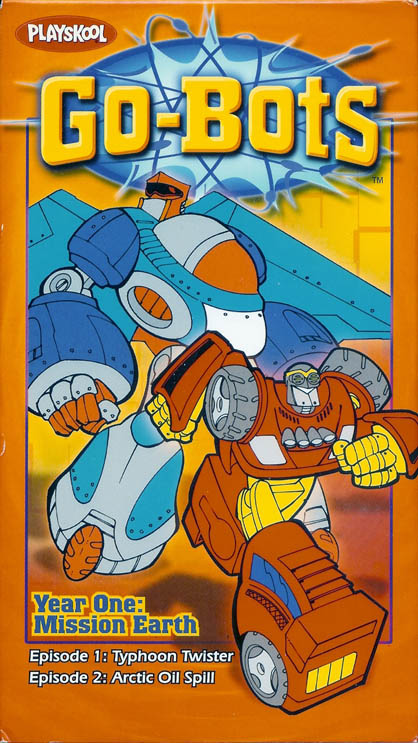 Typhoon Twister & Arctic Oil Spill

- DVD
- Beast Wars: Transformers — Equal Measures (with Cheetor)(2006)
- Beast Wars: Transformers — A Better Mousetrap (with Rattrap)(2006)
- Beast Wars: Transformers — The Spark (with Rhinox)(2006)
- Beast Wars: Transformers — Spider's Game (with Predacon Tarantulus)(2006)
- Beast Wars: Transformers — Possession (with Waspinator or Optimus Primal vs. Megatron)(2006)
- Beast Wars: Transformers — Code of Hero (with Dinobot)(2006)
Others
- Transformers: Cybertron — Hidden (2006)
- Optimus Prime vs Megatron: The Ultimate Battle (2006)
- Transformers Animated — The Battle Begins (2008)
- The Transformers — More than Meets the Eye (2008)
- Transformers: Prime — Masters & Students (2011)
-
Hidden
-
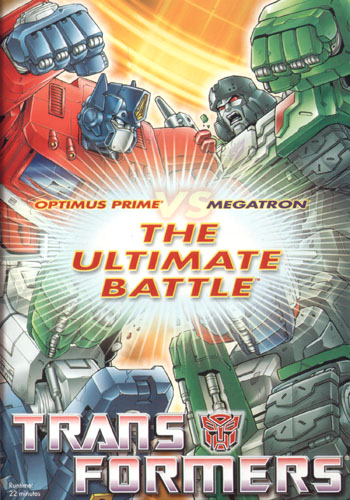 The Ultimate Battle
 -
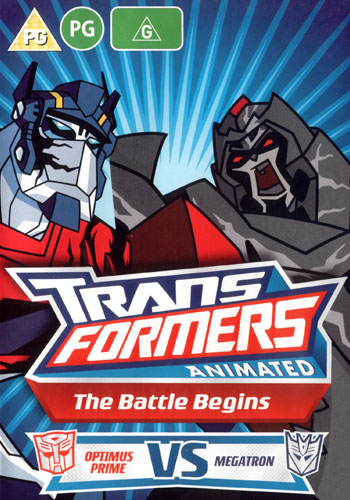 The Battle Begins
 -
More than Meets the Eye
-
Masters & Students


Streaming video
Hasbro Studios
Hasbro Studios is a subscription Roku app that features many Hasbro shows, including many Transformers titles.
Hasbro Studios Free
Hasbro Studios Free is a free Roku app that features many Hasbro shows, including many Transformers titles with advertisements. The shows in the app are also available on the Tubi TV website and its Roku app.
Notes
- Hasbro isn't all about selling toys and making money. According to Transformers live-action movie writer Roberto Orci, some at Hasbro argued against updating some returning characters in Transformers: Revenge of the Fallen, so that parents would not have to buy the same toy twice for their children just because of a minor change or modification to the characters' designs.[10] (We will just point out now that they still did that.)
- According to Hasbro Australia representatives and designer Eric Siebenaler, all of the Transformers toys jointly developed between Hasbro and Takara/TakaraTomy are manufactured at factories contracted to the Japanese toy company. This means Takara is indirectly responsible for whatever quality control problems you have been having with your toys, so you can stop complaining about it being entirely Hasbro's fault.
- Hasbro is the patron of the Hasbro Children's Hospital. See here for how the fandom contributed to it in 2010.
- In 2008, Hasbro purchased all rights to the library of Sunbow programming based on the toy company's brands, including the American Generation One Transformers cartoon and international rights to most of the televised Japanese Generation One canon.
- Hasbro owns Hasbro Studios, a media company which includes Allspark Animation, producer of the Prime, Rescue Bots, Robots in Disguise (2015), Cyberverse and Rescue Bots Academy cartoons, Boulder Media Studio, the animation studio for Cyberverse and Rescue Bots Academy, and Allspark Pictures, co-producers of the upcoming Bumblebee film. This represents a more direct involvement in producing media affiliated with its brands.
See also
Footnotes
- ↑ Brandweek article on Hasbro's new movie-related business strategy
- ↑ Press Release
- ↑ [1]
- ↑ Hollywood Reporter article on the acquisition
- ↑ USA Today: "Transformers: From Toy Story to Serious Art?"
- ↑ Steve-o's 2005 BotCon Report
- ↑ Ars Technica article on the CCFC/FCC story.
- ↑ July/August 2009 edition of the Allspark Hasbro Q&A
- ↑ July/August 2009 edition of the TFormers Hasbro Q&A
- ↑ Roberto Orci posting at TFW2005.com


