Transformers: More than Meets the Eye: Difference between revisions
Fusionwalrus (talk | contribs) Oddities on the Sunrunner and Bumblebee pages |
Fusionwalrus (talk | contribs) Missing pages in the cover gallery |
||
| Line 610: | Line 610: | ||
*In the IDW collected edition, at least, Darkwing's robot mode art has been incorrectly photoshopped with one image over the other, leaving him with an extra-thick torso, too many fins on the back and four arms, amongst other errors. | *In the IDW collected edition, at least, Darkwing's robot mode art has been incorrectly photoshopped with one image over the other, leaving him with an extra-thick torso, too many fins on the back and four arms, amongst other errors. | ||
*Excavator is listed as part of the "Micromaster Constructor Squad" instead of "Micromaster Combiner Constructor Squad." | *Excavator is listed as part of the "Micromaster Constructor Squad" instead of "Micromaster Combiner Constructor Squad." | ||
*Sunrunner is correctly drawn with propellers, but is labelled "jet" anyway. | *Sunrunner is correctly drawn with propellers, but is incorrectly labelled "jet" anyway. | ||
*On the left knee of Bumblebee's pretender shell, someone has typed the words "place text here". | *On the left knee of Bumblebee's pretender shell, someone has typed the words "place text here". | ||
*There were eight issues, but only six pages in the two cover galleries of the trade paperbacks. Issue #5 featuring Shockwave and Issue #8 featuring Cybertron were excluded. | |||
==Notes== | ==Notes== | ||
Revision as of 01:00, 2 January 2021
| The name or term "More than Meets the Eye" refers to more than one character or idea. For a list of other meanings, see More than Meets the Eye (disambiguation). |


Transformers: More than Meets the Eye is the first of a series of profile books published by Dreamwave Productions in 2003. The book included a profile for every extant Generation 1 toy character at the time of publication, plus some originating from the original cartoon and Marvel Comics continuity. A sequel series was published for Armada, and the same was planned for Energon.
The series has no known physical weaknesses.
Overview
More Than Meets The Eye was originally conceived to be a 4-issue series under the title of Transformers: Profiles and was intended to be outsourced by Dreamwave, to be written by Destination Entertainment. Destination's rather grandiose original plans involved weaving their own take on the Dreamwave timeline passively throughout all the character profiles, seizing this opportunity to shape some of the then-contemporary fiction since presumably they were being kept well away from contributing anything in the main books.
Destination's timeline was to have been a remarkably convoluted creation, having each original year of Transformers characters originating with each millennium of the war (with even the very definition of millennium here being stretched to "every million Cybertronian years"). The 1984 characters would originate in the first millennium, the 1985 ones in the second, and so on, despite this idea having been contradicted by books Dreamwave had already published at the time (and not making even remotely one lick of sense either way, as it would mean that, for instance, Kup would have been younger than Bumblebee).[1] Additionally, explanations as to how characters such Galvatron, Goldbug and Powermaster Optimus Prime could exist at the same time as their original counterparts were not forthcoming. Transformers Profile Book One was initially scheduled to be released in December, 2002.
Three months later, Destination was removed from the project and the entire endeavor was renamed into Transformers: More than Meets the Eye and re-solicited as a far more modest and uncomplicated series of Transformers: Universe-style profiles,[2] released as eight issues in 2003. The series was also released as a 2-volume trade paperback edition in December 2004, which included introductions by the authors, and bonus artwork, though not the intro and conclusion story.
The series profiled all characters that were released by Hasbro between 1984 and 1991, as well as a few characters that appeared only within Marvel Comics/Sunbow Productions animated projects between 1984 and 1987. The series also introduces new content in order to establish parameters for stories within the Dreamwave Generation One continuity, particularly in the "special topics" issue. A number of personalities were created from scratch for the Micromasters, many of whom were little more than names and mottos prior.
The profiles follow the same format as the original 1980s Marvel profile book, Transformers Universe. A characteristic quote leads off each bio, followed by Bio, Weapons/Abilities, and Weaknesses. Many profiles are told from the perspective of another character ("from the datatrax of"); Grapple, for example, narrates the profile for his friend and associate Hoist. Despite initial reports that the profile book would be re-creating the entire Transformers universe from scratch, most established characters stay close to their original profiles, with some occasional massaging when a character's popular fictional portrayals clashed with their profile.
Artwork was done by numerous artists. As such, there are stylistic differences among the various profiles. Some of the original art submissions were rejected as not being consistent with the Dreamwave "house style", i.e. that of Pat Lee. Lee's hand and/or influence is particularly visible on some of the earlier and more popular characters, who often feature his characteristic rounded, swollen limbs, tiny heads, and enormously thickened metal panels. Don Figueroa drew a huge number of profile entries as well, including many of the best known characters. Lesser known characters were apparently left to other artists, who were allowed a freer hand; however, attempts at conveying a character's personality through their profile art were generally quashed.
Issue #1

Issue #1 opens with a one-page intro story in which Beast Wars Megatron (or the Dreamwave universe's version of him) gains access to Vector Sigma, with the intent of reading all these files.
Originally published: April 30, 2003
Credits
- Writers: Adam Patyk & Brad Mick (for entire series)
- Pencils: Pat Lee, Don Figueroa, Guido Guidi, Mark Brooks, Makoto Ono, Ke Jiang, Sanford Greene, Alex Lin, Matt Kuphaldt, Dan Khanna
- Inks: Ferdinand Poblete, Erik Sander, Elaine To, Clayton Brown, Rob Armstrong, Don Figueroa, Makoto Ono, Sanford Greene, Matt Kuphaldt, Dan Khanna
- Colours: Pat Lee, David Cheung, Blond, Rob Ruffolo, Mike Majestic, Elliot Kravchik, Twincruiser, Kenny Martinez, Bonnie Cheung, Makoto Ono, Sanford Greene, Matt Kuphaldt, Dan Khanna
Profiles
- Aerialbots
- Airwave and his airport
- Alpha Trion
- Apeface with Spasma
- Arcee
- Astrotrain
- Axer and his Turbo Cycle
- Backstreet
- Banzai-Tron with Razor-Sharp
- Barrage
- Barricade
- Battletrap
- Beachcomber
- Beastbox
- Big Daddy
- Big Hauler
- Big Shot
- Blackjack
- Blackout
- Blaster
- Blast Master
- Blaze Master
- Blitzwing
- Bludgeon (2 pages)
- Bluestreak
- Blurr
- Bomb-Burst (2 pages)
- Bombshock
- Brainstorm with Arcana
- Brawn
- Broadside
- Bugly (2 pages)
- Bumblebee
- Buzzsaw
- Camshaft
- Carnivac (2 pages)
- Catilla (2 pages)
- Cement-Head with the Cannon Transport
- Chainclaw (2 pages)
- Chase
- Chromedome with Stylor
- Cindersaur
- Cliffjumper
- Cloudburst (2 pages)
- Cloudraker
- Combaticons
Issue #2

Originally published: May 29, 2003
Art Credits
- Pencils: Don Figueroa, Guido Guidi, Mark Brooks, Makoto Ono, Ke Jiang, Joe Ng, Sanford Greene, Alex Lin, Matt Kuphaldt, Dan Khanna
- Inks: Ferdinand Poblete, Erik Sander, Elaine To, Clayton Brown
- Colours: Blond, Mike Majestic, Elliot Kravchik, Twincruiser, Kenny Martinez, Chris Walker, Sigmund Torre, Trang Dang, Felipe Smith, Linda Bergkvist, Ramil Sunga
Profiles
- Constructicons:
- Cosmos
- Countdown and his rocket base (2 pages)
- Crankcase
- Crossblades (2 pages)
- Crosshairs with Pinpointer
- Crumble
- Cyclonus
- Darkwing and Throttle
- Detour
- Dinobots:
- Direct-Hit
- Dirge
- Dogfight
- Doublecross
- Doubledealer with Knok and Skar (2 pages)
- Doubleheader (2 pages)
- Downshift
- Dreadwind with Hi-Test
- Dropshot
- Eagle Eye
- Eject
- Erector and his crane
- Excavator
- Fangry with Brisko
- Fastlane
- Finback (2 pages)
- Fireshot
- Fixit
- Fizzle
- Flak
- Flamefeather
- Flattop and his aircraft carrier
- Flywheels
- Fortress Maximus with Cog/Gasket/Grommet, Cerebros, and Spike (3 pages)
- Freewheeler
- Freeway
- Frenzy
- Full-Barrel
- Galvatron (2 pages)
- Gears
- Getaway with Rev
- Gnaw
- Goldbug
- Grand Slam
Issue #3

Originally published: June 25, 2003
Art Credits
- Pencils: Don Figueroa, Mark Brooks, Makoto Ono, Ke Jiang, Joe Ng, Alex Lin, Pat Lee, Andrew Froedge
- Inks: Ferdinand Poblete, Elaine To, Clayton Brown
- Colours: Blond, Mike Majestic, Elliot Kravchik, Sigmund Torre, Trang Dang, Linda Bergkvist, Shaun Curtis
Profiles
- Grapple
- Greasepit with his gas station
- Greaser
- Grit
- Grotusque
- Ground Hog
- Groundbreaker (2 pages)
- Groundpounder
- Groundshaker with his ATV
- Growl
- Gunrunner (2 pages)
- Gusher
- Gutcruncher with his Stratotronic Jet
- Guzzle
- Half-Track
- Hammer
- Hardhead and Duros
- Heave
- Heavy Tread
- Highbrow and Gort
- Highjump
- Hoist
- Horri-Bull and Kreb
- Hosehead and Lug
- Hot House with his fire station
- Hot Rod
- Hound
- Hubcap
- Hubs
- Huffer
- Hydraulic
- Hyperdrive
- Iguanus (2 pages)
- Inferno
- Insecticons:
- Iron Works with his communications station
- Ironhide
- Jackpot with Sights
- Jazz
- Jetfire
- Joyride with Hotwire
- Kick-Off with his Turbo-Pack
- Knockout
- Krok with Gatoraider
- Kup
- Landfill with Silencer and Flintlock
- Landmine (2 pages)
- Laserbeak
- Longtooth (2 pages)
- Mainframe with Push-Button
- Megatron (3 pages - includes Cybertronian forms)
Issue #4

Originally published: July 30, 2003
Art Credits
- Pencils: Don Figueroa, Makoto Ono, Ke Jiang, Alex Lin, Andrew Froedge, Marcelo Matere
- Inks: Ferdinand Poblete, Elaine To, Erik Sander, Keith Morris
- Colours: Mike Majestic, Elliot Kravchik, Sigmund Torre, Trang Dang, Linda Bergkvist, Espen Grundetjern, Rob Ruffolo
Profiles
- Meltdown
- Metroplex with Six-Gun, Slammer and Scamper (3 pages)
- Mindwipe and Vorath
- Mini-Spies (4 models - 2 pages)
- Mirage
- Misfire and Aimless
- Missile Master
- Moonrock
- Motorhead
- Mudslinger
- Needlenose with Sunbeam and Zigzag
- Neutro
- Nightbeat with Muzzle
- Nightflight
- Octane
- Octopunch (2 pages)
- Oiler
- Omega Supreme (2 pages)
- Optimus Prime (2 pages)
- Outback
- Overdrive
- Overflow
- Overkill
- Overload with his car carrier trailer
- Override
- Over-Run with his Attack Copter
- Perceptor
- Phaser
- Pincher (2 pages)
- Pipeline
- Pipes
- Pointblank with Peacemaker
- Pounce
- Power Punch
- Powerdashers (3 models)
- Powerglide
- Power Run
- Powertrain
- Predacons:
- Pretender Monsters:
- Birdbrain (2 pages)
- Bristleback (2 pages)
- Icepick (2 pages)
- Scowl (2 pages)
- Slog (2 pages)
- Wildfly (2 pages)
- Monstructor
Issue #5

Originally published: September 4, 2003
Art Credits
- Pencils: Don Figueroa, Ke Jiang, Alex Lin, Andrew Froedge, Marcelo Matere, Joe Ng, Rob Ruffolo
- Inks: Ferdinand Poblete, Elaine To, Tracy Ho
- Colours: Mike Majestic, Elliot Kravchik, Sigmund Torre, Rob Ruffolo, Susan Luo, Shaun Curtis
Profiles
- Protectobots:
- Prowl
- Punch/Counterpunch (2 pages)
- Quake with Tiptop and Heater
- Quickmix with Boomer and Ricochet
- Quickswitch (2 pages)
- Rad with Lionizer
- Raindance
- Ramhorn
- Ramjet
- Ratbat
- Ratchet
- Ravage
- Red Alert
- Red Hot
- Reflector:
- Repugnus
- Retro
- Rewind
- Road Hugger
- Roadblock (2 pages)
- Roadburner
- Roadbuster
- Roadgrabber (2 pages)
- Road Handler
- Rodimus Prime
- Rollbar
- Roller Force
- Rollout with Glitch
- Roughstuff and his military transport
- Ruckus
- Rumble
- Runabout
- Runamuck
- Sandstorm
- Scoop with Holepunch and Tracer
- Scorponok with Zarak and Fasttrack
- Scourge
- Seacons:
- Searchlight
- Seaspray
- Seawatch
- Shockwave (2 pages)
- Sideswipe
- Sidetrack
Issue #6

Originally published: September 24, 2003
Art Credits
- Pencils: Don Figueroa, Ke Jiang, Alex Lin, Andrew Froedge, Marcelo Matere, Joe Ng, Rob Ruffolo, Pat Lee, Guido Guidi, Makoto Ono
- Inks: Ferdinand Poblete, Elaine To, Tracy Ho, Erik Sander
- Colours: Mike Majestic, Elliot Kravchik, Sigmund Torre, Rob Ruffolo, Susan Luo, Espen Grundetjern, J. I. Winterbell Lee, Trang Dang, Cil Cheung
Profiles
- Siren with Quig
- Sixshot (2 pages)
- Sizzle
- Skids
- Skullcruncher with Grax
- Skullgrin (2 pages)
- Sky High (2 pages)
- Sky High
- Sky Lynx
- Skyfall with Top-Heavy
- Skyhammer (2 pages)
- Skyhopper with his helicopter
- Skystalker with his interstellar shuttle
- Skywarp
- Slamdance
- Sledge
- Slide
- Slow Poke
- Slugfest
- Slugslinger with Caliburst
- Smokescreen
- Snapdragon with Krunk
- Snarler (2 pages)
- Slapdash with Lube
- Soundwave
- Spaceshot
- Sparkstalker
- Spinister with Hairsplitter and Singe
- Splashdown (2 pages)
- Springer
- Sprocket with his Attack Cruiser
- Squawkbox
- Squawktalk
- Squeezeplay with Lokos
- Stakeout
- Starscream
- Steeljaw
- Stonecruncher
- Storm Cloud
- Stranglehold (2 pages)
- Strikedown
- Stunticons:
- Submarauder (2 pages)
- Sunrunner
- Sunstreaker
- Surge
- Sureshot with Spoilsport
- Swerve
- Swindler
- Tailgate
- Tailspin
Issue #7

Originally published: October 29, 2003
Art Credits
- Pencils: Don Figueroa, Ke Jiang, Alex Lin, Andrew Froedge, Marcelo Matere, Joe Ng, Makoto Ono
- Inks: Ferd Poblete
- Colours: Mike Majestic, Elliot Kravchik, Sigmund Torre, Winterbell Lee, Cil Cheung, Joshua Perez, Ed Racho, Sue Ng]]
Profiles
- Tailwind
- Takedown
- Technobots:
- Terrorcons:
- Terror-Tread with the Cannon Transport
- Thrust
- Thundercracker
- Thunderwing (2 pages)
- Topspin
- Tote
- Tracer
- Tracks
- Trailbreaker
- Tread Bolt
- Treadshot with Catgut
- Triggerhappy with Blowpipe
- Trip-Up
- Trypticon with Full-Tilt and Brunt
- Twin Twist
- Ultra Magnus (2 pages)
- Vanquish
- Vroom (2 pages)
- Warpath
- Waverider (2 pages)
- Weirdwolf with Monzo
- Wheelblaze
- Wheelie
- Wheeljack
- Whirl
- Whisper
- Wideload
- Windcharger
- Windsweeper
- Wingspan
- Wreck-Gar
- Blurr with Haywire
- Pretender Bumblebee (2 pages)
- Cyclonus with Nightstick
- Pretender Grimlock (2 pages)
- Hot Rod with Firebolt
- Pretender Jazz (2 pages)
- Kup with Recoil
- Powermaster Optimus Prime with Ginrai
- Scourge with Fracas
- Pretender Starscream (2 pages)
Issue #8

Originally published: December 3, 2003
Includes a one-page conclusion to the Megatron story begun in issue 1.
Art Credits
- Pencils: Joe Ng, James Raiz, Edwin Garcia, Don Figueroa, Alex Lin
- Inks: Rob Armstrong
- Colours: Mike Majestic, Elliot Kravchik, Sigmund Torre, Winterbell Lee, Joshua Perez, Ed Racho, Rob Ruffolo, Edwin Garcia, Sebastian Caisse, Ferd Poblete
Subjects
- The Ark (2 pages)
- Autobots (3 pages)
- Cloning Technology
- Combiners (2 pages)
- CR chambers / stasis pods
- Cybertron (6 pages)
- Cybertronian martial arts (2 pages):
- Decepticons (3 pages)
- Earth (2 pages)
- Energon
- Energon-based weaponry
- The Fallen (2 pages)
- Gladiatorial combat
- The Great Shutdown
- Guardian robots (3 pages)
- Headmasters (2 pages)
- Junk and Junkion (2 pages)
- The Matrix (2 pages)
- Micromasters
- Autobot Battlefield Headquarters
- Decepticon Anti-Aircraft Base
- Autobot Missile Launcher Transport
- Nebulon
- The Nemesis (3 pages)
- Powermasters
- Pretenders
- Quintessa and Quintessons (2 pages)
- Shockwave's experiments:
- Size/mass change
- Space bridge
- Sparks
- Special abilities (3 pages)
- Laser scalpels
- Teleportation
- Chemical spray
- Invisibility
- Telepathy
- Force field
- Null ray
- Super-speed
- Common enhancements
- Targetmasters
- Transwarp Drive
- Unicron (2 pages)
- Vector Sigma
- Wreckers
- Glossary (2 pages)
Omissions

- While More Than Meets The Eye featured Action Masters, it did not include Action Master versions of pre-1990 characters and therefore also not their partners. Thus the guide omits the following US characters and/or accessories entirely: Grimlock's Anti-tank cannon, Fistfight, Blaster's Flight Pack, Bumblebee's Heli-pack, Inferno's Hydro-Pack, Megatron's Neutro-Fusion Tank, Optimus Prime's Armored Convoy, Scorpulator, Jazz's Turbo Board, Prowl's Turbo Cycle, Starscream's Turbo Jet, Wheeljack's Turbo Racer, Tyrannitron, and Wingthing. This becomes goofier with the collected editions; due to their choice of artwork, Wingthing appears on the back cover but not in the actual books.
- Gasket and Grommet are not shown as separate vehicles, only in their combined form as Cog.
- Weapon modes are not shown for Scoop's Targetmaster partners Tracer, and Holepunch.
- Combined vehicle modes are not shown for the Mega Pretenders (Thunderwing, Vroom, and Crossblades).
- Ultra Pretenders Roadblock and Skyhammer are both missing their outer vehicular shells, though both are mentioned in the text.
- Base mode is not shown for the ATV.
- Only one-half of the Cannon Transport is shown (the same half, in mobile artillery mode, is shown with both partners.) Its base and combined transport modes are not shown at all.
- Mobile artillery and combined transport modes are not shown for the Missile Launcher.
- The Tanker Truck is not shown at all, either with its respective Micromasters or in the Micromasters reference section.
- The Anti-Aircraft Base's tank mode is not shown.
- Base and flight modes are not shown for the Battlefield Headquarters.
- Powermaster Optimus Prime's smaller robot form is not shown.
- Flattop's aircraft carrier is shown but not its 'interstellar jet' mode.
Errors and critiques


- In issue #2, Eagle Eye was drawn with his Generation 2 Decepticon namesake's jet mode. For the TPB, the art was edited somewhat to look more like the G1 character.
- In the trade paperback edition, the picture of Wingspan in robot mode has an Autobot insignia.
- In the trade paperback edition, Nautilator's weapon mode is depicted differently on Nautilator's page and Piranacon's page. (On Nautilator's page, his beast mode head and claws surround the weapon barrel; on Piranacon's page, Nautilator's beast head and claws are at the rear of the weapon.)
- The character models for Blackout and Spaceshot were reversed, so that Spaceshot was portrayed as the front half of their combined vehicle mode and Blackout as the rear half. This error carried over into the bio text as well, so it is entirely possible that the personality assigned to Spaceshot was intended for Blackout, and vice versa. This error was never corrected.
- Not an error per se, but the alphabetization is inconsistent. Earlier subgroups like the Dinobots, the Insecticons, and the combiner teams are alphabetized by their subgroup names, while the Micromaster teams are split up by individuals. However, while a deliberate decision may have led to alphabetizing some characters by their individual names and others by the name of their subgroup, Slapdash and Sureshot are definitely alphabetized incorrectly.
- Likewise, Micromaster bases are inconsistently shown. Some appear with their owners; of these, many are only shown in one configuration. Others only show up in the special topics issue.
- Many characters had their art drawn by multiple artists, with Dreamwave's editors picking the versions they liked best or those that fitted best with the profile. For example, Blades also had artwork drawn for him by Matt Kuphaldt that was not used for the final product.[3] That doesn't necessarily mean what ended up being published was always the best quality art, though that's a highly subjective matter.
What's not a subjective matter, however, is the fact that what was ultimately selected by the editors often resulted in different artists' artwork being used for the same characters' robot and alternate modes in many instances, leading to some glaring incongruities when the two modes appear side by side. For example, the angled windshield on Oiler's robot-mode chest (pictured at the top of this article) is a nearly-flat windshield on his truck mode. Optimus Prime (pictured to the right) has a similar problem as well as differently styled windows. Goldbug is drawn by Joe Ng as a very angular robot, whereas the vehicle mode is a very accurate rendition of a classic Volkswagen Beetle. Bumblebee's alternate mode, by contrast, bears only very vague resemblance to both a classic Beetle and a New Beetle. Even the clones, Cloudraker and Fastlane, appear very different to each other, though their respective poses (Cloudraker stood up straight and calm, Fastlane in a rather haphazard action pose) don't help either. - In addition, artwork for characters' alternate modes is, on occasion, a maddeningly literal drawing based on their toy, instead of any kind of accurate, in-universe representation of the actual object they transformed into. Ravage's tape mode, for instance, is more of a folded-up-robot mode than an actual cassette tape.
- In other instances, artists also applied their tendency to draw the robots with an excessive amount of detailing to the alternate mode. This results in Downshift's car mode being cluttered with a ridiculous number of panel lines, making for a rather unconvincing disguise.
- Octopunch's crab mode art is traced directly from his packaging art.
- Frustratingly, some of the best-known characters such as Megatron, Fortress Maximus, Starscream, Jetfire and Octane have some of the poorest artwork.
- In the IDW collected edition, at least, Darkwing's robot mode art has been incorrectly photoshopped with one image over the other, leaving him with an extra-thick torso, too many fins on the back and four arms, amongst other errors.
- Excavator is listed as part of the "Micromaster Constructor Squad" instead of "Micromaster Combiner Constructor Squad."
- Sunrunner is correctly drawn with propellers, but is incorrectly labelled "jet" anyway.
- On the left knee of Bumblebee's pretender shell, someone has typed the words "place text here".
- There were eight issues, but only six pages in the two cover galleries of the trade paperbacks. Issue #5 featuring Shockwave and Issue #8 featuring Cybertron were excluded.
Notes
- The original version of issue 3's cover depicted Goldbug, whose profile was published in issue 2, rather than Huffer.[4]
- During the time that the Dreamwave were releasing the individual issues it became known that they only ever had the rights to release Transformers comics in North America. With immediate effect supply of Transformers comics to foreign countries was stopped. This left international Transfans with only a partially completed run of MTMTE, and having to resort to other methods to acquire the remainder.
- Additional profiles for characters such as Sunstorm (rather notably absent in the MTMTE profile books) and the Female Autobots were to be released in Generation One 2004 Datatracks Annual. However, Dreamwave went bankrupt before it would be produced.
- As alluded to below, the covers for the collected editions are... odd. Megatron and Optimus's bios are both in Volume 1, but Megatron is on the cover of Volume 2. However, Optimus does have a profile in Volume 2 for his Powermaster form. Likely, Optimus was used first for marketing reasons.
- Optimus Prime's Powermaster partner is called Ginrai rather than Hi-Q, to match the then-current Toys"R"Us Commemorative Series reissue, though the character described is still Hi-Q.
- Gigatron is mentioned as a pioneer of the Powermaster process.
- These profile books say that a front-end Micromaster Combiner can combine with any rear-end Combiner, and vice versa, implying that in Dreamwave's G1 continuity, front-end Combiners can not combine with each other and rear-end Combiners can not combine with each other (a limitation untrue for the toys or other depictions of the characters).
Collections
Dreamwave released two trade paperbacks (TPB) of the entire collection. Volume 1 contained issues 1–4, Volume 2 contained issues 5–8. No changes were made to the order of articles, and as such the same criticisms apply. Both volumes are quite rare, and as a result can be expensive to acquire. It is much easier to obtain the original individual issues.
- DW Volume 1: October 27, 2004 (ISBN 0973381760, ISBN 978-0973381764)
- DW Volume 2: December 8, 2004 (ISBN 0973381779, ISBN 978-0973381771)
IDW Publishing later reprinted the Generation 1 guides, unchanged from the Dreamwave originals (bar the covers) (and thus reference the DW plots of the Great Shutdown, Shockwave's inventions of the Triple Changers, Duocons etc.).
- IDW Volume 1: October 1, 2008 (ISBN 1600102506, ISBN 978-1600102509)
- IDW Volume 2: December 10, 2008 (ISBN 1600102956, ISBN 978-1600102950)
Issue #8 would later be reprinted as part of Hachette's Transformers: The Definitive G1 Collection.
-
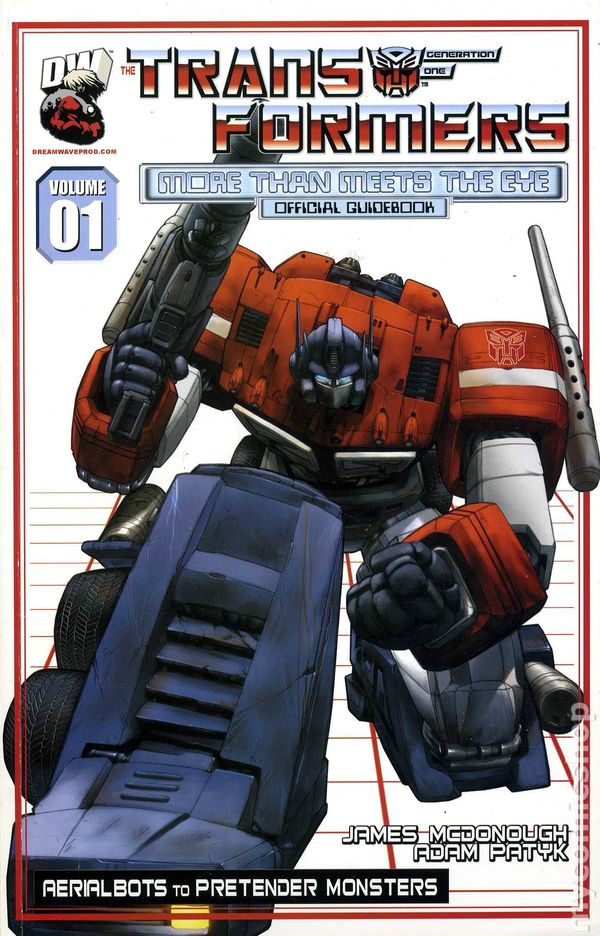 Dreamwave's Volume 1.
 -
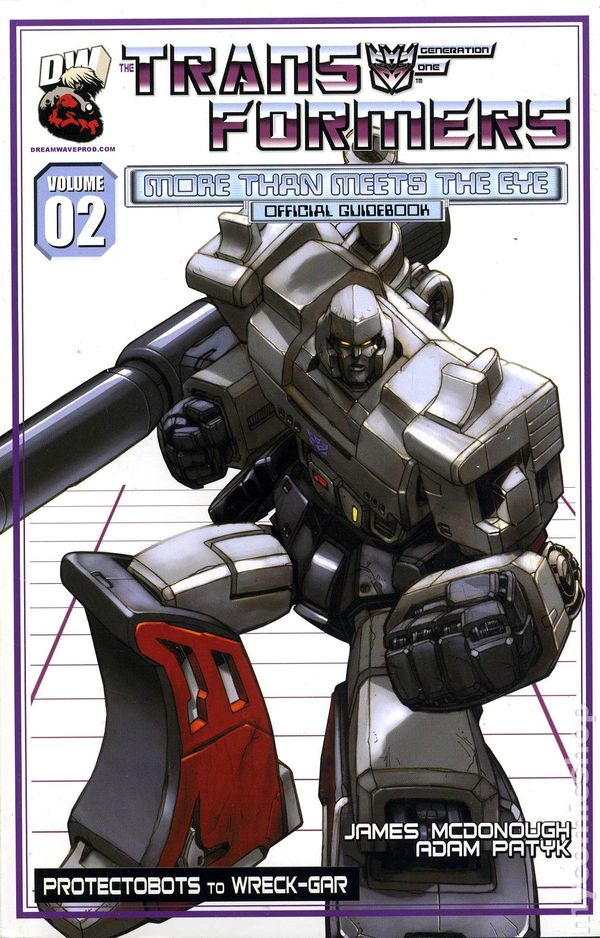 Dreamwave's Volume 2. Unsurprisingly, Megatron's bio is actually in Volume 1.
 -
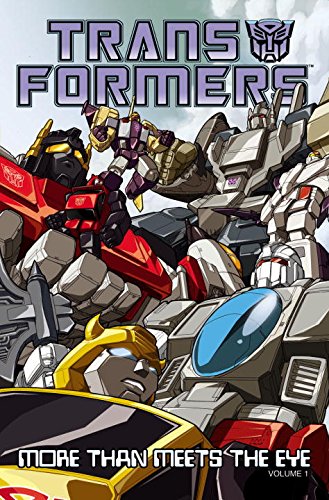 IDW's reprint of Volume 1.
 -
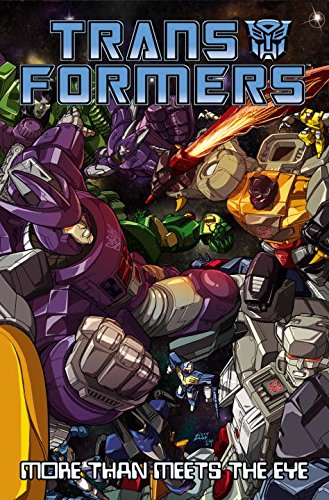 IDW's reprint of Volume 2. IDW continues Dreamwave's tradition.
 -
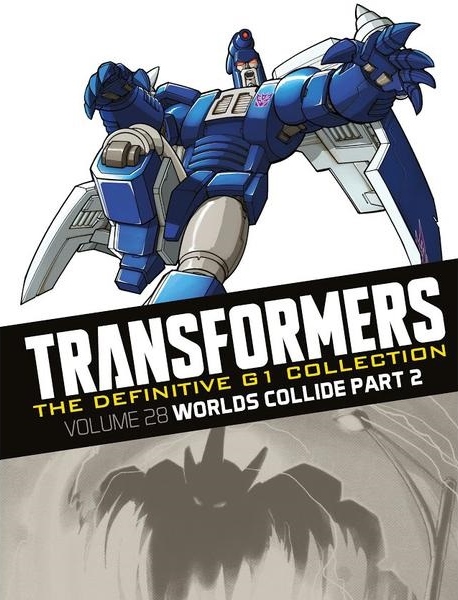 Scourge actually is actually in this book!


References
- ↑ Destination's original interview previewing Profiles at Newsarama
- ↑ Newsarama reports that Profiles has "transformed" into More Than Meets The Eye
- ↑ Artist Matt Kuphaldt's online portfolio, containing profile art for MTMTE not used for the final book.
- ↑ Mark Brooks' original cover artwork for MTMTE #s 3 and 4 on Deviantart


