Death
| This article is about the end of life. For the Horseman of Unicron, see Airazor (Armada). |

Transformers is a children's franchise, but at its core, it's a story of war. This means that the death of major and minor characters sometimes figures into the fiction.
Given the ambiguous nature of Transformer physiology, there is very little consistency regarding what is fatal to a Transformer, even within a single storyline. Damage that one Transformer might shrug off can prove fatal to another, or even to the same character in a different story. Sometimes just a laser blast or two will do the trick. Other times, characters survive being melted, crushed into cubes, and even utterly disintegrated. It does not take a terribly cynical viewer to conclude that the threshold of survival is generally determined by the needs of the plot.
The out-of-universe reasons for a character's death can vary from plot development to the arrival of new toys. Conveniently enough for writers who are beholden to the whims of a toy company, the majority of Transformers characters are machines, which means that death isn't necessarily permanent. Across the various universes, characters that appear to have been killed have been known to pop up alive again at a later date, or go through some sort of resurrection.
"Don't you even have mechanical hearts?"
"The humans don't understand! Our form of life is vastly different from theirs!"Spider-Man, Sparkplug Witwicky, and Optimus Prime, "Prisoner of War!"
In-fiction causes of death

There is little consistency in what can kill a Transformer. Sometimes it takes just a shot. Other times, even totally annihilating a Transformer's body still doesn't do the trick. Even the most basic method of killing, which is to destroy or otherwise cause the loss of a Transformer's spark, varies quite a bit in its details from story to story, character to character, and series to series.
However, over time there has been some convergence of concepts regarding Transformer design across the various franchises and storylines. The concept of Sparks as a Transformer's driving life force has become nearly universal, and with it, the notion that loss of Spark equals death. Various 2005 IDW continuity comics, particularly More Than Meets The Eye, have delved deeply into this, positing that a Transformer can die if their Spark, brain or (in a new and unique twist) transformation cog are sufficiently damaged, known as "Rossum's Trinity". MTMTE also makes note of the difficulties in killing a Transformer, and how things like decapitation may not be lethal in the right circumstances.
If one is so inclined, these concepts can be applied retroactively to many, if not all, older stories - so that various means of death described below can be seen simply as the means of inflicting the requisite damage on a Transformer's vital bits.
When a Transformer dies, the loss of their life force (or artistic convention, out here in the real world) often results in them turning gray. The most well-known example by far is Optimus Prime's death in the animated movie; Prowl can also be glimpsed turning gray as he falls during the shuttle assault. This idea has shown up in a few other places, such as the Animated cartoon and the More Than Meets the Eye comics, the latter of which coined the term "aggressive depigmentation" to describe the phenomenon.
Weaponsfire
| “ | This was almost too easy, Starscream! | ” |
—Megatron (like the fandom) is surprised to find how easily Autobots die, The Transformers: The Movie | ||


Like humans, Transformers can be killed by damage caused by energy, projectile, and chemical weapons. Just how many shots it takes is widely variable, however.
- In the original The Transformers cartoon:
- Many casualties of the Battle of Autobot City (and its run-up), including Prowl, Brawn, Ratchet, Ironhide, and Optimus Prime, are victims of energy weapons. The Transformers: The Movie This was quite a change from the cartoon's M.O., wherein the same characters routinely got shot and blasted all the time and shrugged it off, or at worst spent some time in the repair bay. Brawn and Prowl (whose tech specs show endurances of 9) both went down after one shot.
- Ultra Magnus subsequently "dies" after being shot a few times by the Sweeps, exploding into pieces. He is soon revived by the Junkions, however. The Transformers: The Movie
- In the Japanese continuity, Ultra Magnus dies again, for real this time, after Sixshot shoots him a few times. Ultra Magnus Dies!!
- In the Marvel comics:
- Impactor is cut down by a single head shot from Macabre. Target: 2006
- Most deaths in the Generation 2 book occur from energy weapons, such as Red Alert, Devices and Desires! as well as numerous generics. War Without End! Quite a few victims explode spectacularly after being shot, including Tantrum, The Gathering Darkness Runamuck, Quake, New Dawn and Smokescreen. Escalation!
- In the Beast Wars cartoon:
- Dinobot dies after incurring severe damage from numerous Predacon weapons. Code of Hero Other characters have survived similar or worse levels of damage, but the episode gave a reason: Dinobot refuses to go into stasis lock, which his onboard computer warns could "result in loss of Spark" if he keeps it up.
- Tigerhawk is disintegrated by the main cannon of the starship Nemesis. The same cannon subsequently blasts Inferno and Quickstrike, apparently killing them, though their "death" may be permanent simply because there was nobody around to put them back together - or at least, nobody who cared to. Nemesis Part 2
- Armada cartoon: Optimus Prime dies holding back the Hydra Cannon, the damage causing him to crumble to dust. Crisis
- Dreamwave G1 comics: Grimlock is gunned down by Motormaster. The Age of Wrath He got better. Prime Directive #3
- Universe: Tankor is shot and killed by Rhinox during the final battle of the Universe War.
- This happens a lot in the Movie continuity:
- Brawl and Blackout both die from weapons fire. Transformers
- Arcee and Elita-One and possibly Chromia are killed by Decepticon fire.
- All the Appliancebots are shot dead by Bumblebee.
- A crapload of Protoforms are shot down by NEST soldiers. Revenge of the Fallen
- Crowbar is shot in the face by Ironhide.
- Que is brought to his knees by a shot to the chest from a Decepticon protoform before Barricade finishes him off by shooting him in the back. Dark of the Moon
- Leadfoot is killed by a massive onslaught of gunfire from Cemetery Wind. Ratchet is brutally whittled down in a similar manner, until Lockdown comes and executes him. Age of Extinction
- "Shattered Glass": Megatron gets his face blown off/in by Cyclonus. Reunification: Part 4
- Many goons during the War for Cybertron die from being shot. War for Cybertron
- Prime cartoon: Dreadwing is killed by a shot through the chest by Megatron. Regeneration
- Cyberverse cartoon:
- Prowl leaps in front of a shot meant for Optimus Prime. While dialogue suggests he could have lived, he is not seen afterward as the lights in his optics fade out. Battle For Cybertron II
- In Megatron X's reality, the tyrant shot his universe's Optimus Prime with his fusion cannon and subsequently seized the Matrix of Leadership for himself. The Other One
- War for Cybertron Trilogy cartoon:
- Bug Bite and Exhaust are shot by Cog (Bug Bite in the chest and Exhaust in the head) and left adrift in space. Earthrise episode 6
- Barricade is possibly killed by a shot from Optimus Prime, since he never appears again and one of the AllSpark ghosts uses his character model. Kingdom episode 2 Kingdom episode 6
Big explosions
| “ | They're going to blow us all to pieces! Guardian's booby-trapped - packed with enough explosives to level this whole mountain! | ” |

Transformers characters often assume that explosions are more lethal than they really are; characters survive explosions all the time. An explosion's messy nature makes a good "out" for a writer to fake a character's death. The Wrath of Grimlock! Gone but Not Forgotten! The Agenda (Part 2) Nevertheless, a few characters have been permanently killed by explosions. (This list omits characters who exploded from within, like Ultra Magnus up above.)
- In the Marvel comics:
- Straxus is the victim of an interdimensionally triggered explosion that destroys his body. The Bridge to Nowhere! However, in the UK continuity he survives as a raggedy, bodiless head. ...The Harder They Die!
- In an alternate future, a wounded Inferno dies in the fiery explosion of a crashing shuttlecraft. The Legacy of Unicron!
- Roadbuster is killed when a prototype pathblaster exploded in his face. Time Wars
- Finback is presumably killed in the explosion of a huge gun battery. Misfire tried to warn him off, and may have been killed in the same explosion. On the Edge of Extinction!
- Beast Wars cartoon:
- Optimus Primal is blown to bits — terminally so — by the transwarp explosion that destroyed the Planet Buster. Other Voices, Part 2
- Depth Charge is killed by the explosion that resulted from Rampage's death (either his exploding spark, or the exploding energon shard that pierced it.) Nemesis Part 1
- Several of the Beast Era Wreckers (Sonar, Spittor, the Deployers) are destroyed when part of their ship explodes with them in it. Betrayal
- Energon: Bruticus Maximus is killed when Storm Jet causes a massive explosion that engulfed them both.
- Prime:
- Movie Continuty:
- Long Haul, Scrapper, and several Decepticon Protoforms are killed by a human air strike in Egypt. Revenge of the Fallen
- Crankcase blows up when Ironhide kicks him into a gas station. Dark of the Moon
- Blitzwing gets blown to bits when Bumblebee shoves his own missile into his chest and detonates it. Bumblebee
- War for Cybertron Trilogy cartoon: Elita-1, Jetfire, Chromia, Red Alert, Scrapface, and possibly Shockwave are caught in the explosion that destroys Kaon Arena. Earthrise episode 6
- Last Bot Standing: Strongarm died when Rodimus attempted to force her shuttle to land... and instead caused her to fatally crash. Last Bot Standing issue 3
Impact trauma
Falling off a cliff or mountainside or tall building is usually just as fatal to Transformers as it is to, say... Wile E. Coyote. Only on rare occasion does it result in death:
- Classics continuity: Hacksaw meets his end by falling from a huge communications tower. The New World
- 2005 IDW continuity:
- Doubledealer is shot, falls off a mountain and smashed to bits on impact. Spotlight: Doubledealer
- Infinitus gets knocked down a very big hole by Beak and dies. Last Light
- Movie continuity:
- Devastator falls off the Great Pyramid of Giza after a rail gun blows his arm apart. He tumbles back down the monument and collapses as he dies. Revenge of the Fallen
- Barricade is smashed to pieces and killed by being flung into a freeway column. Movie Adaptation Issue Number Four
- Hatchet meets his end when Dino sends him crashing into a car.
- The Beast falls off a cliff and shatters. The Beast Within Part 2, Consequences At least, we hope that's where and how it ended.
- Prime: Skyquake crash-lands after Bumblebee punched out vital components in his alternate mode, reducing his body to a partially transformed scrapheap.
- Last Bot Standing: Gripper met his end when he fell off a cliff and slowly bled out. Last Bot Standing issue 3
Disassembly

Taking a Transformer apart into its component parts - or ripping them to pieces - can occasionally kill them:
- Marvel comics:
- Bludgeon meets this fate in an alternate future, when Swoop uses a repair spider to pull him apart into his component pieces. Another Time & Place
- A future version of Ultra Magnus may have been killed when a group of Decepticons mobbed him and ripped him up. Time Wars

- Movie continuity:
- Megatron kills Jazz by ripping him in half. Transformers
- The Wreckers gang up on a Decepticon pilot and tear him apart.
- Optimus tears Shockwave's optic from his damaged head. Dark of the Moon
- Dropkick gets torn apart by a chain wielded by Bumblebee. Bumblebee
- 2005 IDW continuity:
- Pyro is torn apart and killed while making a final stand against a mass of generic Decepticons. Last Stand of the Wreckers #5
- Atomizer died when Getaway tore him apart. Journey's End
- Prime cartoon:
- When fighting Megatron's zombie army, Ratchet recommends dissection to Optimus to "cut" them down to size. How this is more effective then just blasting the living slag out of them is still up for debate. Darkness Rising, Part 4
- Airachnid manages to offline Breakdown by tearing him limb from limb, leaving only a pile of mutilated body parts in her wake. Crossfire
- War for Cybertron Trilogy cartoon:
Bifurcation

| “ | I have no desire to be carved up into Auto-sushi. | ” |
—Tracks, "Make Tracks" | ||
A particular subset of disassembly, getting chopped in half is pretty graphic for a kids' story, even one about robots, so it doesn't happen very often.
- Marvel comics: In a dream sequence, Grimlock slices Megatron in half, killing him. Victory!
- Japanese G1 cartoon: Predaking gets sliced in half by Dai Atlas. The strike dissects what appears to be an organic brain in his head. Enter the New Supreme Commander, Dai Atlas!
- Beast Wars Metals: Terrorsaur is killed by being sliced in half by Primal's mace. Beast Wars Metals #1
- Movie continuity:
- Sideways dies when Sideswipe slices his car mode in two.
- Ravage dies when Bumblebee yanks his spine out, tearing him apart.
- Jetfire slices Mixmaster in half at the chest but Mixmaster survived this. Getting his skull stomped off, not so much. Revenge of the Fallen
- Lockdown meets his end in this manner courtesy of Optimus Prime. Age of Extinction
- Cliffjumper gets vertically bisected by Dropkick. Bumblebee
- War For Cybertron: In the opening, a Decepticon goon is chopped in half by Optimus Prime.
- 2005 IDW continuity: Ambulon is chainsawed in half vertically by Pharma. The Divided Self (Ratchet specifically noted that horizontal bifurcation would be survivable - indeed, not much later, Megatron would be quite active after being ripped apart at the waist by Galvatron. Finest Hour: Dark Cybertron Chapter 5)
- Ravage later briefly survives being torn in half by Tarn, Rage, Rage before succumbing to his wounds. Do Not Go Gentle
- When Gozer attacked Cybertron, it tore Devastator in half, lengthways. Ghosts of Cybertron Part 2
Crushing

Quite a few characters have been crushed into deactivation:
- In the Marvel comics:
- Highbrow is smashed between Unicron's palms, while Bomb-Burst and Hardhead meet a similar fate when Unicron steps on them. On the Edge of Extinction!
- Inferno is apparently killed when a very large building collapses on top of him. Escalation!
- Unicron Trilogy cartoons:
- Thrust is killed when caught between two folding sections of Unicron's external armor. Union
- Shockblast is crushed by Unicron's hand on Blizzard Planet. The Power of Unicron
- His brother Six Shot meets a similar fate, crushed under the heel of a super-sized Galvatron. Galvatron Terror

- IDW continuity:
- Movie continuity:
- Dispensor is crushed under Ratchet's foot. Alliance #1
- Scorponok's head is crushed by Jetfire's bare fist. Revenge of the Fallen
- Shatter is crushed by a tanker ship that crashes into a dock. Bumblebee
Melting


They're made of metal; therefore, with enough heat or sufficiently acidic material, they can melt. This is one of the more fool-proof methods of killing a Transformer; few, if any, have survived it.
- In the G1 cartoon:
- An acid vat would apparently have been enough to destroy Optimus Prime. The Search for Alpha Trion
- Another acid vat is used to disintegrate living victims of Unicron. The Transformers: The Movie
- In the Marvel comics:
- Victims of the Decepticon smelting pools on Cybertron are reduced by intense heat into their base metals, including Scrounge. The Smelting Pool!
- It is possible that an acid bath from (naturally) Blot offlined Tracks (for a while anyway). Dark Star
- Scorponok is partially melted by Unicron's flame-breath and subsequently dies. On the Edge of Extinction!
- The Cybertronians use some kind of acid to rather messily eradicate some of their Decepticon ancestors, including Stranglehold. New Dawn
- In the Beast Era cartoons:
- Terrorsaur and Scorponok are apparently melted to death after tumbling into a lava pit within the Predacon base. Aftermath
- Optimus Primal's body is seemingly melted into the floor after his climactic face-off with Megatron. Considering how many god-like forces were unleashed and conflicting during the battle, his demise may be due to more than simple temperature-induced melting. Fallout
- According to Garrison Blackrock, the living metal that constitutes Cybertronian biology can be broken down using a cocktail of complicated polymers such as polyhydroxybutyrate; the process — one assumes — proving fatal to the Transformer in question. Aphelion
- Cyberverse cartoon: Drift is implied to have been melted by toxic Energon waste, as Hot Rod barely survived the experience. Battle For Cybertron III The Dead End
Disintegration
| “ | I saw the end! They died in a cosmic funeral pyre! | ” |

Plasma, energy fields, and stellar atmospheres can all utterly destroy a Transformer's body. Like being melted, being reduced to one's component molecules would seem to be a surefire way of getting killed, but quite a few characters seem able to survive the process as ghosts and/or disembodied sparks:
- Generation 1 cartoon: Starscream's spectacular death at the hands of Galvatron might be categorized as incineration. The Transformers: The Movie
- Quite a few characters met this fate in the Unicron Trilogy, but all survived it in some fashion:
- Megatron's spark persisted within his burnt-out body when he was dropped into the exploding Unicron. Mortal Combat Megatron Resurrected
- Demolishor's body was obliterated by an expanding energon grid, but his spark survived the process and was placed in a new body. Go for Unicron!
- Inferno was destroyed when he threw himself into a star, but his spark was salvaged by the Autobots and, again, placed in a new body. Farewell Inferno
- And finally, Megatron (Galvatron, whatever) threw himself into Primus's new energon sun to prevent Unicron from possessing him, killing himself yet again. The Sun This death was so inconsequential that his subsequent resurrection wasn't even explained! Fallen
- Megatron was disintegrated again, Cybertron before he returned to life thanks to unholy powers of the Armor of Unicron. Darkness After being stabbed through the Spark by Rhisling, his body disintegrated as he passed on into the next life. Unfinished
- Cosmic Rust causes a Transformer's body to disintegrate to nothing:
- The Thirteenth Legion died of Cosmic Rust. Cosmic Rust
- Ironhide dies after several shots from Sentinel's Cosmic Rust Blaster, though the big hole they left in his torso couldn't have helped much either. Dark of the Moon
- Exposure to even a single carrier of the disease has been known to wipe out entire planets. Blurr was one of its victims, along with the rest of Velocitron. Terminal Velocity
- In the 2005 IDW continuity, magic is one of the few things that can reliably wound or kill a Transformer; the energies unleashed are anathema to mechanical life, and Transformers exposed to such power soon begin to crumble and die. Casualties of this method include Kup Schismatic and Quickswitch. Good Men
Consumption
| “ | ...If we don't find the Matrix, some bad guy's gonna eat us! Right? | ” |
—Longtooth, "Deadly Obsession" | ||


Getting eaten is essentially being torn apart, crushed, and melted all in a row, and it's usually fatal. Quite a few critters in the multiverse are equipped to devour giant robots:
- In the G1 cartoon:
- Various life forms are routinely devoured by the Sharkticons on Quintessa. These include Kranix, a mechanical life form, though not a Transformer. Kup and Hot Rod would have suffered this fate as well, but fought their way free. The Transformers: The Movie
- Quite a few Transformers found their way into Unicron's gullet, though many survived the experience. The Transformers: The Movie
- In the Marvel comic:
- Scraplets are a mechanical disease - tiny robots that fed on Transformers. A hapless freighter pilot dies after being infected, and quite a few other 'bots only narrowly survived being infected. Crater Critters
- The Mecannibals eat robots routinely, including quite a few Transformers during their sojourn on Cybertron. All the Familiar Faces! Out to Lunch! There is some indication that they can actually reconstitute their victims from their "recycled" parts, though this is never explicitly shown. Recipe for Disaster!
- Unicron skewers Brainstorm and eats him. On the Edge of Extinction!
- The subsurface-dwelling demons devour Runabout. On the Edge of Extinction!
- The Swarm "devours" innumerable Cybertronians and a handful of older-generation Transformers as well, though this is through a molecular process almost akin to incineration. Swarm Total War! A Rage in Heaven!
- The Sharkticons kill two of the Mutants by gobbling them up. Or ripping them apart. Or both. We don't really know. Betrayal
- Flanker is eaten up and killed by the "Deluxe" Insecticons.
- In the live-action films:
- Grimlock and Scorn eat various KSI Sentries and at least one KSI Boss Age of Extinction
- Grimlock also made a snack out of Dreadbot. The Last Knight
Decapitation

Sometimes cutting a Transformer's head off is fatal. Sometimes!
- In the Marvel comics:
- The Megatron clone kills Cyclonus by ripping his head off. Dry Run!
- Several of the Wreckers are destroyed by having their heads ripped or blasted off, including Twin Twist and Topspin, respectively. Time Wars
- Razorclaw has his head cut off by a propeller fired by Leadfoot, presumably (given the Generation 2 book's emphasis on body count) killing him. A Rage in Heaven!
- In the movie continuity:
- Characters frequently die by decapitation of some form: Bonecrusher, Transformers and Grindor Revenge of the Fallen are particularly notable examples. Optimus Prime LOVES doing this.
- Decapitation is a mere inconvenience for Frenzy the first time. The second time, when the blow actually destroys most of his head, proves fatal.
- Megatron is decapitated in the third movie. Que and Ironhide's heads fall off when they die, possibly to add finality to their demises. Dark of the Moon
- Onslaught met his end after losing his head to Drift's sword. The Last Knight
- In the 2005 IDW continuity:
- The heads of Springarm and Wheelarch are removed and then mockingly put on display to creep out Orion Pax. Chaos Theory Part 2
- In the Aligned continuity, Vehicons and Insecticons are frequently murdered by decapitation.
- In the 2019 IDW continuity: Quake loses his head and his spark to Bumblebee. Prisoners
- Last Bot Standing: Nitro dies when Rodimus rips his head off. Last Bot Standing issue 1
Destruction of brain
| “ | Next strike in the neural cluster, yes? Weakest spot on all Transformers... | ” |

In the early days of the franchise, a Transformer's life force was sometimes understood to be entirely contained within their brain module, most prominently in the Marvel comics. Destroying the brain would kill the Transformer. This premise was eventually modified to incorporate the more esoteric concept of sparks.
- In the Marvel comics:
- In an alternate future, Shockwave is blasted by Death's Head, who kills him by extracting and crushing his brain module. The Legacy of Unicron!
- The Throttlebots avoid death by having their brain modules removed from their bodies shortly before their bodies are destroyed (by crushing). Toy Soldiers!
- Movie continuity:
- Optimus rips Grindor's head apart with two hooks. Revenge of the Fallen
- Soundwave, Laserbeak, and Starscream's heads are blown to bits by explosives or other weapons.
- Optimus Prime kills Sentinel Prime by shooting him in the head with Megatron's shotgun. Dark of the Moon
- Nitro Zeus dies when his head gets blown off by Bumblebee. The Last Knight

- In the 2005 IDW continuity, the brain module is part of Rossum's Trinity and its destruction will cause the destruction of both the spark and the transformation cog, killing the Cybertronian in question:
- Overlord blasts Rotorstorm right in the head, destroying his brain module. Last Stand of the Wreckers issue 4
- Impactor kills Snare by crushing his brain module. Last Stand of the Wreckers issue 4
- Squadron X are all shot in the head. Last Stand of the Wreckers issue 4
- In the Functionist Universe, every Cybertronian possesses an obsolescence chip that can be remotely detonated, destroying their heads. Rewind and all other Cybertronians with data slug alt-modes are killed in a mass recall. The Custom-Made Now
- Trailbreaker dies when Kaon smashes his brain module against his own forcefield. Births, Deaths, and Interventions
- Tarantulas uses his size changing powers to blow open Roadbuster's head from the inside out. Sins of the Wreckers issue 4
- Oiler has his head sliced in two by a Junkion. Future Glories Lost
- Kup exploits Razorclaw's "secret weakness" to defeat him... shooting him in the head and blowing his cranium to bits. (Kup points out that it's most people's secret weakness.) The Iron Klaw
- Adaptus met his end when Solomus drilled directly into his brain. The Unremembering
- Beast Wars: Uprising:
- The Resistance use a device to short-circuit the remnants of Cerebros's consciousness, frying the Cyberdroids that contain his tripartite brain. Head Games
- Last Bot Standing:
- Moon and Wildwheel are both impaled through their heads with a girder, most likely destroying their brain modules in the process. Last Bot Standing issue 3
- Rodimus kills Treadshock by crushing his head with a boulder. Last Bot Standing issue 3
Destruction of spark
| “ | RAW energon! Right through your twisted spark! | ” |
—Depth Charge to Rampage, "Nemesis Part 1" | ||

Getting stabbed right through the spark is almost always fatal:
- In Beast Wars: The supposedly immortal Rampage is killed when Depth Charge pierces his spark with an energon blade. Nemesis Part 1
- TransTech: Skyfall dies when Alpha Trion rams his sword right through his chest. Transcendent: Part 6
- Energon: Constructicon Maximus dies when Storm Jet impales and crushes his spark.
- Cybertron: Galvatron dies when Optimus Prime impales him with Rhisling. Unfinished
- Movie continuity:
- Titan's Movie comics: Transformers have forcefields shielding their sparks, which can be externalized to protect bodywork. Jazz loved doing this, leaving him far more vulnerable to death by destruction of spark than he would otherwise be. Lost in Space 4: Jazz
- Optimus Prime dies when Megatron stabs him through the chest with his death-lock pincer, followed by a blast from his fusion cannon through the spark chamber. The Fallen also meets his end when a resurrected Optimus punches through his chest and crushes his spark. Revenge of the Fallen
- Cyberverse: Slipstream is killed when Bludgeon stabs her in the back through her spark. Parley
That's not the only way to destroy a spark either:
- Beast Machines continuity: Rhinox — already reduced to a spark within the matrix — ceases to be when Megatron annihilates his spark from existence. Singularity Ablyss
- 2005 IDW continuity:
- Tarn has modified his vocal processor so that he can get his voice into synch with a spark's pulse and then get it to stop. Rules of Disengagement
- The universal killswitch built by Chief Justice Tyrest worked by scrambling the Matrix derived sparkcode shared by every constructed cold spark.
- Sentinel Prime wanted Sovereign to power up by eating Outrigger's spark, a power shared by the Titan Masters. This would have killed the Circle of Light member. Ten to Midnight
- Beast Wars: Uprising: The Vehicons destroy the sparks of those they inject with a nano-virus. The victim is simultaneously turned into another Vehicon in the process.
Loss of spark
| “ | Warning. Further expenditure will result in permanent loss of spark. Stasis lock must commence. | ” |
—Dinobot's internal computer, "Code of Hero" | ||

Sometimes sparks can survive outside of a body; sometimes they cannot. In the Beast Era, there is some indication that a spark left outside a body will soon begin to return to the Matrix/AllSpark/another dimension.
- When Dinobot expires after his final battle, his Spark is seen exiting his body. The implication is that a sufficiently damaged body can no longer hold a spark within this continuity. Code of Hero
- Beast Machines subsequently showed living sparks existing outside of bodies on a regular basis. The sparkless bodies were simply considered shells, rather than "dead", due to the fact that the sparks were forcibly removed with a spark extractor.
- Animated cartoon: Prowl dies when he intentionally relinquishes his own spark. Endgame, Part II
- Movie continuity:
- Jetfire rips out his own spark chamber to give Optimus a fighting chance. Revenge of the Fallen
- The Fallen dies when Optimus punches through his chest and crushes his spark. Revenge of the Fallen
- Lockdown executes a wounded Ratchet by removing his spark. Age of Extinction
- Cyberverse cartoon:
- In Cyberverse's second season, this is Starscream's ultimate goal, planning to use the AllSpark to rip the sparks from every Transformer and bring peace through genocide. He succeeds in doing this to his Seeker followers before he is ultimately thwarted. Dark Birth
- Shockwave uses a doohickey to zap his spark into the Allspark and corrupt it. A few minutes later, Cheetor uses the same device to do the same and counteract Shockwave's deeds. Battle For Cybertron IV
Energy overload
| “ | We may need energon for power, but this is too much of a good thing. | ” |


The average human needs a lot of water to survive. But too much water results in a horrible death. Similarly, Transformers need energy to survive, but too much of it can be a very bad thing. Sometimes it's just plain old energy; other times it some special god-like force that does them in.
- In the Marvel comics:
- An Underbase-empowered Starscream slaughters dozens of Transformers with energy blasts, Dark Star which reportedly burn out millions of their microchips. Guess Who the Mecannibals Are Having for Dinner? Some Transformers are seen to recover from these attacks, either via conventional repairs All the Familiar Faces! or through the power of Nucleon. The Void! (US)
- Starscream himself dies when he absorbs all the energies of the Underbase. Dark Star
- Landmine is apparently killed when struck by a blast of energy from the Matrix, though the physical effect is more like being hit by an especially powerful laser blast. All Fall Down (issue)
- Super-God Masterforce cartoon: Sixknight dies from an overcharge of BlackZarak's Devil Power. Malevolent and Inhuman! The True Form of Devil Z
- 2005 IDW continuity: Runabout dies when one of the Reapers zaps him full of energy, causing him to explode from within. Devastation issue 6
- Movie continuity: Megatron is killed when Sam Witwicky shoves the AllSpark into his chest. Transformers Evac does the same thing with the Allspark shard with Megatron Transformers: The Ride – 3D
- Transformers Animated cartoon: Optimus Prime gets caught in an explosion of AllSpark energy that may have been sufficient to kill him, although he also fell off a very tall building immediately afterwards (Starscream was caught in the same explosion and survived, but was knocked offline for an unspecified period.)
Energy depletion
On rare occasion, Transformers can simply run out of energy completely and expire.
- Marvel comics: the ancient Overlord dies from a lack of energy. State Games
- Cybertron cartoon Vector Prime dies after he helps the crew to time travel. Guardian
- Movie continuity: Jetfire explains that a lack of energon causes the Transformer equivalent of aging, such as rusting joints, mental confusion, and pieces falling apart, followed by an indefinite period of stasis that can only be reversed by an infusion of Allspark energy. Revenge of the Fallen
Disease
You may think giant robots couldn't have diseases but it turns out they can!
- Marvel comics: Snarl contracts Corrodia Gravis, a wasting disease where your body is consumed by rust as your metal breaks down at the molecular level. Only a systems boost from a compatible donor could save Snarl Assassins but the disease came back anyway. The best cure is to store a Transformer's brain in remote storage and build a whole new body. Destiny of the Dinobots!
- 2005 IDW comics: Pharma engineers the Red Rust virus: spread by touch and triggered by transforming, it causes all the coolants, dispersants and anti-rusting agents in a Transformer to cross-contaminate and cause a molecular breakdown. The first sign is when the Transformer starts "crying" the fuel out. How Ratchet Got His Hands Back Most of Delphi was killed. Life After the Big Bang
- And of course, there's the aforementioned Scraplets, cosmic rust, and the similarly named Rust Plague.
Aging
While many characters are portrayed as being old, dying of old age is almost unheard of in Transformers.
- In Transformers UK, it is implied Transformers have long, but not endless life spans. In Kup's story, Kup says that he was put on a spaceship to live out his "remaining years" alone. In another story, Goldbug says that he may never understand humans, even if he lives to be 2 million.
- In the 2005 IDW continuity, Ratchet notes that the process of a Cybertronian aging to death (also referred to as age-related burnout) is a relatively recent discovery. He also notes that many, both spiritual and scientific, still refused to "give up on this-this very seductive idea that we're immortal". Tailgate had been diagnosed with cybercrosis, a fatal condition that has been around since before Nova Prime's era but which Ratchet believes in this case was brought about by a combination of the radiation Tailgate had been exposed to upon Vector Sigma's re-ignition in addition to his old age. Far in the future, Ratchet himself would succumb to age-related burnout.
- Regeneration One: Although it takes eons, all Transformers eventually die of old age after being disconnected from the life-giving powers of Primus. The War to End All Wars, Part 5
Suicide
Sometimes a Transformer kills himself for some reason, or tries to.
- Marvel comics
- Dirge and Nightbeat, rather than be eaten by the Swarm, self-destruct.
- Beast Wars
- Transformers can deliberately override the stasis lock protocols, even if this will result in death. Code of Hero
- In the final battles, Depth Charge allows himself to be blown up, killing Rampage. Rampage laughs maniacally as he detonates, suggesting that he was deliberately trying to die. Nemesis Part 1. Dinobot II let himself go down with the Nemesis. Nemesis Part 2
- Energon: Galvatron, Starscream, and Mirage throw themselves into a sun and vaporize themselves. Snow Cat and Demolishor may have also done this.
- Revenge of the Fallen: Jetfire rips out his entire spark housing for Optimus Prime to have enough power to kill The Fallen. Revenge of the Fallen
- 2005 IDW continuity
- A NAIL protester kills himself by repeatedly transforming until his transformation cog burns out. How to Say Goodbye and Mean It
- Centurion alludes to a desire to find his old spaceship so that he can die there. How exactly he plans to do this is never expounded on. Strange Visitors
Non-fatal deactivation
"No! But neither is he what you would term 'dead'!"Spider-Man and Optimus Prime, "Prisoner of War!"

For almost every single cause of death listed above, there's been one or more Transformers who have survived it, sometimes without so much as a period of unconsciousness.
In particular, "deactivation" is the Transformers equivalent of being in a coma. Numerous Transformers are seen to enter this state and eventually recover, such as the Autobots deactivated by Shockwave, The Last Stand who later were repaired. However, the line between death and deactivation is a blurry one. Sometimes the two words are used interchangeably, even in reference to characters who are later revived. Most of Starscream's Underbase victims were described as deactivated, and were sometimes lamented as "dead" while at other times were shown undergoing repairs. Back from the Dead Gone but Not Forgotten! The Gathering Storm
"Stasis lock" would eventually give a more concrete name to the state of deactivation. The inert Transformers on the crashed Ark were retconned as being in stasis lock. Various Beast Wars characters would go into stasis lock to maintain their spark when their body had sustained too much damage from weaponsfire or energon absorption. Animated showed a crew of Autobots voluntarily entering protective stasis lock in anticipation of a crash landing.
Some of the quasi-fatal things which can cause a Transformer to "deactivate" include:
Impact trauma
Smashing into something usually knocks out a Transformer, but almost never actually kills them:
- The crew of the original Ark are deactivated when the ship crashes on Earth and lies inert for 4 million years More than Meets the Eye, Part 1 The Transformers (issue)
- Marvel comics: Gears falls to his "death", but is patched together and talking again in short order. Prisoner of War!
Decapitation

| “ | Anyone who can lop your head off in one blow is alright by me! | ” |
—Landmine jokes about Cloudburst's near-death experience, "Recipe for Disaster!" | ||
Like we said before, decapitation is sometimes fatal... and other times it isn't.
- Marvel comic:
- Optimus Prime is able to survive as just a head when Shockwave separates it from his body in an effort to get the Creation Matrix. The New Order
- Cloudburst is abruptly decapitated by sword, but is just fine after some repairs. Recipe for Disaster!
- G1 cartoon: Optimus Prime is disassembled into his component parts, but functions just fine as nothing more than a head once Ratchet connects a few wires. City of Steel
- Beast Wars cartoon: Inferno survives having his head blasted or otherwise knocked off multiple times, Spider's Game Other Voices, Part 2 Coming of the Fuzors (Part 1) Code of Hero and even puts it back on himself one time. He even accidentally swaps heads with Megatron once, much to the latter's annoyance. Coming of the Fuzors (Part 2) And let's not even get started on how many times Waspinator has lost his head.

- 2005 IDW continuity:
- Runamuck is just fine when one of the Reapers whacks his head off. (He doesn't fare so well when another Reaper crushes his head with a boulder, however.) Devastation issue 6
- Red Alert's head is removed in an apparent suicide attempt; he survived because he was put back together in time, before his Spark had faded out. Shadowplay, Part 1: Post Hoc Shadowplay, Part 2: Patternism
- Animated cartoon: Decapitated victims of the Animated Headmaster rarely show any ill effects other than not having a body anymore. Headmaster The Return of the Headmaster A Bridge Too Close, Part II
- Movie Continuity:
- Frenzy survives his first decapitation by Mikaela Banes. Transformers
- Megatron's consciousness survives his decapitation in the Chicago battle, even after having an axe lodged right into his processor. Age of Extinction
- Mohawk had himself blown up by Bumblebee, yet his head remained functional, and he himself continued to speak. The Last Knight
Dismemberment
Transformers get ripped to pieces all the time, and recover from it:
- Marvel comic: Scorponok tears Tantrum to pieces. Blitzwing slices Horri-Bull in half at the waist. Both are seen alive later on. Cold War!
- Last Stand of the Wreckers: Guzzle is torn in half by Overlord and is easily repaired. The same also happens to Fortress Maximus.
- Revenge of the Fallen: During a fierce battle, Optimus Prime not only cuts off Grindor's arm with an Energon blade, but he rips off Starscream's arm with his bare hands, and proceeded to beat him with it.
Spark removal
| “ | His spark can't exist outside a living body! | ” |
A Transformer's spark—their "soul", their living essence—can be removed from their body, or the body can be destroyed around them
- The destruction of Starscream's body, and his subsequent survival as a ghost, was eventually retconned to be his Spark enduring without a physical form. The Transformers: The Movie Starscream's Ghost Possession
- Beast Wars cartoon: Tigatron and Airazor's sparks spend quite some time wandering around behind Tigerhawk, before combining and entering his body. Other Victories
- In the Beast Machines cartoon:
- Megatron de-sparks most of Cybertron's population and stores their sparks in a big barrel. Most were restored to bodies eventually. Endgame Pt. III: Seeds of the Future
- Blackarachnia's spark wanders around bodiless for a time. Revelations Part III: Apocalypse
- Megatron himself, his spark in a depolarized state, wanders the surface of Cybertron without a body for a time. Spark of Darkness
The treatment of bodiless sparks in Beast Machines is seen by some fans as contradicting the canon established by Beast Wars, particularly the quote above.
- In the 2005 IDW continuity, the spark, like the other two parts of Rossum's Trinity, can be safely removed and stored with the proper medical equipment.
Limbo
Sometimes Transformers get shunted out of creation as we know it, and into various alternate, sub- and non-dimensions.
- Marvel comics:
- The trans-time dimensional portal crosses unspace, "a bit of dimensional nothingness" where Ratchet and Megatron vanished and were believed dead. The Gathering Storm
- Transformers mass-displaced by time travel wind up in a formless dimension known as Limbo.
- 2005 IDW comics: Megatron severely damages Optimus Prime in battle and plans on finishing him off by crushing his spark core. Optimus Prime feigns death by downloading his "consciousness" into his trailer section, causing his robot mode to appear dead. In the time it took for Prime's consciousness to transfer to his trailer, he briefly enters limbo, the transitional infraspace between life and death. Escalation
Resuscitation
Robots are machines. They can be switched off, taken apart, blown to bits, and put back together. Ergo, in many continuities and cases, "death" is not nearly as permanent a condition as it is for us fragile fleshy types.
Reconstruction

| “ | I've done it! Optimus Prime lives! | ” |
- Generation 1 cartoon:
- Optimus Prime is simply repaired back to life by a Quintesson. Some fixing of this and that, a burst of power, and boom, suddenly he's alive again. The Return of Optimus Prime, Part 1
- Ultra Magnus's death is undone after his limbs were reconnected to each other. The Transformers: The Movie
- Marvel comics: Optimus Prime's mind gets encoded on a disk. After a new Powermaster body was constructed for him, the disk's contents are loaded into it, and Optimus Prime lives again. (One wonders why they couldn't make as many Optimus Primes as they pleased.) People Power!
- Movie continuity: Megatron's consciousness manipulates KSI into building him a new body, which he subsequently infects. Age of Extinction
Spark transfer
Transferring a Transformer's spark into a new body constitutes a form of resurrection, particularly if the Transformer's previous body was destroyed.
- Beast Wars cartoon: Optimus Primal is restored to life when Rhinox manages to recall his spark from the Matrix, a special circumstance only enabled by a temporary window into transwarp space. Coming of the Fuzors (Part 2)
- Beast Machines cartoon: various Vehicon generals are brought to life by placing other Transformer's sparks into them.
- Armada cartoon: Smokescreen is shot through the chest at point blank range by the Requiem Blaster Sacrifice but his spark survived and is put into a new body. Regeneration
- Energon cartoon: Inferno and Demolishor both have their bodies atomized; however, their sparks both survive, and are placed into new bodies. (The upshot of all of this is that it's nigh-impossible to kill a Unicron Trilogy Transformer, unless they do it themselves.) Go for Unicron! Farewell Inferno
- Animated cartoon: The spark of a dying Yoketron is placed into a new protoform body by Prowl; however, Yoketron consciously chooses to let his life end, and expires anyway. Five Servos of Doom
- 2005 IDW comics: Lug gets brought back to life after spending five hundred years as a spark fragment in an Energon flower by being transplanted into a snowflake of sentio metallico, which results in her being reborn as a protoform. This Machine Kills Fascists
"Magical" substances
- Marvel comics: The miraculous healing properties of Nucleon bring many Autobots back to life, as well as a few Decepticons. The Void!
- Energon cartoon: Megatron is revived by the all-encompassing power of energon, as was Unicron. Megatron Resurrected
Primus and Primus-related powers
| “ | Where the Last Autobot is concerned, even death, it would appear, is an abstract concept! | ” |
—Optimus Prime explains his latest revival, "End of the Road!" | ||
Anything tied to the primordial life-force of the Transformers' god Primus tends to be a cure-all for death. This includes Primus himself, his various power-wielding avatars and servants, and the assorted Matrixes and Allsparks, all of which can deliver an infusion of the essence of life itself. In some continuities, this is portrayed as a Transformer's spark being brought back out of the Allspark dimension.

- In the Marvel comics:
- The Last Autobot is granted the power of recreation by Primus, which he uses to raise numerous fallen Autobots from the battlefield. End of the Road! (US)
- Optimus Prime is eager to find the lost Creation Matrix, stating that it would be able to restore many deactivated warriors to life. Bird of Prey!
- Optimus Prime is restored to life by the Swarm after it had ingested the energies and knowledge of the Matrix. A Rage in Heaven!
- In the movie continuity:
- The AllSpark is shown repeatedly to be capable of restoring just about anything. Frenzy gets a whole new body from its power, Bumblebee temporarily gets his voice back, Transformers and Megatron is restored to life by merely a fragment of it. Revenge of the Fallen
- Optimus Prime is restored to life by the Matrix of Leadership, an Allspark-related talisman. Revenge of the Fallen
- Sentinel Prime is revived after crash landing on the moon by the Matrix of Leadership, courtesy of Optimus Prime. Dark of the Moon
- Beast Machines cartoon: Optimus Primal's body is destroyed, but the AllSpark granted him the choice of uniting with it or being reborn. He chose the latter, and poof, just walked right out of the Oracle bubble in a brand new version of his previous body. Fallout
- Armada cartoon: Optimus Prime is brought back to life by the power of the Mini-Cons after his body was disintegrated. Miracle
- "Shattered Glass": Skyfall is resurrected when he and his gestaltmates are combined and reborn by Primus into Nexus Prime. Reunification: Part 5 Nexus Prime then brings Megatron back from the other side of the Allspark and infuses him with some of Primus's power to become Galvatron. Reunification: Part 6
Zombies
- Dude, zombies!
Immortality
Immortal sparks
Certain sparks have mutant qualities that allow them to, potentially, exist forever.
- Starscream survives his death at the hands of Galvatron; this was later explained as him having a "mutant indestructible spark". Starscream's Ghost Possession Bad Spark
- Rampage was created as an attempt to duplicate Starscream's immortal spark. Bad Spark He is eventually killed by Depth Charge, so the attempt may be seen as unsuccessful. Nemesis Part 1
Other
- Multiversal singularities such as Unicron and The Fallen were immortal, existing in multiple dimensions simultaneously as extensions of the same being across different dimensions (reverse-time dimensions, for example, are key to revival of the singularities). Multiversal singularities ceased to exist with the coming of the Shroud, nullifying this concept.
- Animated Starscream cannot be killed so long as he retains his Allspark fragment embedded in his forehead. Whether or not this ability extends to other AllSpark creations is unknown.
- Denizens of the Dead Universe can essentially regenerate themselves out of nothing, no matter how much damage was inflicted on them. This ability appears to no longer apply, post-Expansion, except when in direct proximity to the Dead Universe.
- Thunderwing's Pretender shell makes him nearly invincible. At the very least, he is able to withstand incredible amounts of salvo and not even flinch.
- Waspinator can never completely die no matter what for some reason. It's probably because if he died, the universe wouldn't be able to inflict pain on him anymore.
Out-of-fiction causes of character death
Drama / character culmination

At its best, character death can be a moving plot development, the fruition of an ongoing character arc.
- Scorponok spends much of Simon Furman's Marvel US run conflicted and doubting himself, and under the weight of his pre-Headmaster self's reputation. He finally gets past this and takes the fight to Unicron, dying in the process, his last words asking Optimus if he'd done good. On the Edge of Extinction!
- Suspecting that they would have to remove a character from the show, the writers of Beast Wars began planning for Dinobot's death several episodes ahead of time. Thus, when it came, it was the outcome of the character's own choices, flaws, and history, and played a crucial role in the show's plot. Code of Hero
- Sunstreaker's death in All Hail Megatron was intended to follow a similar style of arc... only it's missing the whole choices, flaws and history thing. Oh well!
- Optimus Primal's death(s) in Beast Machines are likewise the outcome of his own choices and character. End of the Line Endgame Pt. III: Seeds of the Future His death in Beast Wars, by contrast, is more a moment of dramatic pathos — knowingly walking into danger, his enemy got the better of him. Other Voices, Part 2
- Ironfist's death in Last Stand of the Wreckers is his main plot arc, quietly built up in the background since the first issue.
Consequences of war

It's hard to take a war story seriously when nobody actually dies. The reality of war can be more readily portrayed when characters die. Generics are particularly handy for this, allowing death to be shown while not removing primary characters (retail toys!) from the story. The results can range from high drama and pathos to numbingly pointless body counts.
- Impactor's death is used to drive home the threat of the Decepticons as well as the risks taken by the Autobots and their commanders. Target: 2006
- The Generation 2 book features several deaths which drive home the realities of war. Most notably, Red Alert's destruction serves to make Grimlock acutely aware of just how badly he'd screwed up. Devices and Desires!
- Pretty much every death in Last Stand of the Wreckers comes under this.
- Cliffjumper, Tailgate, Skyquake and Makeshift are all killed in their first Prime episodes, due to just plain bad luck in the first three cases and because of a deliberate Autobot killing in Makeshift's. The Vehicons are presented as sentient and as being killed by Autobots in large numbers. Jeff Kline famously said at the advent of Prime that all deaths would be final. While the rule applied to the majority of the series, it was happily ignored when it came time for the deaths of Bumblebee, Megatron, and Optimus Prime, who were all revived almost immediately after death (admittedly it took until the follow-up series to revive Optimus a second time, but let's face it, we're used to that by this point).
- In Megatron X's reality, the Autobots lost the war and all of them probably died.The Other One
Increased threat

An enemy that kills is an enemy to be taken seriously. Thus a writer will frequently throw in some preliminary deaths to point out how seriously the bad guy should be treated.
- The generic who dies at the beginning of "City of Fear!" serves to show the zombies as a true life-threatening menace.
- Likewise for Runabout's death at the hands of the demons ; On the Edge of Extinction! knowing they can devour a Transformer makes the reader more concerned about the Dinobots' subsequent fate. Still Life!
- In "Last Stand of the Wreckers", Overlord makes corpses in practically every scene he's in!
- Cliffjumper in Prime is set up as a main character and then killed in five minutes, immediately putting the Prime Decepticons forward as a major threat.
- Ratchet is brutally hunted down and killed early into Age of Extinction by Cemetery Wind and Lockdown, to show what has befallen the majority of the Cybertronians on Earth (and the old cast from the first three films) and what will happen if the survivors are caught.
- Transformers: Unicron begins with Unicron already having noshed on Velocitron, which had previously appeared a few times in that continuity's works while never exactly being a major focus, and soon the Space Knights find the corpse of Cliffjumper, whose last major appearance had been a good four years prior, but then Wheeljack, who has been a main character in the last few years, dies as well, proving the situation is now beyond serious. Also, several named Space Knights from Rom's own series die, but they're nasty, bigoted jerks so nobody feels bad when they snuff it.
Cast thinning
Generation 1 stories were particularly notorious for acquiring gigantic casts as they rolled on, because of the franchise's longevity. A simple way to make things more manageable was simply to kill off large numbers of characters in battle.
- Examples are rife in the Marvel comics:
- The "Time Wars" storyline gets rid of the Wreckers and quite a few Decepticons as well.
- The Underbase Saga even more explicitly clears out dozens of characters, leaving perhaps 2 dozen characters from each faction in the story.
- The battle with Unicron in "On the Edge of Extinction!" likewise got rid of a lot of older characters, leaving the story free to concentrate on more of a core cast (and associated newer toy characters.)
- The Transformers: The Movie does this on a smaller basis. While only a handful of characters were actually killed off, many more cast members simply disappeared without explanation in the following season of the cartoon.
- Wreckers #2 deals with its oversized cast by killing off scads of characters right up front.
More recent stories - particularly those without the overriding imperative to sell toys, such as the G1 IDW comics - have accepted that not every character must be constantly accounted for at all times or roll-called every issue, allowing larger casts to simply exist in the background until needed. Another alternative, particularly visible in the Beast Wars cartoon, is to give new bodies (based on corresponding new toys, of course) to existing characters, allowing them to continue promoting new toys across multiple seasons of the show.
Character motivation

A quick and easy way to create enmity between characters is for the antagonist to kill someone close to the protagonist.
- In Marvel's comics, Carnivac's revenge plot against the new Mayhem Attack Squad is motivated by Bludgeon's murder of Catilla. A Savage Place!
- In Energon, Wing Saber nee Dagger swears revenge on Shockblast after the murder of his partner, Padlock. Shockblast: Rampage He then forgets to care about Shockblast later but, y'know, Energon story.
- In Prime, Airachnid and Arcee's conflict is down to Airachnid's murder of Tailgate. Predatory She keeps throwing this in Arcee's face.
Clear space for new toys

Some fiction has an inherently limited capacity for characters. Beast Wars and Beast Machines are by far the most prominent examples; their CGI animation made character animation expensive and necessitated removing an old character before a new one could be brought in. But any medium can be susceptible to this toy-driven phenomena.
- The numerous casualties of The Transformers: The Movie are fairly explicitly removed from the story to make way for a wave of new toy/characters.
- Terrorsaur and Scorponok had to be removed — quickly — to make room for the two upcoming Fuzor characters, hence their sudden, blink-and-you-miss-it death in "Aftermath".
- Airazor and Tigatron were removed for similar reasons. When their plot was finally resolved, it was, surprise, via a new toy!
Fleshling death
"WHAT?! Impossible! Their spark's not eternal?"
"One life. That's all they've got."
"Bahh. Then they really are poorly designed."Demolishor and Megatron, "Energon Grid"
In general, Transformers fiction is pretty squeamish about showing the deaths of Earth's organic creatures. But it's a war, and sometimes it does happen. The out-of-universe reasons generally fall into three categories: Consequences of War, Emotional Pathos, and BLOOD IZ KEWL.
The various cartoons tend to show organic death the least, as they are most clearly aimed at, and easily accessible by, children. Comics tend to be less reluctant to show the impact of the Transformers' war on innocent lives, though the death rate varies by series. Latter-day Generation 1 books especially revel in high body counts, because squishing stupid humans is killer and awesome and radical and hardcore. Even the occasional children's storybook has been known to off mass quantities of the dumb fleshies.
Animal death


Cute little animals are almost always killed off for reasons of Emotional Pathos:
- A little girl's pet puppy named Pis barks at Wilder and is kicked so hard he died. Rage!! Little Devils with No Need for Rules
- The "Battle Dog" is shot down by the Decepticons after running away from Megatron's experiments. Fight! Super Robot Lifeform Transformers #8
- Jazz reminds Bumblebee that The Fallen once shot down a ship full of Antilian bumble-puppies. (Decepticons have a thing for killing puppies.)
- The dog-like Noble is shot at by Megatron because of his hatred for organics Sparkwar Pt. III: The Siege and was later mourned by his "owner", Nightscream. Spark of Darkness
- A stray shot from Tigatron accidentally causes an avalanche which kills his friend Snowstalker. Law of the Jungle
- Terrorsaur eats an eagle. Power Surge Tarantulas eats a cute little rat, Victory and nearly eats an antelope as well. Code of Hero
- In order to save Blackarachnia, Silverbolt knocks a saber-toothed tiger off a cliff, presumably killing it. Bad Spark
- Elita-1 uses Sentinel's shield to knock a spikey rock onto a giant spider, effectively killing it. She later used Optimus' axe to kill some new-born baby spiders. Along Came a Spider
- Human villain Trophy White has a grisly display of stuffed and mounted animal heads. Bring Me the Head of Optimus Prime
- Laserbeak takes potshots at a vulture for fun in Africa. Dark of the Moon
- Megatron killed a friggin' elephant in Africa. (In the adaptation, at least.)
Human death

- Marvel US: The original Marvel book ignored or glossed over human casualties, which were rarely if ever shown; the panel at right, from US #37, shows a very unusual instance of a human dying right in front of us. One of the few human(oid)s to die on-panel was Galen, killed off to make way for Spike. Generation 2 was much more explicit about human death, as Bludgeon and later Jhiaxus attacked Earth for the purpose of inflicting casualties.
- Marvel UK: The UK-original stories were much less reluctant to show human death; within the first year or so, humans had died in Autobot-induced car wrecks and at the hands of mind-controlled Autobots.
- In Regeneration One, after his revival on Earth, Megatron manages to gain control of Earth's nuclear arsenal and uses it to push humanity to the brink of extinction. Loose Ends, Part 3 During that conflict, Megatron has some fun terrorizing the population with his army of zombie Decepticons. Ratbat tracks down and killed Buster and Jessie Witwicky in a car wash; had he had his full faculties, he might have appreciated the irony. Less Than Zero
- In almost every US-aired cartoon series, humans essentially never die. Even Transformers Animated, which features the city of Detroit getting smashed by robot battles virtually every week, never once mentions humans getting killed. And then Transformers: Prime showed up.
- A human is shown slumped against a wall in "Darkness Rising, Part 5", a victim of Soundwave, though it isn't clear whether he was dead or merely unconscious.
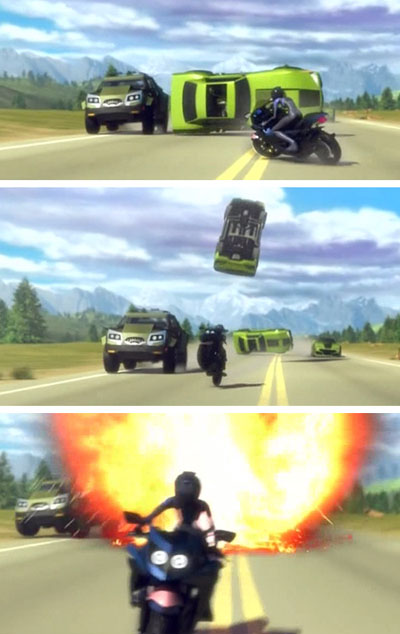
They'll, uh, be okay, maybe. - When human terrorists are featured, they will often die. Piloted or driven vehicles explode and enemies are implied to be crushed. "Convoy" is the first of numerous examples.
- When Nemesis Prime attacks a military base in his self-titled episode, it's likely his rampage cost the lives of numerous soldiers.
- When the military attacked Darkmount, its fusion cannons devastate the entire force, presumably killing them all.
- Cylas is the first human to die on-screen in Western Transformers animation, but not before thanking Airachnid for finally freeing him of his gruesome existence.
- A human is shown slumped against a wall in "Darkness Rising, Part 5", a victim of Soundwave, though it isn't clear whether he was dead or merely unconscious.
- Contemporary toyline-based comics (Armada, Energon) seem to follow a similar policy, avoiding showing, only mentioning, human death.
- Japanese cartoons, by contrast, don't seem to mind showing human deaths (or dog deaths, for that matter).
- The Dreamwave G1 comics really thought it was totally awesome and cool and radical to kill off those stupid humans. Thus, they start off with Megatron smushing some stupid humans. More smushing and killing and blowing up follows. DIE, dumb stubbies, DIE!
- 2005 IDW continuity managed to avoid this for a long time, showing human death only when it was particularly integral to the plot... then All Hail Megatron came down the pike. DIE, stupid fleshies, DIE!
- The live-action movie continuity implies a great deal of human death. Revenge mentions a body count of over 9,000 (don't even think about it), and massive damage is done during the battle of Mission City, though little of it is shown on screen. And of course, the first film begins with Blackout wiping out an entire military base. A handful of humans are killed directly on-screen, most notably Donnelly. Then of course we get to Dark of the Moon, which has Decepticons laying siege to Chicago, killing most of its citizens, including several being shot and exploding and disintegrating into just skulls directly in front of the camera. That's not even mentioning Laserbeak, whose job it is to assassinate civilians, even if it means befriending their children to do it. Twisted.
- Dylan Gould is killed when he was shoved into Sentinel Prime's space bridge generator, but given he was a villain it's not so much of a concern. Dark of the Moon
- Sam Witwicky was killed by Megatron but brought back to life by the Primes.
- Lucas Flannery, in a bit of karmic retribution (for having tipped off Cemetery Wind to Optimus' location against Cade's wishes), gets fried by one of Lockdown's grenades and his mangled corpse is converted into Transformium. James Savoy says his sister was a casualty of the Battle of Chicago, which he uses as an excuse to sadistically hunt and kill Autobots and their sympathizers. He ends up getting knocked out of a very high window by Cade Yeager for attempting to kill his family. Later, his boss, Harold Attinger, is brutally gunned down by Optimus Prime when he tries to kill Cade for sympathizing with the Autobots. Additionally, Joshua Joyce tries to scramble paramedics to the scene of Galvatron's rampage (much to Attinger's disgust), believing people were killed. And then there's the Dinobots stomping through the densely crowded streets of Hong Kong. They certainly killed more people than Decepticons!
- Cybertron's arrival to Earth was predicted to cause tens of millions of human casualties. When its continents began reconnecting, the human news reported they were literally scraping away major cities such as Hong Kong and projected to kill millions.
- Bumblebee introduces a new method of human death: liquification. Dropkick uses a special gun that performs this feat on some random guy and later Dr. Powell. Bumblebee
- The alternate timeline arc in Titan's Movie comic featured big wars on Earth and lots of destruction, clearly insinuating human death while not being explicit. The exceptions were in issue #10, where NATO is said to be suffering losses of 11,506 and the Palais Bourbon is blown up when people are still clearly inside. Sam Witwicky, meanwhile, was stated to have died.
- Titan quite blatantly stated that the Free Men had caused great loss of life at an air base, a rare example of humans killing humans. In the same story, Robert Epps opens fire on militia men, which kinda implies he was killing them. Bring Me the Head of Optimus Prime Similarly, Wheelie of all people is seen zapping humans at close range during a Decepticon attack; with no "oh it was a stun beam" handwave and the 'Cons not pulling punches, it sure seems like he's murdered 'em! Outlaw Blues
- In Kiss Players, several Kiss Players were seen being devoured by Legions.

Characters who die a lot
- Optimus Prime
- Starscream — He dies quite a lot.
- Dirge (G1) — the unlucky guy who also gets killed off in many continuities
- Quake — the unlucky guy who gets killed over and over in the same continuity, but doesn't seem to mind.
- Cy-Kill — a Go-Bots character transferred to many Transformers comics just to be killed off violently, for no other reason than the lolz of ending his toyline, his universe, and finally his life... repeatedly.
- Sentinel Prime (G1) — the unlucky Prime who must die.
- Solus Prime, who perishes in every continuity to involve the Thirteen, because Megatronus's downfall just can't happen any other way.
See also
References
- ↑ (According to an interview at BotCon 2011 with the Prime show runners, Makeshift was deemed too overpowered to be a regular in the show, so they killed him off at the end of the episode.)


