Fight! Super Robot Lifeform Transformers (toyline)
 |
| |||||||||||||||
Fight! Super Robot Lifeform Transformers (戦え! 超ロボット生命体 トランスフォーマー Tatakae! Chō Robotto Seimeitai Transformers) is the ostentatious title given to Takara's version of the original The Transformers franchise (retroactively known as "Generation 1") and its accompanying toy line in Japan. Launched in 1985, one year after the franchise had been launched in Hasbro markets, the various aspects of F!SRLTF combined Hasbro's 1984 and 1985 products into one large line, and subsequently continued under that title from 1985 all the way up until 1992, with various sublines rolled out approximately every year and a single more-or-less consistent sequencing of toy ID numbers. In most cases the annual (sub)line logo would be found on the back of the toy packaging, but this was moved to a more prominent frontal location for 1991's Return of Convoy.
The line started very parallel with Hasbro's offerings, but over time the two companies pursued some pretty different visions for the brand... and then swung back closer together before finally ending in 1992. Transformers would not be back on Japanese toy shelves until 1995, when the short-lived G-2 toyline would hit.
Overview
[edit]Takara took Hasbro's lead and brought the new universe of living robots to Japan in 1985, where it was a massive success. Despite many/most of the toys having been available just a year or two prior, the new story and cartoon propelled Transformers sales far beyond those of the lines that the toys originally came from. Diaclone and Micro Change were quickly discarded in favor of the new hotness as kids ate up this new take on the giant robot genre, one that was a fresh change from the sheer amount of "piloted mecha" robot toylines/cartoons out prior.
Fight! Super Robot Lifeform Transformers was the overarching branding for the Transformers line in Japan all the way up to 1992, and was in fact the only consistent branding for every year up until 1990, despite the corresponding cartoons using a variety of unique secondary titles, some of which were reflected on some (but not all) of those years' toys.

The parallel years
[edit]Takara launched their permutation of the Transformers brand in 1985, a year later than Hasbro, and released most of the products from Hasbro's 1984 and 1985 offerings during its initial year. Broadly speaking, this toyline was mostly similar to its Hasbro counterpart, save for a few notable color variants — namely a "NASA"-themed Astrotrain and an unchromed, blue-accented, cannon-less Megatron — and the toys actually having fully-functional spring-loaded launchers (due to differing safety standards in Japan). This earlier toyline also featured multiple multi-character giftsets, something usually not seen in the Hasbro version. Unfortunately, the line-up wasn't quite complete: many toys weren't sold due to being made by rival companies (particularly Bandai) or other licensing issues; a few were simply delayed until the following year, others were relegated to mail-aways, and a small number just never happened at all, for no discernible reasons.
In one interesting international oddity, Italian company GiG also began distributing their The Transformers toyline in 1985 under Hasbro licensing for the brand, but with the toys carrying from their previously-held Takara licenses for the Diaclone and Micro Change lines: the result was a few odd instances of toys releasing in Italy with the American brand name and logo but in Japanese-style packaging, including Takara's numbering system.
By the second year, Takara had mostly caught up with Hasbro, releasing a few stragglers not included in the 1985 line-up as well as the vast majority of Hasbro's 1986 offerings. This year's product was almost completely identical to the Hasbro 1986 line, from releases to colors, mostly minus Sky Lynx due to mold licensing issues. A considerable number of toys featured an additional "Scramble City" branding on their packaging, marketing them as part of the eponymous play pattern that was advertized by an original video animation. Meanwhile, toys that are commonly associated with Transformers 2010, the Japanese dub of season 3 of the original cartoon, featured no additional branding at all.
By and large, the Japanese Transformers line had shaped up into becoming more or less identical to its international Hasbro counterpart... Until it suddenly wasn't.
The divergence years
[edit]
1987 featured the toys accompanying the first Japanese-only follow-up anime, The Headmasters. It was during this year that Takara took its first steps in breaking away from Hasbro's line. While most of the line is pretty dang identical to the US line, Takara added a large number of extra toys to its line: the previously-unused Diaclone Trainbots, retooled and redecoed prior toys like Twincast, Soundblaster, Stepper and Artfire, and even the all-new-mold Autobot Master Warriors and W Cassettebots. Contrary to the anime itself, only the toys that were actually Headmasters featured an additional "The Headmasters" branding on their packaging, while Targetmaster figures featured an additional "Targetmaster" branding instead, and two combiner teams even featured the "Scramble City" branding again. Another big and odd addition is that the Beastformers, released by Hasbro as a standalone toy line (named "Battle Beasts") from the get-go, were initially released by Takara in Transformers-branded packaging before they became their own thing in Japan as well.
1988 was the year that Takara really took Transformers in its own direction, accompanied by the second Japanese-original anime series, Super-God Masterforce. While the toyline mostly featured the same sculpts as the Hasbro line, many were given new decos, and portrayed as completely different characters (namely, the Powermasters were dubbed the Godmasters, and like the new Headmasters were humans who piloted unliving robot Transtectors). The line also tossed in a few new items, most importantly the colossal Decepticon double-Godmaster Overlord. This series was also the first one to release a female character toy, the Headmaster Junior Minerva. She'd then be the only one for the better part of a decade. Similar to previous years' offerings, the "Super-God Masterforce" branding appeared nowhere on the toys' packaging, with the exception of two role-play items. Instead, various sub-brandings such as "Godmaster", "Pretenders", "Seacons" and the previous year's "The Headmasters" are used to identify specific toy gimmicks.
By 1989, Takara's direction of the Transformers brand had diverged so far from Hasbro's that the Japanese toy line was almost completely different from what Hasbro's markets received that year, accompanied by the third and final fully-fledged Japanese-original anime, Victory. The majority of the line-up was made up of all-new sculpts unique to Japan (although one of them also saw release in Italy, of all places), with the rest filled out by significant retoolings of Hasbro-released sculpts. Combiners were a major focus, with four combiner teams in the central cast, and the huge Autobot leader Star Saber combining with his own jet-base as well as another huge bot to become an absolutely massive warrior. Once again, the "Victory" branding appeared nowhere on the toys' packaging, which instead featured gimmick-specific sub-brandings such as "Brainmaster", "Multiforce", "Crossformers", "Dinoforce" and "Breastforce".

The later years
[edit]As the Hasbro US line was winding down in 1990, Takara kept going, but Transformers's star was fading in Japan as well. For the first time, the toy line-up was no longer backed by a TV-aired cartoon, instead relying on a single OVA and magazine layouts to advertise it. While the new sculpts continued with the three larger Powered Masters taking center stage, the rest of the line was Micro Transformers, and only some of them were redecoed from Hasbro's releases. The Destron presence was also severely cut back, on the theory that kids were way more interested in buying "good guy" toys. (Japanese toylines in general tend to be light on the villains.) Thus all but one of the Hasbro Decepticon Patrols were changed into Cybertrons for Japan, and the only large villain is Metrotitan, a redecoed Metroplex. Gimmick-specific sub-brandings for this year were "Micro Transformers" and "Micro Transformers Powered Masters" (plus a re-release of the 1987 Trainbots, now with their own "Trainbots" sub-branding), while the actual "Zone" branding only appears on a single product that includes the aforementioned OVA.
1991 featured the first actual fully-fledged subline that can be considered such, seeing as the title Return of Convoy not only appeared consistently on all of that year's toys' packaging, but was also presented on equal footing with the main Fight! Super Robot Lifeform Transformers title. In keeping with tradition, though, the corresponding fiction (namely, magazine spreads and a one-shot comic) was not titled "Return of Convoy", but rather "The Battlestars", the name of the series' main hero team. Return of Convoy took a grab at nostalgia in an attempt to stave off cancellation. Optimus Prime was brought back as "Star Convoy", and even came with a Micromaster version of Hot Rod. They were backed up by a handful of new molds, including a six-Micromaster super robot combiner but most of the small line was recycled Micromasters and Micromaster Combiners in their Hasbro decos, all as Autobots.
Destrons were completely excised from the line this year. While a reborn "Super Megatron" was presented as the primary villain in-fiction, he would not receive a toy for 30 years.
The final series of Japan's "Generation 1", Operation Combination played up combiners, which were popular toys in Takara's concurrently-running (and TV-cartoon-backed) non-Transformers "Brave" giant robot lines, effectively competing against themselves. The Destrons were back, but a bit outnumbered. The two stars of the line are Guard City and Battle Gaia, redecos of Defensor and Bruticus respectively, and two of the most expensive-on-the-secondary-market items in the entire Japanese "G1" line due to their incredible scarcity. Four more Cybertron Micromaster six-teams and a set of four "Vs" sets, straight re-packs of the smaller European-line Turbomasters and Predators, filled out the Japanese Transformers franchise's swan-song.
1985
[edit]The first year's toyline consisted of most of the toys released by Hasbro in 1984 and 1985, most of them without any deco changes. The only significant difference in most of the toys is that the Japanese versions' missile launchers are still fully functional, due to differing safety standards for projectiles.
There are two items with big changes from their US releases. Astrotrain was released in a more NASA-accurate white-and-black deco, but would change to his Hasbro colors for his re-release the following year. Megatron's deco was from a different version of the Micro Change toy: matte grey plastic and blue trim, no scope/stock/silencer parts, and an additional silver-chrome sword accessory. On top of that, the original bullet-firing mechanism was kept intact as well.
Even among those toys without big changes, there were some big differences in how the toys were sold. The "Cassettrons" were sold individually (and came with a clear-plastic tape case) rather than in two-packs. Reflector, a mail-away item in Hasbro's line (not available until 1986!) was a standard retail release in Japan, while several retail toys in the US were relegated to mail-away status in Japan. Some toys also simply didn't see a release one way or another until 1986 (and in a couple of instances, not until nearly two decades later).
In the end, several toys were simply never released at all in the original line. While most of these toys are obvious omissions like the non-Takara sculpts (Jetfire, Omega Supreme, the Deluxe Vehicles, and the Deluxe Insecticons), this list also bizarrely includes Ironhide and Gears, both of whom were pretty dang prominent in the cartoon which was brought over to Japan, including the Gears-focused episode. Even more surprisingly, Takara did release "Laserwave" (aka Shockwave), a sculpt that had not originated with the company, having licensed the figure from ToyCo just like Hasbro had.
Because toy retail in Japan operates under different premises than in the United States, Takara was not bound to distributing the figures as part of price point-specific assortments like Hasbro did. Instead, each figure shipped by itself. Like its predecessor lines Diaclone and Micro Change, Takara assigned each figure its own ID number; however, because this was Takara's first Transformers toy line, they hadn't completely worked out the system yet, which is why the first year's figures used one single continuous numbering system that alternated between "Cybertron" (Autobot) and "Destron" (Decepticon) characters.
Toys
[edit]| Cybertrons |
|
Dinobots |   | |||||
| Destrons |
|
Buildrons | Insectrons | |||||
Triple Changers
|
VS sets | Robot Point mail order items |
1986 (Scramble City and 2010)
[edit]
 |
| |||||||||||||||

Takara's 1986 offerings consisted of most of the new Hasbro products for 1986, more or less unchanged from the Hasbro versions. And since most of the new toys lacked the missile launchers included with the previous year's figures, there's not even that difference. (It is currently unknown if toys with metal/plastic part variants in Hasbro markets saw similar mid-run changes in Japan.) Some stragglers from 1985 were also thrown in, which included the "VSZ" set, a multi-pack that was the only way to get Skids, Sunstreaker, and Buzzsaw (who had been replaced by Rumble as Soundwave's pack-in partner the previous year). The only real dropouts from this year's line-up were the non-Takara-sculpt Sky Lynx and, bizarrely, the Battlechargers Runamuck and Runabout.
A considerable portion of the 1986 Takara figures featured an additional "Scramble City" logo on their packaging in addition to the main "Fight! Super Robot Lifeform Transformers" title, meant to accompany the OVA of the same name. The figures released under this branding included not only the year's Combiner "Special Teams" (Airbots, Protectobots, Stuntrons and Combatrons), but also Metroflex (Metroplex), his opponent Dinosaurer (Trypticon) and the two "City Commanders" Ultra Magnus and Galvatron. Ultra Magnus was a redeco of a figure from Takara's Diaclone line, and Galvatron a new toy created for Hasbro's The Transformers: The Movie animated feature film whose Japanese release was delayed by several years. The centrally featured Combiner teams and Metroflex, meanwhile, were originally designed for an aborted 1985 Diaclone line named Jizai Gattai (自在合体, "Limitless Combination"), which was shelved when Transformers proved successful in America and Takara elected to import it instead. The line was so named for the modular construction of the limb toys to "free-combine" (later, "scramble") to form any arm or leg of the larger robot. Dinosaurer, finally, was a new toy designed to interact with the Combiner teams in the same fashion as Metroflex.
The remaining figures released by Takara in 1986 accompanied the Japanese version of the Transformers cartoon's third season, released in Japan as Fight! Super Robot Lifeform Transformers 2010, although the toys themselves did not feature the "2010" branding. Also included among the Japanese 1986 releases were the remaining figures created for The Transformers: The Movie.
Last year's two big exceptions, Astrotrain and Megatron, changed for their 1986 re-releases. Astrotrain was changed to match the Hasbro version. Megatron —this year only available as part of a "Good Bye Megatron" multi-toy set— remained unchromed gray plastic, but got the red trim and scope/arm-cannon accessory to make him more animation-accurate... while still not coming with the silencer and stock. (He also kept the bullet-launching mechanism and sword accessory from before).
One important change to the packaging this year was that the toys' ID numbers were now split by faction, with "C-XX" (Cybertron) and "D-XX" (Destron) numbers on every box, with the numbering picking up after the last 1985 release, 49 Laserwave. This would continue though all subsequent lines up until the end of "Generation 1", and the numbers themselves did not re-set from year to year, they just kept getting bigger. (Lines after "Generation 1" would still number the toys, but the C/D distinction would sometimes be dropped, and the numbers would frequently re-set when a new line was not a direct sequel to something else.)
Toys
[edit]| Airbots (Scramble City) | Minibots |
|
Cassettbots |    | ||||
City Commander (Scramble City)
|
Cybertron City (Scramble City) | Protectobots (Scramble City) | Cybertrons
| |||||
| Triple Changers | Stuntrons (Scramble City)
|
Jetron | Cassettrons | |||||
Fortress Staff (Scramble City)
|
Destron City (Scramble City)
|
Combatrons (Scramble City) | Animatrons | |||||
VS sets
|
"Good Bye" sets
|
Robot Point mail order items |
Notes
[edit]- ↑ Wheelie was listed among the other Minibots in a 1986 Takara toy catalog, but his toy was released later than the rest of them, between C-79 Blurr and C-81 Wreck-Gar.
- ↑ 2.0 2.1 Cyclonus and Scourge were listed as "Jetrons" alongside Ramjet and Thrust in a 1986 Takara toy catalog, but their toys were released later than the other two, between D-69 Bruticus and D-72 Octone.
1987 (The Headmasters)
[edit]
 |
| |||||||||||||||
Takara's new releases for 1987 started out simply as a continuation of the previous year's line-up, with the two new Combiner teams, the Techbots and the Terrortrons, even featuring the "Scramble City" sub-branding again. Following that came figures that were ostensibly intended to accompany the first Japanese-original Transformers anime, The Headmasters, although only the toys that were actually Headmasters featured an additional "The Headmasters" sub-branding on their packaging, while the Targetmaster figures featured a toy-only "Targetmaster" logo instead, with the primary branding for the toys still remaining as "Fight! Super Robot Lifeform Transformers". Because of this, it's difficult to pinpoint a specific cut-off point for the new "line".
The toys themselves were still largely just the same toys released by Hasbro in the West that year with little to no alteration. However, there were a number of toys exclusive to Japan, most of which today command large sums on the secondary market due to rarity (or at least perceived rarity) in the West. Most of the prior year's product was still available through 1987.
The 1987 Transformers toyline also included the Beastformers subline, which Hasbro marketed in the West as the completely separate property Battle Beasts. Notably, Gnaw, a figure released by Hasbro in 1986, was initially only available in Japan as a promotional item as part of a Beastformer giveaway before being made available as a mail order item during the following year, shipping in U.S. Hasbro packaging.
Both the Cybertrons and the Destrons feature several notable gaps in their ongoing ID numbering; some (but not all) of which were retroactively filled up years later with Takara reissues of the Targetmaster versions of the 1986 Autobots that had previously only been released in that form by Hasbro.
Toys
[edit]Techbots (Scramble City)
|
Throttlebots | Firebots
|
Headmaster Autobots (The Headmasters)
|
     | ||||
| Targetmaster Autobots (Targetmaster) |
|
Doublespy
|
Clonebots
| |||||
Fortress Maximus (The Headmasters)
|
Cassettbots | Trainbots | Cybertron Master Warriors (The Headmasters) | |||||
Terrortrons (Scramble City)
|
Headmaster Crazytrons (The Headmasters) | Targetmaster Jetrons (Targetmaster)
|
MegaZarak (The Headmasters) | |||||
| Clonetrons | Doubletrons
|
Six Changer
|
Headmaster Horrortrons (The Headmasters)
| |||||
Cassettrons
|
Robot Point mail order items | Campaign items |
Beastformers
[edit]
 |
| |||||||||||||||
- Main Article: Beastformers (franchise)
The initial Beastformers toyline was sold under the Transformers banner in 1987. Most of the figures were sold in individual Transformers-style boxes, in big display cases of 36. However, only 54 of the 76 Battle Beasts figures were sold as Transformers; ironically, two of the toys skipped are the first Beastformers shown in the Headmasters cartoon. Weirdly, despite the toys having actual ID numbers sculpted onto their bodies and weapons, said numbers were nowhere on the packaging like on the regular Transformers toys. The figures are nigh-identical to the Hasbro versions, though some variants in the Hasbro line are the only way they were sold in Takara's markets.
In 1988, Beastformers became its own line without the Transformers branding, releasing most of the rest of the Battle Beasts toys in Japan, plus the new faction of Laser Beasts. It also made use of the beasts' ID numbers.
The details of these toys' releases are actually fairly complex and we won't get into it all here; the main Beastformers page breaks it all down plus includes the post-Transformers sequel-series releases. Only the Transformers-branded toys are listed here.
| Series 1 | Series 2 |  | ||||||
| Series 3 | Multi-packs
|
| ||||||
Fortress
|
Mail-away prizes |
Notes
[edit]- ↑ Omitted from the 1987 retail line-up, Repugnus (marketed as "Repug") was offered as a chance-to-win lottery figure with the 1987 Beastformers figures, ultimately shipping in Hasbro packaging. He was assigned the ID number "C-98" in official marketing materials.
1988 (Super-God Masterforce)
[edit]
 |
| |||||||||||||||


Beginning in 1988, Takara released the toys intended to accompany the successor to the Headmasters anime, Super-God Masterforce. This was also the year during which Takara began to change the direction of its Transformers line significantly away from Hasbro's.
Most of the sculpts used in Masterforce were released in Hasbro's line, but a great many Hasbro toys from this year were skipped altogether in Japan, including over half of the Pretenders. And many of the toys the two lines did share had significant color differences, although it was a bit scattershot as to who got changed and who didn't. The Powermaster Optimus Prime toy was retooled to make the new hero-team leader Super Ginrai toy, and a handful of new sculpts were released, including the gargantuan Overlord. Takara even took one last dip in the Micro Change well for a pseudo-role-play Transformer (Browning), alongside redeco/retoolings of the prior year's most massive toys.
Virtually all of the toys were also characterized very differently from Hasbro's story even if the toys themselves remained unchanged, so even though the toys are identical, well, the characters are pretty much completely incompatible.
In addition to the main "Fight! Super Robot Lifeform Transformers" title and the "Masterforce" box-back banner, the Godmasters (Takara's version of the Powermasters) featured a toy-only "Godmaster" sub-branding, similar to the previous year's Targetmasters. Likewise, the Pretenders had their own "Pretenders" logo, while the Headmaster Juniors as well as both Grand Maximus and BlackZarak featured the same "The Headmasters" branding as the previous year's figures. Surprisingly, the Seacons featured their own team-specific "Seacons" logo, instead of yet another use of the "Scramble City" logo as one would have expected based on precedent.
The ID numbers for the figures made a huge leap, skipping several numbers in the two-digit region from C-131 Raiden to C-201 Metalhawk (another Japanese-only figure) for the Cybertrons, and from D-109 Overkill to D-201 Blood for the Destrons, so that both sides were on equal footing again. Lander, despite being assigned his own ID number (C-200), was actually only available via mail order. After only a few Pretender figures with numbers in the 200 region, the ID numbers jumped up again to C-301 Goshooter and D-301 Wilder, and subsequently remained in the 300 region.
Toys
[edit]| Masterforce Warriors (Godmaster) | Sparkdash | Seacons | Pretenders |
   | ||||
| Headmaster Junior Autobots (The Headmasters) | Headmaster Junior Monsters (The Headmasters) | Godmaster Autobots (Godmaster) | Godmaster Jetrons (Godmaster) | |||||
The Headmasters
|
Godmasters
|
Other | ||||||
"Lander Present Campaign" prize
|
Robot Point mail order items
|
|
| |||||
| Role-play items |
1989 (Victory)
[edit]
 |
| |||||||||||||||

1989 saw Takara release the toys intended to promote the Fight! Super Robot Lifeform Transformers: Victory cartoon.
The 1989 line-up was a major departure from previous year's offerings, insofar as it was almost completely different from the Hasbro product released that same year (which was heavy on the Micromasters and Pretenders). Where previously, Takara had used most of the same molds as Hasbro's concurrent lines —with some color changes and the occasional retool or new Japanese-exclusive figure— the majority of 1989's toys were all-new sculpts designed solely by Takara for their own market. The rest were significant retoolings of Hasbro figures in entirely new colors. Most of these toys, including the retools, never saw release in Hasbro's markets, and the few that did only came well after their Takara releases (and with significant changes to boot). The only toy in the series that is identical to a Hasbro release was available only via mail-order, not sold in stores.
The 1989 line-up also had a heavy focus on combiner teams, every one of which was available both as individual releases and as a gift set.
The Brainmasters and Breastforce had their own toy-only "Brainmaster" and "Breastforce" logos similar to the previous years' Targetmasters, Pretenders, Godmasters and Seacons. Oddly, the Crossformers Black Shadow and Blue Bacchus (with their own "Crossformer" logo on the packaging) featured ID numbers that placed them in the middle of the Masterforce-based Destrons, despite sporting a 1989 copyright on their packaging.
Because of their uniqueness, the Victory-based figures are very popular in the West for older fans and collectors, commanding a lot of money on the secondary market.
Several of the toys would see additional releases: Italian company GiG, which had a unique business relationship with Takara since 1983, released Galaxy Shuttle as part of their version of the Transformers line in Italy; Hasbro's European-market continuation of the Transformers series later took the three car-mode Brainmasters and four of the Breastforce members, took away their combiner-bot-bits, redecoed them, and sold them as the Motorvators and Rescue Force, respectively; Deathsaurus, Greatshot, and Galaxy Shuttle all got redecoed and/or retooled for Takara's later non-Transformers giant transforming robot Brave toylines; and the Multiforce were re-released in individual boxes as part of Takara's convenience-store-release Micromaster series as "Micromaster DX" toys.
Toys
[edit]| Multiforce |
|
Brainmaster
|
|
  | ||||
Other
|
|
Hero Set
|
Crossformer
| |||||
| Dinoforce | Breastforce
|
|
|
Notes
[edit]1990 (Zone)
[edit]
 |
| |||||||||||||||

1990 marked the downturn of Takara's original Transformers. The theme for this year was Transformers: Zone, but rather than a fully-fledged anime series, the line's advertising media was slashed to minimum, getting only a single-episode VHS tape for animation and a single installment of manga, leaving story pages in TV Magazine to push the toys to kids.
The overwhelming majority of the year's line-up is made up of the "Micro Transformers", most of which had been released by Hasbro as "Micromasters" in the previous year, and only a comparative handful bear any notable differences from the Hasbro releases. On top of that, all but one team were sold as Autobots, presumably in a "kids buy more good guys" move to boost sales. (Japanese "boys toy" line are historically very light on the villain toys, if they have any at all. Transformers was a real outlier there, and potentially a major reason it was so popular early on.)
The headliners this year, and the only toys unique to Takara, were the three Powered Masters (not to be confused with Powermasters): larger toys that transform from robot to space-vehicle-things to bases that can attach to the Micro Transformer bases using the same ramps. Each Powered Master has a battery- or spring-powered gimmick meant to push/launch the smaller Micros. They could also combine into Big Powered, a gigantic jet-tank-thing. They are opposed by Metrotitan, a Metroplex redeco and the only other Decepticon in the line. Notably, the Powered Masters are noticeably lighter than comparably-sized toys from past lines. Their plastic parts are thinner overall and lean towards hollowness, presumably as a cost-saving measure.
Like the previous years' offerings, the toys were still branded as part of "Fight! Super Robot Lifeform Transformers", with the "Zone" livery on the back of the box - except for the C-350 "Original Video Anime" set, which included a VHS tape "front-branded" with the Transformers: Zone OVA. In addition, the toys featured "Micro Transformers" logos, with the Powered Masters featuring a "Micro Transformers Powered Masters" variant.
While the Micro Transformers are largely ignored by fans, the four larger pieces command large sums on the secondary market today, especially Powered Master Roadfire.
Some figures from this year would be re-used in Takara's later Brave non-Transformers toylines: Dai Atlas and Sonic Bomber became non-Transformer villain toys in The Brave Express: Might Gaine, whereas the Micromaster Stations, sans Micromasters, were released as mini-playsets with non-transforming robot figurines in Brave Police: J-Decker.
Toys
[edit]


Notes
[edit]- ↑ 1.0 1.1 The Build Patrol Team, the Sky Patrol Team and the Race Track Patrol Team were listed as "New Micro Transformers" in a 1990 Takara toy catalog. Their toys were released later than the other Patrol Teams, after C-349 Roadfire and the C-350 Original Video Anime set.
- ↑ The Big Powered giftset was released later than its individual components, after the C-350 Original Video Anime set, the C-351 Build Patrol Team and the C-352 Sky Patrol Team.
- ↑ Though this set was called the "Thunder Arrow" in pack-in catalogs, what kids got was the Hasbro-release Micromaster Decepticon Jet Command Center, in Hasbro packaging.
1991 (Return of Convoy)
[edit]
 |
| |||||||||||||||
1991's Transformers: Return of Convoy (トランスフォーマーリターン・オブ・コンボイ) was the first Transformers subline released by Takara that featured the subline logo on the front of the packaging instead of the back, on equal footing with the main Fight! Super Robot Lifeform Transformers branding.
On the one hand, Return of Convoy heralded the big return of Convoy (aka Optimus Prime) to the Japanese Generation 1 continuity; on the other hand, however, by this time the Transformers brand was struggling to survive, leading to a very lean line of releases, most of them unchanged from their Hasbro counterparts released the year before. The line remained heavily focused on Micro Transformers, with the larger toys having "base modes" that could be linked together to form mini-cities.
Most toys this year came with Micro Trailers, small truck/trailer units that could store a single Micro Transformer, and launch them with a spring-loaded mechanism. The trailers were designed to be linked together, both in a train-like configuration (using the Micromaster Combiner pegs on the front and back bumpers) and side-to-side for storage in Sky Garry's carrier-jet mode (using 5mm posts). A handful of Zone Micro Transformer teams were also re-released with Micro Trailers.
This was the first series to be completely devoid of Decepticons, on the theory that Japanese kids were less likely to buy villain toys.
Toys
[edit]

1992 (Operation Combination)
[edit]
 |
| |||||||||||||||
The final series in Takara's "Generation 1" run, 1992's Fight! Super Robot Lifeform Transformers: Operation Combination (戦え!超ロボット生命体トランスフォーマー 合体大作戦 Tatakae! Chō Robot Seimeitai Transformer Gattai Daisakusen) takes the award for having the smallest number of individual releases in a "major" Transformers toyline. On the other hand, every release in the line is a multi-pack, containing anywhere from two to six individual robots. Also, Decepticons are back! Yay!
The line was advertised solely with story pages which did nothing to flesh out any of the individual components of the six combiner teams, however.
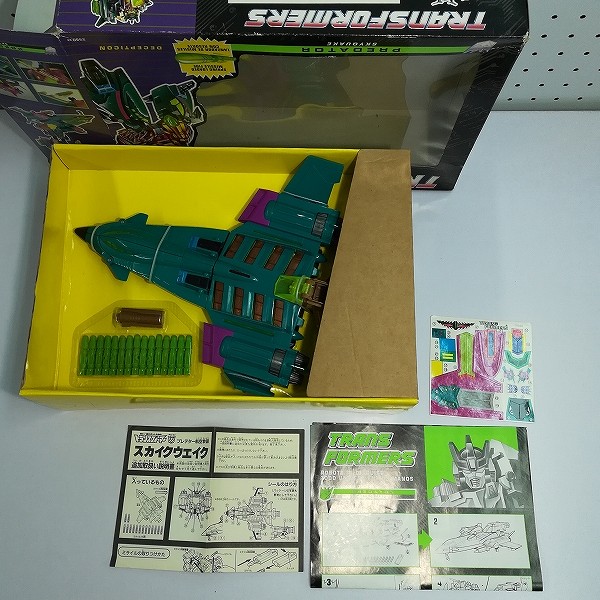
One final curio beyond even Operation Combination occurred near the end of the year, when five toys from 1992's European assortment made their way to Japanese shores without comment from Takara or even regional packaging.[1] The toys were identifiable from their European releases only by stickers on the boxes with their names and the Fight! Super Robot Lifeform Transformers logo[2] as well as translated instructions.[3]
After this, Transformers ended in Japan, not to resurface until 1995's short-lived Transformers G-2 toyline. In the interim, Takara put out more Brave series to provide giant transforming robot toys and fiction.
Toys
[edit]Micro Transformer 6-Robot Gestalts
|
VS Sets
|
5-Robot Gestalts
|
 | |||||
| Mail-aways | Motorvators (imports) | Others (imports) |
Post-series releases
[edit]Beginning in the early 2000s, Takara released new toys based on their version of Generation 1 with increasing frequency. This was initially limited to reissues of toys from the 1980s, but eventually grew to encompass new toys that represented "upgraded" versions of the G1 characters, eventually expanding to include characters from the Headmasters, Masterforce, and Victory eras.
The sheer number of "new" toys of these characters released over the last 18 (and counting) years is insane, so we're not going to list them here, but rather point you to this list of post-"G1" "G1" toylines. Instead, the following list is going to be limited to toys specifically branded as part of Fight! Super Robot Lifeform Transformers, which primarily included reissues and redecos thereof, although there is one particular toy we need to point out in specific.
In 2006, Takara released the Cybertron Primus toy in Fight! Super Robot Lifeform Transformers packaging, complete with a "00" ID number, rather than in Galaxy Force, their version of Cybertron. This toy even has the Hasbro release's Cyber Key Code on the key, which the Japanese version of the line lacked. They would later redeco the toy into "Creator Primus" in 2010.
The Transformers Encore reissue line also features the Fight! Super Robot Lifeform Transformers logo on its packaging, but for the sake of simplicity, we have put all toys branded as part of Encore on its own separate page. Likewise, the The Transformers: Collector's Edition-branded toys use the Fight! logo on their bio cards, and sometimes also on their packaging.
LaserDisc
[edit]
In 1994 and 1995, Takara released LaserDisc sets containing the Fight! Super Robot Lifeform Transformers cartoon. As they continue the numbering used by the toys, they are included here for completeness.
LaserDisc sets
[edit]- C-376 Convoy Set
- D-342 Megatron Set
Toys
[edit]Retail releases
[edit]2000
|
2001
|
2002
|
2004
|
 | ||||
| 2005
|
2006
|
Exclusives
[edit]


Notes
[edit]- The Decepticon leader mentioned in the Operation Combination fiction, Scrash, never received a toy. In fact, he was never even shown. A theory is that Scrash would have been the toy known as Skyquake. The use of the Turbomasters and Predators in the Operation Combination toyline seems to support this, as does the fact that in some European markets, Skyquake was sold under the name "Crash". Skyquake was also released in Japan in the European packaging, with only some legal information on the back changed to Japanese, which seems to bear the idea out further.